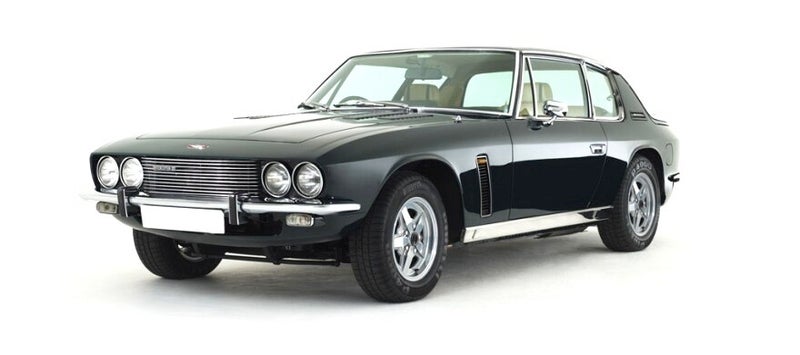
The Jensen Interceptor is a grand touring car which was hand-built at the Kelvin Way Factory in West Bromwich, near Birmingham in England, by Jensen Motors between 1966 and 1976.
The Interceptor name had been used previously by Jensen for the Jensen Interceptor made between 1950 and 1957 at the Carters Green factory. Jensen had extensively used glass-reinforced plastic for the fabrication of body panels in the preceding two decades, but the new Interceptor saw a return to a steel body-shell.
The body was designed by an outside firm, Carrozzeria Touring of Italy, rather than the in-house staff. The early bodies were built in Italy by Vignale, before Jensen took production in house, making some subtle body modifications.
Jensen Motors used Chrysler V8 engines for the Interceptor, starting with the 6276 cc. In 1970, the Chrysler V8 produced 335 hp. Since this engine was detuned by Chrysler for use with low octane petrol, and only produced 250 hp SAE net in 1971, Jensen chose to use the 7200 cc Chrysler engine for 1971.
For 1971, two V8 engines were offered. One had a four-barrel carburetor and produced 305 hp. The other, which had three 2-barrel carburetors and produced 330 hp, was only available in 1971. Only 232 cars were built with the 440 "six pack", called the Jensen SP (with no "Interceptor" badging), and it had the distinction of being the most powerful car ever to have been made by Jensen.
For 1972, the V8 engine with three 2-barrel carburetors was no longer produced by Chrysler. The engine that remained was detuned to 280 hp. Chrysler continued to offer a high-performance engine through to 1976 when it only produced 255 hp.
The Mark II was announced in October 1969, with slightly revised styling around the headlamps, front grille and bumper, and revised rear lights. The interior was substantially revised in order to meet US regulations, and air conditioning was an option.
The Mark III, introduced in 1971, revised the front grille, headlamp finishers and bumper treatment again. It had GKN alloy wheels and air conditioning as standard, and revised seats. It was divided into G-, H-, and J-series depending on the production year.
A convertible with powered soft top was introduced in 1974, mainly intended for the American market but also sold in Europe. 267 convertibles were made. In total 6408 Interceptors were produced.
The Interceptor's sleek styling and powerful motor attracted many celebrity buyers including Lynda Carter, Cher, Winthrop Paul Rockefeller, and Frank Sinatra, although the Interceptor may have taken some styling cues from the Brasinca Uirapuru, with a distinctive large, curving wrap-around rear window that doubled as a tailgate.







Create Your Own Website With JouwWeb