


The Tyrrell Racing Organisation was an auto racing team and Formula One constructor founded by Ken Tyrrell (1924–2001) which started racing in 1958 and started building its own cars in 1970.
The team experienced its greatest success in the early 1970s, when it won three Drivers' Championships and one Constructors' Championship with Jackie Stewart. The team never reached such heights again, although it continued to win races through the 1970s and into the early 1980s, taking the final win for the Ford Cosworth DFV engine at the 1983 Detroit Grand Prix.
The team was bought by British American Tobacco in 1997 and completed its final season as Tyrrell in the 1998 Formula One season. Tyrrell's legacy continues as the Mercedes-AMG F1 team, who is Tyrrell's descendant through various sales and rebrandings via BAR, Honda, and Brawn GP.

With the help of Elf and Ford, Tyrrell achieved his dream of moving to Formula One in 1968 as a team principal for the team officially named Matra International, a joint-venture established between Tyrrell's own privateer team and the French auto manufacturer Matra. Stewart was a serious contender, winning three Grands Prix in the Tyrrell-run Matra MS10. The car's most innovative feature was the use of aviation-inspired structural fuel tanks. These allowed the chassis to be around 15 kg lighter while still being stronger than its competitors. The FIA considered the technology to be unsafe and decided to ban it for 1970, insisting on rubber bag-tanks.
For the 1969 championship, the Matra works team decided not to compete in Formula One. Matra would instead focus its efforts on Ken Tyrrell's 'Matra International' team and build a new DFV powered car with structural fuel tanks, even though it would only be eligible for a single season. Stewart won the 1969 title easily, driving the new Cosworth-powered Matra MS80 which corrected most of the weaknesses of the MS10. Stewart's title was the first won by a French car, and the only one won by a car built in France as well as by a car entered by a privateer team. It was a spectacular achievement from the British team and the French constructor that both had only entered Formula One the previous year.
001

1970


The Tyrrell 001 is a Formula One racing car which was designed by Tyrrell Racing's chief designer, Derek Gardner and used at the end of the 1970 and the beginning of the 1971 Formula One season. The car competed in five Grands Prix, retiring on four occasions and achieving one second-place finish.
The 001 followed the basic outline of Tyrrell’s car the previous year, the 1969 double Championship-winning Matra International MS80. Powered by a 2993cc Ford-Cosworth DFV engine and a Hewland FG400 5-speed gearbox, the car was entirely conventional, except for a wide, blade-like nose above the front radiator’s air intake.
The 001 car ultimately birthed three different chassis known as 002, 003 and 004. For the 1971 season, François Cevert would pilot 002 and Jackie Stewart would race the 003, whilst 004 was not completed until later in the year. A third car, 004, was built later in the year but only served as a spare.

Jackie Stewart
Peter Revson
002


1971-1972
The Tyrrell 002 is a Formula One racing car which was designed for the 1971 and 1972 Formula One seasons by Tyrrell's Chief Designer, Derek Gardner. It was essentially the same design as the Tyrrell 001, but incorporated some detail changes, and 002 (and 003 and 004) were built with longer monocoques, as François Cevert was taller than Jackie Stewart.
François Cevert drove every race of the 1971 season in the 002. The first race for the 002 was the 1971 South African Grand Prix when Cevert retired through accident. While he drove his first race on the expanded Watkins Glen track in 1971, it was Cevert's first and only victory- at the circuit where he would be killed at 2 years later.

François Cevert
003


1971-1972
The Tyrrell 003 is a Formula One (F1) racing car which was designed by Tyrrell's chief designer, Derek Gardner and used in the 1971 and 1972 F1 seasons. It was driven by Jackie Stewart to the 1971 World Drivers' Championship.
The 003 was effectively the same as the Tyrrell 001 with a redesigned nose section, longer wheelbase, and a narrower monocoque.
Driven by Jackie Stewart, it debuted at the 1971 Spanish Grand Prix and won at the first attempt. Tyrrell and Stewart took advantage as Lotus and Ferrari struggled during 1971; they won six races with Stewart claiming his second World Championship.
The 1972 season saw Lotus back in form with Emerson Fittipaldi challenging Stewart for the championship. The Tyrrell 003 was not a match for the developed Lotus 72 and the Tyrrell team only won when the 72 failed to finish.
Tyrrell 003 remains the Tyrrell team's most successful chassis.

Jackie Stewart
004


1972
The Tyrrell 004 is a Formula One racing car which was designed for the 1972 Formula One season by Tyrrell's Chief Designer, Derek Gardner. It is the fourth and final car built of the basic Tyrrell 001 design. The 004 was seen in five races, three with Tyrrell: Jackie Stewart drove the 004 in the Monaco Grand Prix to finish 4th; the Scotsman was also scheduled to drive it in the Belgian Grand Prix, but a stomach ulcer put him out of the race, and the team did not use a replacement driver. Patrick Depailler drove the 004 in the French Grand Prix and was not classified, and the Frenchman was given one more opportunity in the 004 for the United States Grand Prix and finished 7th.
The 004 was replaced by the Tyrrell 005, the first car of Gardner's new design. In 1973, 004 was sold to a South African team. Eddie Keizan was not classified in the 1973 South African Grand Prix and finished 14th in the 1974 South African Grand Prix. Keizan also drove the car in the South African Formula One Championship, recording two wins and nine second-place finishes in 1973 and 1974. The car is now owned by a collector in the United States, where it has been restored, and is driven in historic races.

Jackie Stewart
Patrick Depailler
005

1972-1974


The Tyrrell 005 is a Formula One racing car that was designed for the Tyrrell team by their Chief Designer, Derek Gardner. Jackie Stewart drove the 005 in the final four races of the 1972 Formula One season, and it was also used for selected races of the 1973 and the early part of the 1974 seasons. Only one chassis was built and Gardner designed it with a particularly short wheelbase of 238.9 cm specifically to suit Stewart's style and abilities.
As before, the new Tyrrell team relied on the readily available and very potent Cosworth DFV engine, mated to a Hewland gearbox.
The all-new Tyrrell 005 was ready for the home Grand Prix at Brands Hatch. It proved instantly competitive but showed some mechanical failures. There were more issues for the car at the next outing in Austria and it would not be until the final rounds of the year that the bugs were finally ironed out, allowing Stewart to win in Canada and the United States, where Cevert placed second in the new 006.

Jackie Stewart
François Cevert
Patrick Depailler
006


1973
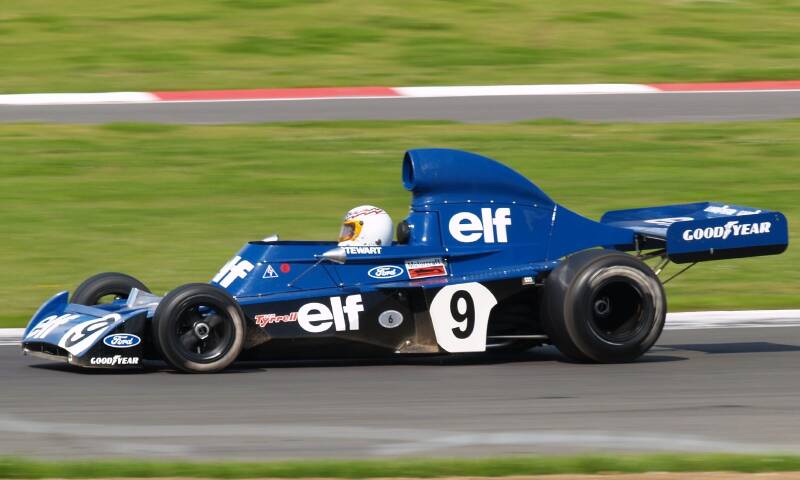
The Tyrrell 006 was a Formula One car designed and built by the Tyrrell Racing Organisation. It was introduced towards the end of 1972. In the hands of Jackie Stewart it won the Drivers' Championship for the 1973 Formula One season, Stewart's third and final title.
The 006 was a very slightly reworked version of the preceding Tyrrell 005 car, but in contrast it was the first Tyrrell-built models to be replicated, the number 006 becoming a model- rather than chassis-number; previous Tyrrells were one-off constructions. In total there were three Tyrrell 006 chassis built: 006; 006/2; and 006/3. The 006 model was gradually phased out in the early part of the 1974 Formula One season as Tyrrell constructed the succeeding Tyrrell 007.
After Cevert's accident a devastated Stewart drove 006/2 around the Watkins Glen circuit once more, in an attempt to understand what had happened to Cevert, parked the car and then walked away from Formula One.

Jackie Stewart
François Cevert
Patrick Depailler
Jody Scheckter
007
1974-1977
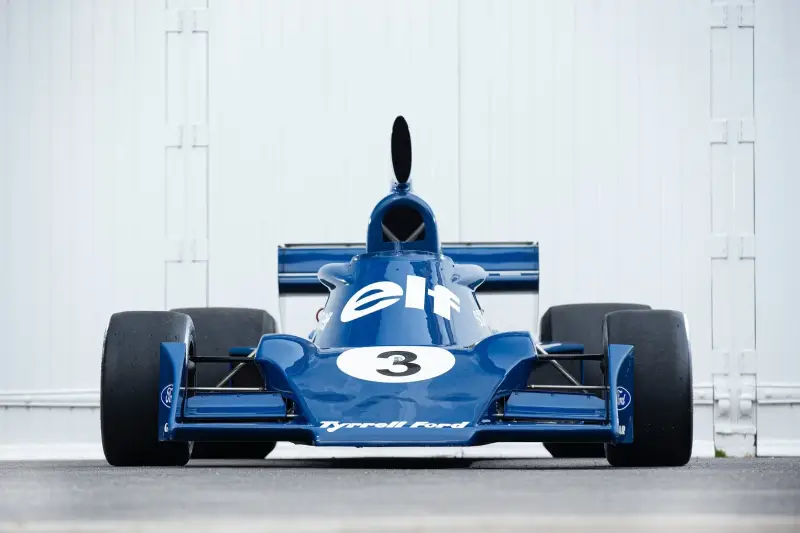
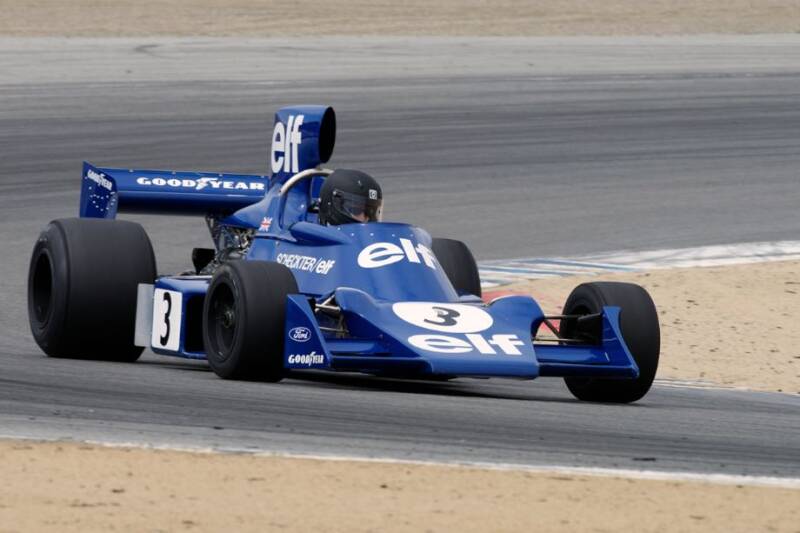
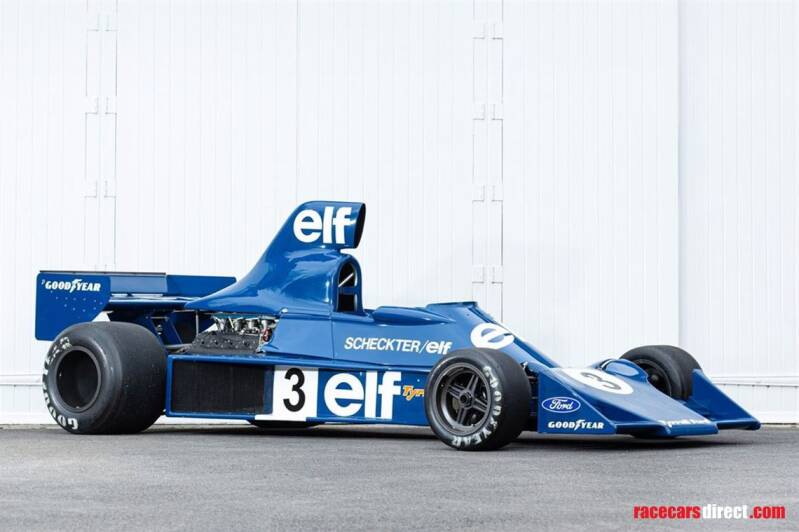
The Tyrrell 007 is a Formula One racing car, designed by Tyrrell's Chief Designer, Derek Gardner. It was used in the 1974, 1975, 1976 and 1977 Formula One seasons.
Ken Tyrrell, owner of Tyrrell Racing needed two new drivers for 1974 because Jackie Stewart retired from driving at the end of 1973 and François Cevert was killed at the 1973 season finale in the United States. The team had originally planned to have Cevert and Jody Scheckter as their driver line up for 1974. Following Cevert's death, Tyrrell signed Patrick Depailler as replacement. In the first three races of 1974, (Argentina, Brazil and South Africa), Tyrrell used the earlier 005 and 006 chassis.
In 1974 the Tyrrell team scored 52 World Championship points; four points were scored by the 005 and the 007 scored 48 points, earning them third place in the Constructors' Championship standings.
In 1975 the team scored twenty five World Championship points, earning them fifth place in the Constructors' Championship standings.
In 1976 the team scored 71 World Championship points, 13 points were scored by the 007 and the Tyrrell P34 scored 58 points, earning them third place in the Constructors' Championship standings.

Patrick Depailler
Jody Scheckter
p34

1976-1977


p34b
The Tyrrell P34 (Project 34), commonly known as the "six-wheeler", was a Formula One (F1) race car designed by Derek Gardner, Tyrrell's chief designer. The car used four specially manufactured 254mm diameter wheels and tyres at the front, with two ordinary-sized wheels at the back. Along with the Brabham BT46B "fancar" developed in 1978, the six-wheeled Tyrrell was one of the most radical entries ever to succeed in F1 competition and has been called the most recognisable design in the history of world motorsports.
The P34 was introduced in September 1975 and began racing in the 1976 season. It proved successful and led other teams to begin design of six-wheeled platforms of their own. Changes to the design made for the 1977 season made it uncompetitive, and the concept was abandoned for Tyrrell's 1978 season. The P34B was wider and heavier than before. The other six-wheeled designs ended development, and F1 rules later stipulated that cars must have four wheels in total. The cars later had some success in various "classics" race events, but today are museum pieces.

Jody Scheckter
Ronnie Peterson
Patrick Depailler
008

1978


The Tyrrell 008 was a Formula One car manufactured and raced by the Tyrrell Racing Organisation team during the 1978 season. Driven by Didier Pironi and Patrick Depailler, it achieved several podium finishes including a win at the 1978 Monaco Grand Prix.
The Tyrrell 008 was designed by Maurice Philippe to replace the six-wheeler Tyrrell P34 used the previous two seasons. It used an aluminum monocoque in front of a V8 Cosworth DFV.
The 008 was originally conceived as a fan car, similar to the Brabham BT46. The idea was to position the radiators in the underside of the car, in turn tidying up the aerodynamics, and use the fan to extract heat from them. A small rear mounted fan had been developed to cool the oil and water radiators with the added bonus of aerodynamic downforce, but unlike Gordon Murray's effort, the team could not get the technology to work effectively. The car regularly overheated during testing and the fan was quietly dropped. Murray's assistant, David Cox, had however observed the 008 in testing and gave his boss all of the details that he could.
The team finished in fourth place in the Constructor's Championship with a total of 38 points.

Didier Pironi
Patrick Depailler
009


1979
The Tyrrell 009 was a Formula One racing car that was designed by Maurice Philippe for Tyrrell Racing for the 1979 season.
The 009 was powered by the Ford-Cosworth DFV V8 engine and made its competition debut in the first race of the season in Argentina. The 009s were driven by Frenchmen Didier Pironi and Jean-Pierre Jarier, with Jarier being replaced by Englishman Geoff Lees for the German GP and Irishman Derek Daly for the Austrian GP. Daly also drove a third car at the final two races of the season. For the 1980 season, the 009 competed in the first two races before being replaced by the Tyrrell 010.
The car achieved four 3rd-place podium finishes during the 1979 season, allowing Tyrrell to finish 5th in the World Constructors' Championship.

Didier Pironi
Jean-Pierre Jarier
Geoff Lees
Derek Daly
010


1980-1981
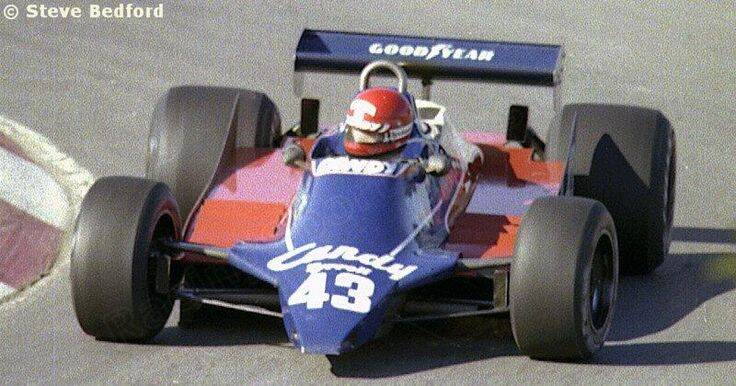
The Tyrrell 010 was a Formula One racing car that was designed by Maurice Philippe for Tyrrell Racing for the 1980 season.
The 010, like all Tyrrells before it was powered by the Ford-Cosworth DFV V8 engine and made its competition debut in the third race of the season in South Africa. Heavily influenced by the highly successful Williams FW07. It utilized inboard rocker-actuated springs and sliding side-pod skirts to maximize ground effect aerodynamic
The 010 was replaced in the middle of the 1981 season by the new 011. The last race for the 010 was the 1981 Austrian Grand Prix where Alboreto qualified 22nd and retired after 40 laps with gearbox failure. While reliable enough to scoring frequent top-6 finishes, the underfunded 010 became historically significant as the first Tyrrell chassis to fail to secure a single podium finish during its lifecycle.

Derek Daly
Jean-Pierre Jarier
Eddie Cheever
Michele Alboreto
Ricardo Zunino
011

1981-1983


The Tyrrell 011 was a Formula One car designed by Maurice Philippe for the Tyrrell Racing Organisation.
The 011 was powered by a Cosworth DFV engine and initially ran on Avon tyres before the team switched into Goodyear rubber. For 1982, Tyrrell made a minor modification to the 011 by redesigning the ground effect and removing the front wing.
For 1983, Tyrrell upgraded the 011 into a derivative version of the car, the 011B. The differences were the removal of the ground effect, smaller sidepods, open engine cover and revised front and rear wings.
The 011 raced in three seasons of Formula One (1981 - 1983) although its only full season was 1982. The 011 was replaced two-thirds of the way through the 1983 season by the Tyrrell 012.

Eddie Cheever
Michele Alboreto
Brian Henton
Slim Borgudd
Danny Sullivan
012


1983-1985
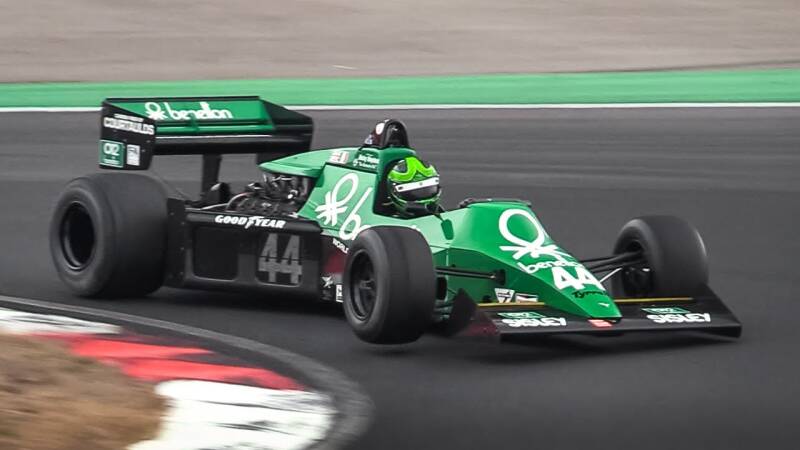
The Tyrrell 012 is one of the most infamous and technically fascinating cars in Formula 1 history. Introduced late in the 1983 season, it was utilized through 1984 and the early stages of 1985.
It is historically significant as the car at the center of Tyrrell's 1984 season disqualification controversy, and it marked the end of the naturally aspirated Ford Cosworth V8 era in F1.
Tyrrell's first carbon fiber monocoque structure. It was built to be as light and nimble as possible to offset the massive horsepower deficit against the dominant turbocharged cars of the era. By 1984, the 012 was the only car on the grid running a naturally aspirated engine. Because it lacked turbo power, Tyrrell engineered the car to run roughly 40 kg below the 540 kg minimum weight limit during the race.
The 1985 Austrian Grand Prix officially marked the final time a naturally aspirated Cosworth DFV-line engine entered a Formula 1 weekend, as Tyrrell transitioned entirely to Renault turbo power.

Michele Alboreto
Danny Sullivan
Martin Brundle
Stefan Johansson
Stefan Bellof
Mike Thackwell
014

1985-1986


The Tyrrell 014 was a Formula One car, designed for Tyrrell Racing by Maurice Philippe for use in the 1985 season. The cars were powered by the turbocharged Renault EF4B V6 engine.
Tyrrell skipped the number 013 because it was considered unlucky.
The car was successor of the 012, which was powered by naturally aspirated Ford Cosworth DFY V8 engine. The team was in fact the last to secure a turbocharged engine deal. The development of the new car was, however, halted due to the lack of funding (after their exclusion from the 1984 season the team lost not only their points, but the money from TV rights and more) and the team used the 012 with Cosworth DFY in it for the first half of the season. The 014 made its debut on the 1985 French Grand Prix. During the season the team scored only 3 points in the 1985 Australian Grand Prix by Ivan Capelli.
The car raced also in the first two races of the 1986 season, before being replaced by the Tyrrell 015.

Martin Brundle
Stefan Bellof
Ivan Capelli
Philippe Streiff
015


1986
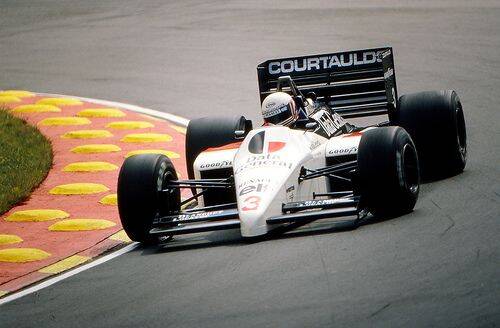
The Tyrrell 015 was a Formula One car designed for Tyrrell Racing by Maurice Philippe for use in the 1986 season. The cars were powered by the turbocharged Renault EF15 V6 engine which was rated at 850 bhp in race trim. The 015 ran on Goodyear tyres and were driven by Martin Brundle in his third season with the team, and Philippe Streiff who joined from Ligier.
The 015 was a development of the team's first ever turbo car, the Tyrrell 014 which had first run the Renault turbo in Brundle's hands at the 1985 French Grand Prix. As the 015 was still unfinished at the start of the season, the team ran the 014 for the first three races of the season. The new car was finally ready for Monaco and proved to be somewhat reliable, if not the fastest car on the grid. The car's best result wasn't achieved until the final race of the season in Australia when Brundle finished in 4th place despite running out of fuel as he crossed the line.
After losing their Renault engines when the factory pulled out of Formula One altogether at the end of 1986, the team reverted to using Cosworth power when they ran the 3.5 litre Ford Cosworth DFZ V8 engine in their 1987 car, the DG016.

Martin Brundle
Philippe Streiff
dg016


1987
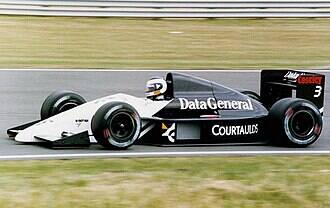
The Tyrrell DG016 was a Formula One racing car designed by Maurice Philippe and Brian Lisles and raced by Tyrrell Racing in the 1987 FIA Formula One World Championship. It was equipped with a Ford Cosworth DFZ 3.5-litre V8.
The DG in the car's name was a reference to the team's major sponsor, Data General.
The car featured a distinct, high engine cover line running continuously from the roll hoop to the rear wing. While unique at the time to maximize airflow to the rear wing, this sleek aerodynamic silhouette laid the visual foundation for modern Formula One car design.
In 1987, F1 introduced a sub-championship for teams running naturally aspirated engines rather than powerful turbochargers. Tyrrell dominated this category, winning the Colin Chapman Trophy with 169 points. In the main World Championship, the DG016 secured 6th place overall for Tyrrell, scoring a total of 11 points and frequently outperforming several turbo-powered cars.

Jonathan Palmer
Philippe Streiff
017

1988-1989


The Tyrrell 017 was a Formula One racing car designed by Maurice Philippe and Brian Lisles. It was built and raced by Tyrrell Racing in the 1988 season and also for the first race of the 1989 season. It used a customer Cosworth DFZ V8 engine as had its predecessor. The car was driven in 1988 by British pair Jonathan Palmer and Formula One rookie Julian Bailey. Bailey was replaced by Michele Alboreto in 1989 as was the Cosworth DFZ replaced by the more powerful 1988 motor the Cosworth DFR.
The 017 was a development of the team's successful 1987 car, the Tyrrell DG016. However, as successful as the DG016 was in the naturally aspirated part of the championship (Tyrrell won the 'Colin Chapman Cup' as the leading atmospheric constructor while Jonathan Palmer won the 'Jim Clark Cup' as the atmo Drivers' Champion), the 017 was equally unsuccessful. Bailey failed to score a point and also failed to qualify for 10 races. Palmer scored all of the team's 5 points with Tyrrell finishing 8th in the Constructors' Championship.
For 1989 the car had minor upgrades for the first race of the season and was dubbed the 017B. The car was still uncompetitive and was replaced from the second race in San Marino with the Tyrrell 018.

Jonathan Palmer
Julian Bailey
Michele Alboreto
018

1989-1990
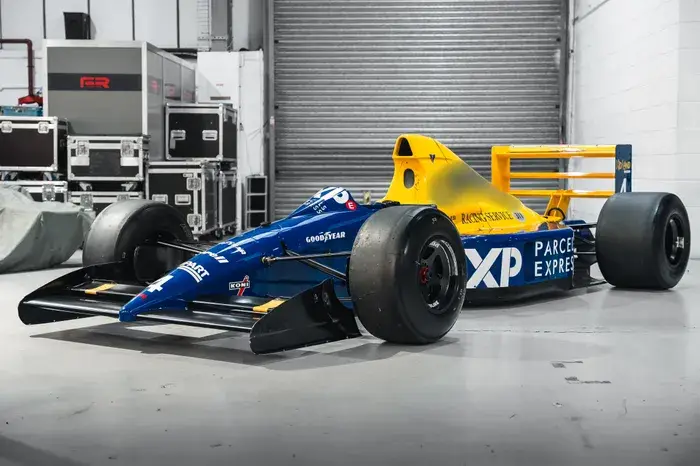
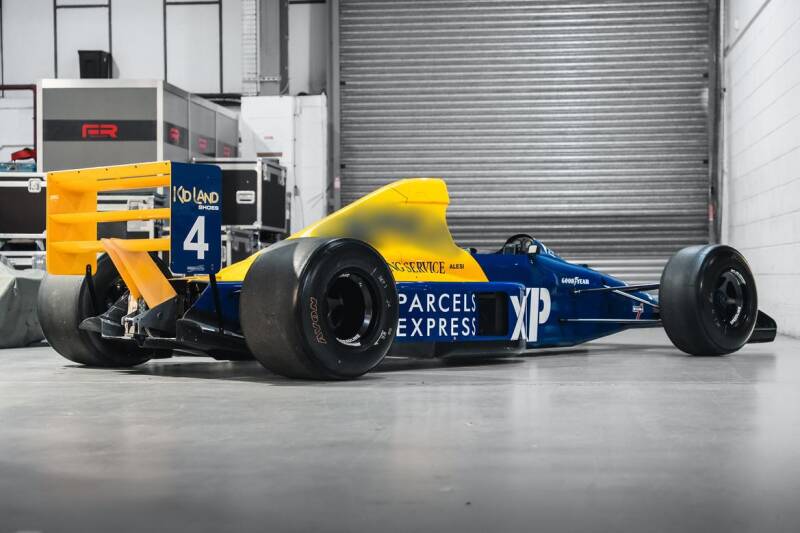
The Tyrrell 018 was a Formula One racing car designed by Harvey Postlethwaite and Jean-Claude Migeot. It was built and raced by Tyrrell Racing. It used a customer Ford DFR engine (approx. 595 bhp).
It was generally believed in the F1 paddock at the time that the 018 with its sleek aerodynamics was one of the fastest of the new 3.5L cars in a straight line, despite running the underpowered customer DFR engine. Its design paved the way for the revolutionary high-nose concept seen on its successor, the 019
The 018 was replaced after two races of the 1990 Formula One season by the first of the "high-nose" cars in Formula One, the Tyrrell 019.

Jonathan Palmer
Michele Alboreto
Jean Alesi
Johnny Herbert
Satoru Nakajima
019


1990
The Tyrrell 019 was a 1990 Formula One racing car, designed by a team led by Harvey Postlethwaite, and built by Tyrrell. It was an evolution of Postlethwaite's first design for Tyrrell, the Tyrrell 018.
The car was introduced two races into the 1990 Formula One season, scoring a point on its debut in the hands of Jean Alesi. The car was powered by the Ford DFR V8 engine - a descendant of the Cosworth DFV, now producing 620 bhp.
By raising the nose cone of the car, Postlethwaite and his team increased the volume of air that was able to pass underneath the car. Conversely, the efficiency of the front wing aerofoils are increased the closer they are to the ground. These conflicting requirements led to the design of the 019's distinctive inverted-V, anhedral front profile.
The car marked the significant point in the evolution of Formula One design in having an elevated nose cone. This was the first time that such an idea had been tried in Formula One racing, and set the template for aerodynamic design ever since.

Satoru Nakajima
Jean Alesi
020


1991-1993
020b
020c
The Tyrrell 020 was a Formula One racing car designed by Harvey Postlethwaite and George Ryton for Tyrrell Racing and raced during the 1991 season, the entire 1992 season and the half of 1993 season.
The 020 was driven by Satoru Nakajima who brought the Honda engine contract with him and also by Stefano Modena. Its best result was a second place by Modena in the Canadian Grand Prix. Tyrrell scored 12 points to finish 6th in the Constructors' Championship with half the points scored by Modena's 2nd in Canada.
The car was powered by the 690 bhp Honda RA101E V10 engine previously raced by McLaren in 1990 and maintained by Mugen Motorsports, which would run Mugen-Honda badged engines the following year for Footwork Arrows.
The car was updated for the 1992 season and was dubbed the 020B. For this season the Honda V10 was replaced with the 680 bhp Ilmor LH10 V10 engine and ran on Goodyear tyres.
The 020 was pressed into service again for the first nine races of the 1993 season. Again updated it was called the 020C. For the third time in three years the car ran a V10 engine but this time it carried the 690 bhp Yamaha OX10A.

Satoru Nakajima
Olivier Grouillard
Ukyo Katayama
Stefano Modena
Andrea de Cesaris
021


1993
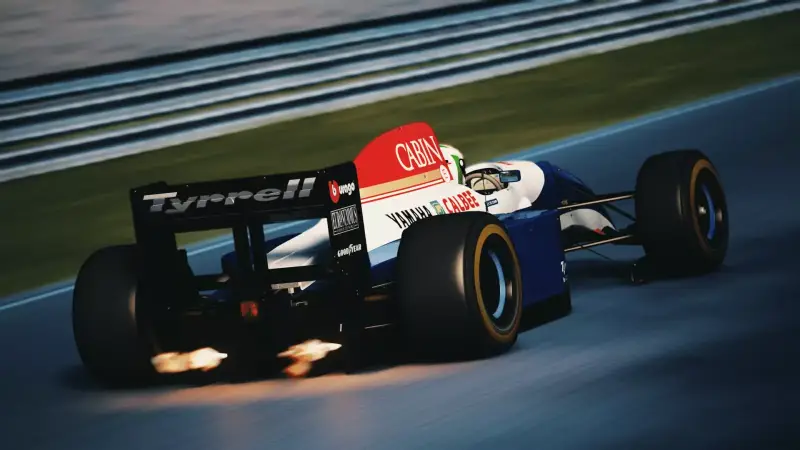
The Tyrrell 021 was Tyrrell Racing's competitive entry for the second half of the 1993 Formula One World Championship. Designed by Mike Coughlan, it was built to replace the outdated Tyrrell 020C chassis.
It was powered by a Yamaha OX10A 3.5-litre V10 (essentially a rebadged Judd GV V10 engine) mated to a Hewland 6-speed sequential semi-automatic transmission.
The 021 did not debut until mid-season at the 1993 British Grand Prix. Tyrrell had relied on the updated 1991-spec 020C for the opening seven rounds while finishing development on the 021. When the car finally arrived, it proved to be completely uncompetitive and suffered heavily from mechanical gremlins, especially gearbox and engine reliability issues. However, the car holds the unfortunate distinction of being one of the least successful models in the team's history, finishing the season with zero points scored.

Ukyo Katayama
Andrea de Cesaris
022


1994
The Tyrrell 022 was Tyrrell Racing's competitive entry for the 1994 Formula One World Championship. Designed by Harvey Postlethwaite and Mike Gascoyne, the car marked a significant return to form for the legendary team following a completely point-less campaign in 1993. It was powered by a Yamaha OX10B 3.5-litre V10 (approx. 650–700 bhp).
The 022 was simple, lightweight, and aerodynamically efficient, serving as the last Tyrrell car to achieve a double-digit points tally in a single season
The 022 was the car with which Tyrrell achieved its final podium finish, courtesy of Blundell at the Spanish Grand Prix.
The Tyrrell 022 was genuinely quick, frequently qualifying and running in the top six. However, it suffered immensely from mechanical unreliability—mostly linked to the Yamaha V10 engine—which caused both drivers to retire from more than half of the season's races. When it did finish, it routinely scored points.
It was replaced by the 023 for 1995.

Ukyo Katayama
Mark Blundell
023


1995
The Tyrrell 023 was a Formula One car designed by Harvey Postlethwaite and Mike Gascoyne for use by the Tyrrell team in the 1995 Formula One World Championship. The car was driven by Japanese Ukyo Katayama, in his third season with the team, and Finn Mika Salo, in his first full season of F1 after driving for Lotus in the final two races of 1994. The team's test driver, Italian Gabriele Tarquini, deputised for an injured Katayama at the European Grand Prix. The best finish achieved by the 023 was fifth, by Salo at the Italian and Australian Grands Prix.
It used a 3-litre version of the Yamaha V10, which had been raced the previous year.
After an impressive 1994 showing with the simple but effective 022, 1995 was a huge disappointment for the team. The 023 chassis proved to be very mediocre and the team's innovative "Hydrolink" suspension was rendered ineffective due to its deficiencies. The Hydrolink suspension was eventually removed from the 023 at mid-season.
Tyrrell eventually finished ninth in the Constructors' Championship, with five points, all scored by Salo, behind Footwork due to Gianni Morbidelli's third-place finish at Adelaide.

Ukyo Katayama
Gabriele Tarquini
Mika Salo
024


1996
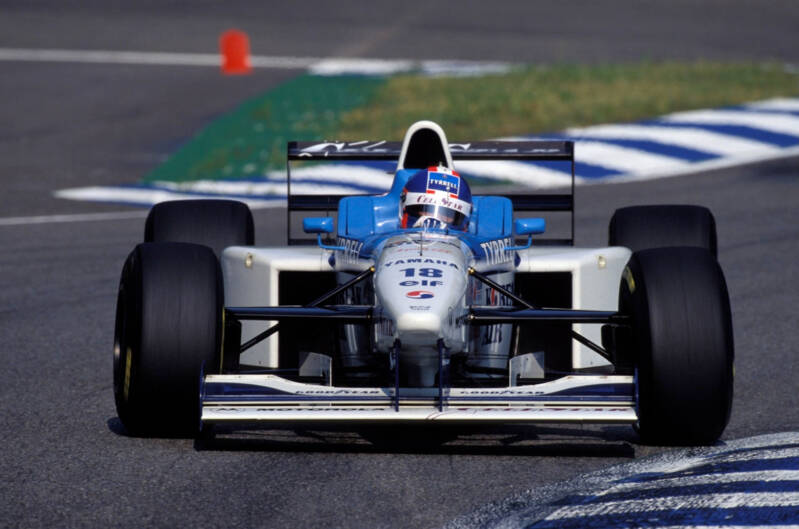
The Tyrrell 024 was the car with which the Tyrrell team competed in the 1996 Formula One World Championship. It was driven by Japanese Ukyo Katayama and Finn Mika Salo, who were in their fourth and second seasons with the team respectively.
The car was a significant improvement over the ineffective 1995 model, prompting Salo to say that they shouldn't be talked about in the same day. However, the team's efforts were severely compromised by the unreliability of their Yamaha engines, a decision which resulted in the team switching to Ford V8 power for 1997.
Salo was generally impressive throughout the season, scoring vital points finishes on three occasions. He again overshadowed Katayama, who moved to Minardi for 1997.
The team eventually finished eighth in the Constructors' Championship, with five points.

Ukyo Katayama
Mika Salo
025
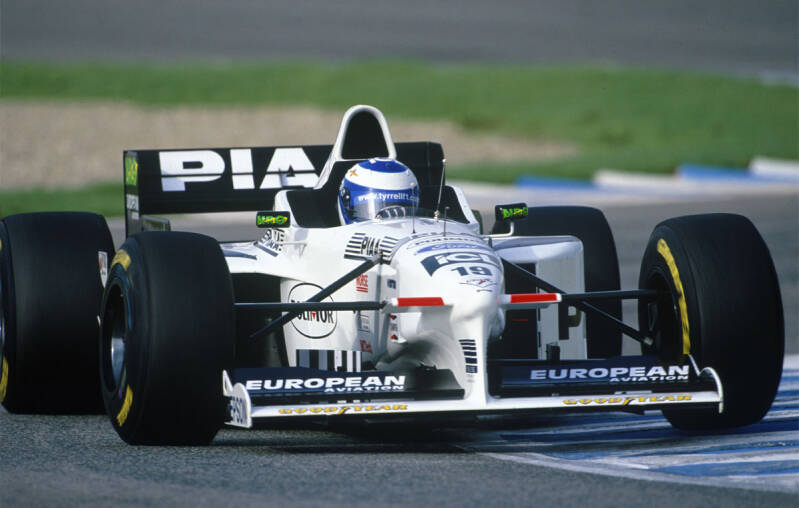


1997
The Tyrrell 025 was the car with which the Tyrrell team competed in the 1997 Formula One World Championship. It was driven by Finn Mika Salo, who was in his third season with the team, and Dutchman Jos Verstappen, who moved from Footwork.
The 025 was an evolution of the previous year's 024, with Ford V8 engines instead of Yamaha V10s in the interests of reliability. However, this came at the expense of power against the V10 cars.
As ever, the team used a fair degree of technical innovation. The 025 eschewed a double support front wing for a single plane unit aimed at cleaning up airflow under the car.
The year was largely disappointing for the team. The chassis was well-balanced, the drivers were quick and the strategy was good but the increase in competitiveness in the sport saw them restricted to a battle with fellow V8 runner Minardi for much of the season. The team eventually finished tenth in the Constructors' Championship, thanks to the two points earned by Salo at Monaco.

Jos Verstappen
Mika Salo

Eventually, and in the face of dwindling form and ill health, Ken sold his team after the 1997 season to Craig Pollock, who at the same time was building British American Racing with his funding and sponsor partner British American Tobacco. Ken left the team following the sale, just before the start of the 1998 season, after a disagreement with Pollock over him choosing Ricardo Rosset for sponsorship money reasons over Jos Verstappen.
The final race for Tyrrell was the 1998 Japanese Grand Prix, where Rosset failed to qualify and teammate Tora Takagi retired on lap 28 after a collision with Esteban Tuero's Minardi.
026


1998
The Tyrrell 026 was the car with which the Tyrrell team competed in the 1998 Formula One World Championship and was the final Tyrrell car to compete in F1. Ken Tyrrell had sold the team to British American Racing prior to the first race. Paul Stoddart had almost bought the team prior to BAR's takeover, but the BAR deal had already been finalized. Stoddart's European Aviation sponsored the team and provided transportation during the season.
The team had a V10 engine and a reasonable chassis, but the season was seen as a holding year before BAR took over in 1999. The car retained the tower sidepod mounted wings introduced by Tyrrell the year before. The wings had been copied by other teams but were banned partway into the season.
The team was unclassified in the Constructors' Championship, with no points but behind Minardi due to the Italian team having a better finishing record.

Ricardo Rosset
Toranosuke Takagi


Create Your Own Website With JouwWeb