


Sauber Motorsport AG was a Swiss motorsport engineering company and race team. Founded by Peter Sauber as PP Sauber AG in 1970, the team produced sports cars and later Formula One race cars as an independent constructor.
In endurance racing, the team achieved two world championships and overall victory at the 1989 24 Hours of Le Mans with Mercedes-Benz. After entering Formula One in 1993, the team transformed multiple times but exited the sport in 2025 as the fourth-oldest constructor in history by races started. The team and its assets were acquired by Audi AG in 2024 to form the chassis construction and sporting basis of the Audi F1 Team.
Each of the team's cars, with the exception of cars built by BMW Sauber, were designated a number proceeded by the letter C to honor Peter Sauber's wife, Christiane. Starting with the C1, which was built in his parents' garage, Sauber's early cars competed in local Swiss championships. The team debuted in FIA competition with the Sauber C5, which competed in the 1977 24 Hour of Le Mans.

c1 1970
After Group C endurance regulations ended, the team entered Formula One independently despite a failed attempt to build a joint project with Mercedes. From 1993 to 2005 the team operated as a private constructor, becoming well known for introducing young talent including Heinz Harald-Frentzen, Kimi Räikkönen, and Felipe Massa. Sauber also pioneered many technological innovations which later became standards, such as high cockpit side walls, longitudinally-mounted gearboxes, and the twin keel front suspension.
beginning and partnership with mercedes-benz (1993–1994)
Sauber intended to pivot to Formula One in direct collaboration with Mercedes, but this joint project was shelved and Mercedes funded Sauber's first engine contract instead. The team re-branded Ilmor V10 engines as Sauber power units, and the new Sauber C12 spent most of 1992 testing across Europe at Lurcy-Levis, Barcelona-Catalunya, and even an airfield in Zweisimmen. The team signed experienced Formula One driver JJ Lehto to partner former Sauber endurance driver Karl Wendlinger for the 1993 season.
c12


1993
The Sauber C12 was the car with which the Sauber Formula One team made its FIA Formula One World Championship debut in 1993. Its design was led by Leo Ress.
Power was provided by a Sauber-branded 3.5-litre V10 built by Ilmor in partnership with Mercedes. The C12 was given the prominence of "Concept by Mercedes-Benz" stickers on the engine cowling due to the two parties' close relationship from their World Sportscar Championship program. The engines were re-branded in 1994 to reflect the partnership.
The C12 had a somewhat mixed record with a total of 12 DNFs due to mechanical failure, including seven engine failures (not including Imola, where Lehto was classified as a finisher). Driver-related incidents accounted for six more DNFs.
The C12 achieved six points finishes and eight non-scoring finishes from 32 starts. It achieved a points total of 12 and 7th place in the Constructors' World Championship standings.

Karl Wendlinger
JJ Lehto
c13


1994
The Sauber C13 was a Formula One car designed by André de Cortanze and Leo Ress for use by the Sauber team in the 1994 Formula One World Championship.
The car was powered by an Ilmor 3.5L V10 engine badged as a Mercedes-Benz. The development of this car signalled Mercedes-Benz's return to Formula One, providing their first engine for an F1 car since 1955.
From the Spanish Grand Prix, the car ran with higher cockpit sides after Wendlinger suffered severe injuries in a side-on accident during qualifying at the Monaco Grand Prix which left him in a coma. Higher cockpit sides were later made mandatory for all cars in the 1996 season, and were still in use up to 2017, when they were integrated with the "halo" system.

Karl Wendlinger
Andrea de Cesaris
JJ Lehto
Heinz-Harald Frentzen
red bull and ford engines (1995–1996)
In conjunction with the Ford deal, Sauber signed a ten-year sponsorship deal with energy drink company Red Bull. Entrepreneur Dietrich Mateschitz purchased a majority share in the team and Fritz Kaiser joined as Sauber's new commercial director.
Frentzen led the team to its largest F1 tally with eighteen points and scored the team's first podium at the 1995 Italian Grand Prix with a third place finish. 1995 also marked the start of the team's long association with Petronas, who joined mid-season and later became a presenting sponsor until 2009.
c14


1995
The Sauber C14 was the Formula One car with which the Sauber team competed in the 1995 Formula One World Championship. The number 29 seat was initially taken by Austrian driver Karl Wendlinger, while the number 30 seat was taken by Germany's Heinz-Harald Frentzen. However, Wendlinger underperformed and was replaced by Frenchman Jean-Christophe Boullion for most of the remainder of the year. The team's test driver was Argentine Norberto Fontana.
The C14 was the only V8 powered Sauber F1 car until the BMW Sauber F1.06 in 2006 and also the last Hinwil-based car to utilize Castrol-branded lubricant products until the Audi R26 in the 2026 season.
The car was launched and raced in the season's early races with a distinctive narrow and drooping nose. At the San Marino GP, this was replaced by a more conventional raised nose carrying the front wing underneath on twin supports. Thus the car became a largely unremarkable mid-1990s F1 midfielder, although it was notable for being the only 1995 F1 car to feature the raised cockpit sides which would be mandated from 1996, and for achieving Sauber's first F1 podium finish with Frentzen 3rd in Italy.

Karl Wendlinger
Jean-Christophe Boullion
Heinz-Harald Frentzen
c15

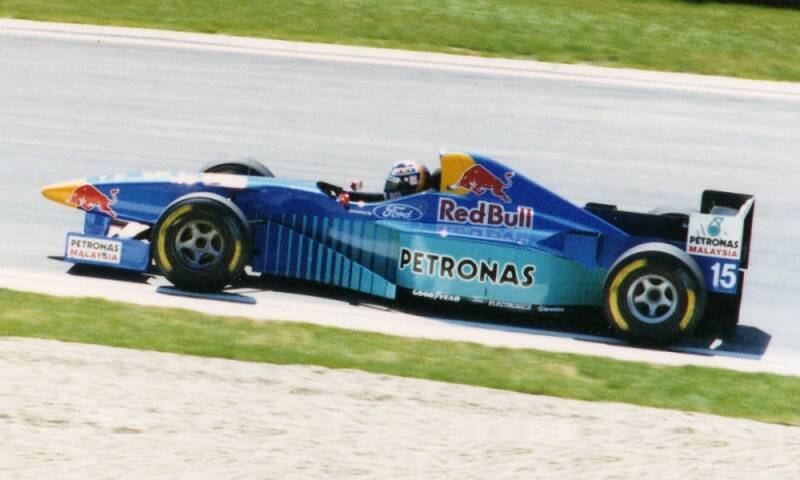

1996
The Sauber C15 was the car with which the Sauber team competed in the 1996 Formula One World Championship. It was powered by the Ford Zetec-R V10 engine and driven by German Heinz-Harald Frentzen, who was in his third season with the team, and Briton Johnny Herbert, who moved from Benetton.
After an encouraging performance in 1995 with a full-works Ford V8 engine, 1996 began troublesome with the new Zetec-R V10. The team scored only 11 points.
The drivers proved well-matched, with Frentzen having a slight edge over Herbert. However, the German left the team at the end of the year to join champions Williams for 1997.
The team eventually finished seventh in the Constructors' Championship, with 11 points.

Johnny Herbert
Heinz-Harald Frentzen
sauber-petronas engineering (1997–2005)
From 1997 until 2005 Sauber used Ferrari designed customer engines and gearboxes built by Sauber Petronas Engineering, a company founded for the sole purpose of building these engines. Sauber licensed nearly every legally licensable part from Ferrari and even had several Ferrari engineers on staff. The first podium for Sauber-Petronas came at the 1997 Hungarian Grand Prix with a third place finish, and a podium followed the next season with third at the 1998 Belgian Grand Prix. However, the team struggled in the lower midfield throughout 1999 and 2000 and achieved only six points at the turn of the millennium.
This agreement to use Ferrari engines lasted until the team's purchase by BMW for 2006.
c16


1997
The Sauber C16 was the car with which the Sauber team competed in the 1997 Formula One World Championship. It was initially driven by Briton Johnny Herbert, who was in his second season with the team, and Italian Nicola Larini.
Initially the C16 car was designed to accommodate Ford Zetec engine but the decision to change from Ford to Ferrari engines in November 1996 brought with it several challenges for the design team led by Sauber technical director Leo Ress. Where the Ford engine featured the V8 mounted to the back of the engine, the additional two-cylinders positioned in the V shape of the cylinder bank, the Petronas-branded Ferrari engine included all three components attached to the rear of the engine and thus required Sauber to change their design approach.
Against some expectations, the car was competitive at the beginning of the season, but fell away slightly as the season progressed due to lack of development compared with better-funded rivals. The team eventually finished seventh in the Constructors' Championship, with 16 points.

Johnny Herbert
Nicola Larini
Gianni Morbidelli
Norberto Fontana
c17


1998
1998 confirmed Sauber's position as a respectable midfield runner unable to make the final breakthrough needed to become a top team. The team's package was quick and reliable, but not quite enough to regularly score points. Indeed, Alesi and Herbert finished just outside the points, in seventh, no less than five times.
The team eventually finished sixth in the Constructors' Championship with ten points. This was their best WCC position so far despite scoring the lowest number of points up until then, but there was still some way to go to take on the likes of Ferrari and McLaren.
It was with this car that the last rounded-shape steering wheel in Formula 1 was used. All steering wheels have been rectangular since then.
For the first few races, X-wings were used, but they were banned after the San Marino Grand Prix.

Jean Alesi
Johnny Herbert
c18

1999
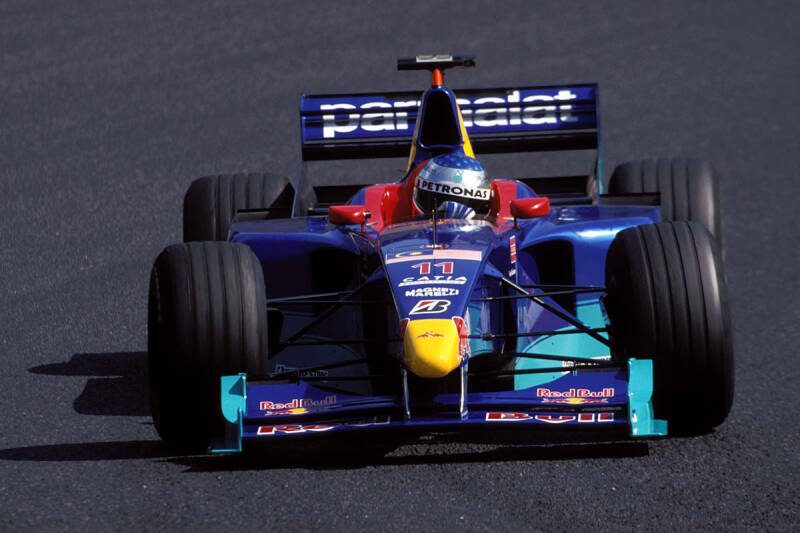
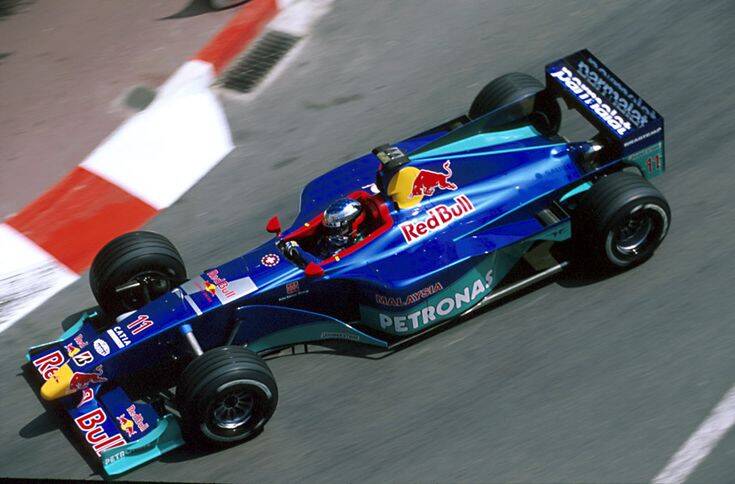
The C18 was a clear development of the C17 from the season prior. The new car did however feature an upgraded Ferrari engine named SPE 03A, rebadged Petronas, and a seven speed gearbox for the first time. The C18 would run Bridgestone tyres, a first for Sauber, as Goodyear withdrew from Formula One before 1999. Bringing Diniz onboard was worth around $7million for the Sauber team, and with the saving on Johnny Herbert's salary, it was estimated Sauber had an additional $12million in budget for developing the C18.
The C18 struggled throughout the 1999 season with a large number of retirements. On just 12 occasions did a C18 cross the finish line of a Grand Prix.
At the end of the season, Diniz and Alesi finished 14th and 15th in the Drivers' Championship respectively, while Sauber finished eighth in the Constructors' Championship, their five points being their lowest tally since their entry into F1 in 1993.

Jean Alesi
Pedro Diniz
c19


2000
The Sauber C19 was the car with which the Sauber Formula One team competed in the 2000 Formula One World Championship. It was driven by the experienced pairing of Finn Mika Salo and Brazilian Pedro Diniz, who had previously been teammates at Arrows in 1998.
The C19 was the first Sauber Formula One car to utilize bespoke Petronas Syntium lubricants after three seasons utilizing Shell Helix lubricants.
This car introduced twin front suspension mounting pylons, a design that would be used enhanced the following year.
The car proved to be reasonably competitive, but not enough to escape from the large midfield group. The team finished eighth in the Constructors' Championship – same position as in 1999, but with more points.
The team experienced one of the worst races of its F1 career at the Brazilian Grand Prix, when both cars were withdrawn from the race after repeated rear wing failures caused by the bumpy track surface.

Pedro Diniz
Mika Salo
c20


2001
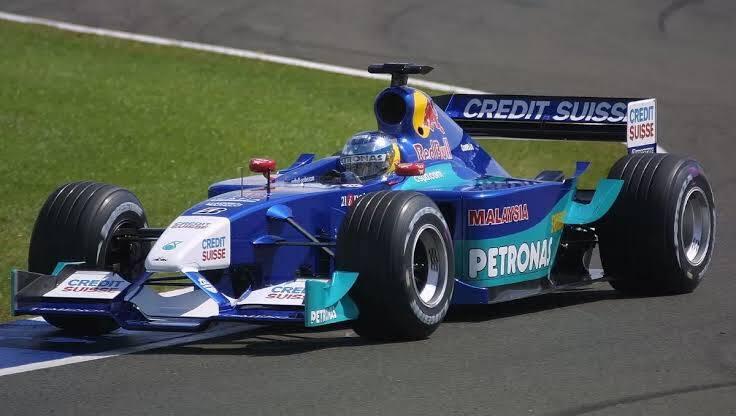
The Sauber C20 was the car with which the Sauber team competed in the 2001 Formula One World Championship. It was powered by a Petronas-branded '01A' 3.0-litre V10, supplied by Scuderia Ferrari. The C20 was notable not only for its eventual position in the Constructors' World Championship but also for a new type of front suspension mounting: the "twin keel". Sergio Rinland designed the car, and then promptly left the team to join Arrows, leaving the C20's development in the hands of Willy Rampf.
The C20 turned out to be one of Sauber's most competitive chassis, providing the team with a points total of 21 and fourth place in the Constructors' World Championship standings.
The C20 achieved 11 points finishes and 10 non-scoring finishes from 33 starts.

Nick Heidfeld
Kimi Räikkönen
c21

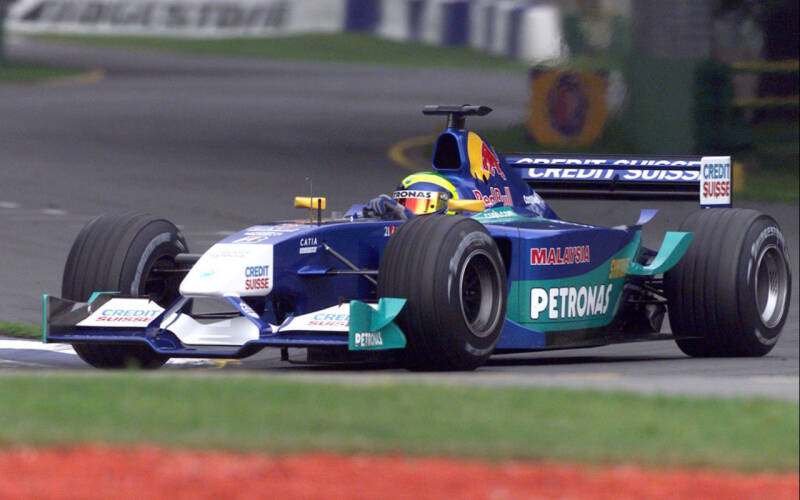

2002
The C21 chassis was an evolution of 2001's successful C20, which had secured Sauber a best-ever fourth place in the Constructors' Championship. It was designed by Technical Manager Willy Rampf and his 24-strong design team. It was therefore similar to the C20, with modifications to the position of the radiators, suspension setup and rear bodywork. The C21 also featured a new gearbox which was more compact and lightweight than its predecessor.
The team continued to use Ferrari engines rebadged in deference to title sponsor Petronas, as had been the case since 1997. Throughout the 2002 season, they used derivatives of the previous year's 051 engine, which had then been used by the Ferrari team in its own F2001 chassis. Although powerful and reliable, the cost of purchasing the year's engine supply was £13 million.

Nick Heidfeld
Felipe Massa
Heinz-Harald Frentzen
c22

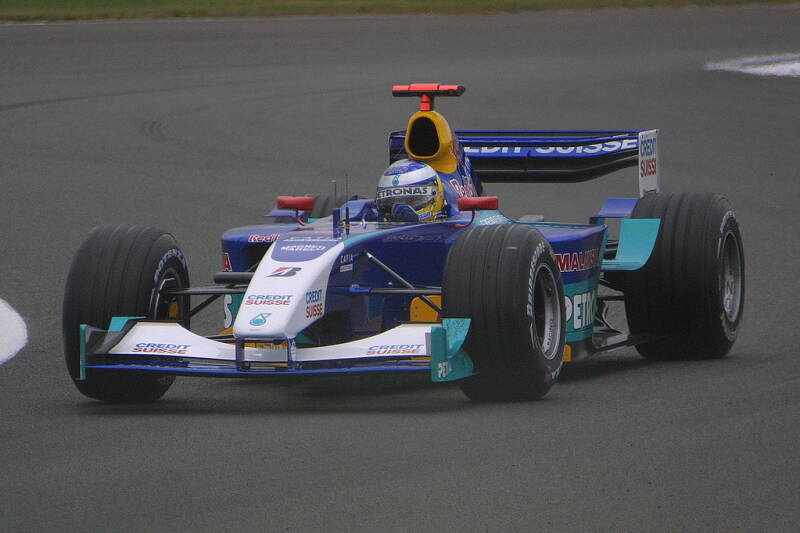

2003
The Sauber C22 was the car with which the Sauber Petronas team competed in the 2003 Formula One World Championship.
The C22 was driven by Nick Heidfeld, now in his third season with Sauber and was paired with experienced former Williams and Jordan Grand Prix driver Heinz-Harald Frentzen, who had deputised for Felipe Massa at the 2002 United States Grand Prix. Massa departed the team to join Ferrari as a test driver. Swiss driver Neel Jani was signed as a test driver for the 2003 season helping develop the C22.
The C22 was the third car designed by Willy Rampf for the Sauber team. Initial designs for the C22 were completed as early as May 2002. Emphasis was placed on improved rigidity of parts, reliability and making the car more compact and lighter than in 2001. Sauber would continue their relationship with Ferrari providing V10 power units for the team. Badged as the Petronas 03A, the engine was based on the Ferrari works engine from 2002 that had taken Michael Schumacher to the world championship title.
The C22 finished the season with 19 points, and took Sauber to 6th position in the Constructors standings. The C22 would be the final Formula One car driven by Heinz-Harald Frentzen, who retired from the sport to join then-General Motors-owned Opel in DTM. Meanwhile, Nick Heidfeld would leave the team but would eventually return when it became BMW Sauber in 2006.

Nick Heidfeld
Heinz-Harald Frentzen
c23

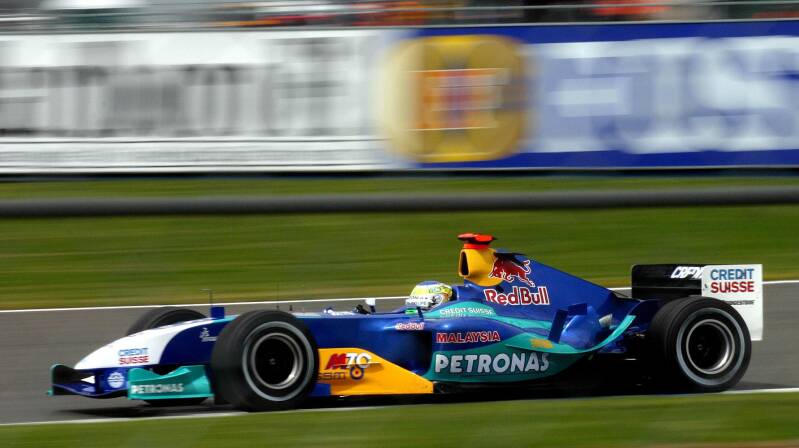

2004
The car was a direct evolution of the Sauber C22. For this purpose, Ferrari's car from the previous year, the Ferrari F2003-GA, was used as a model. In terms of design, care was taken to make the car lighter and test more than last year's car. For the first time, the Sauber car was equipped with the same Ferrari engine type as Ferrari itself and not, as before, with the respective previous year's engine. The engine was designated the Petronas 04A. The fuel also came from Petronas and the car raced with Bridgestone tyres.
The Sauber C23 was unveiled on January 12 in Salzburg at Hangar-7, Red Bull's owned aircraft hangar, to mark the 10th anniversary of Red Bull's sponsorship.
Giancarlo Fisichella scored the most championship points with 22 with a best finish of 4th place at the Canadian Grand Prix while Felipe Massa scored 12 points also with a best finish of 4th place at the Belgian Grand Prix. The team scored 34 points overall and 6th place in the Constructors' Championship.

Giancarlo Fisichella
Felipe Massa
c24

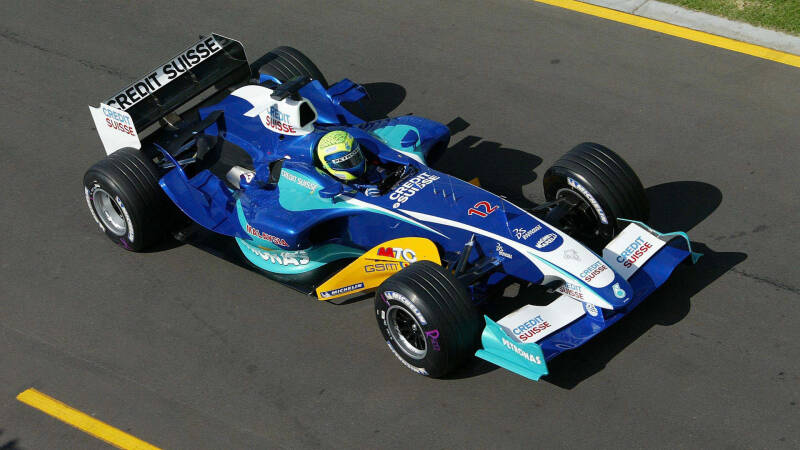

2005
The Sauber C24 was the car with which the Sauber team competed in the 2005 Formula One World Championship.
The C24 was driven by Jacques Villeneuve and Felipe Massa, the first time Sauber had a non-European driver lineup. The team did not have a test driver. Sauber finished eighth in the Constructors' Championship scoring just 20 points - the team's lowest finish since 2000 season largely due to the team struggling to adapt with Michelin tyres due to the C24 chassis initially being designed around Bridgestone tyres.
The Sauber C24 was supposed to be launched in Kuala Lumpur, Malaysia on 11 January to mark the 10th anniversary of Petronas, but the launch was cancelled due to the Asian tsunami disaster in 2004. This car was the first completely designed with the team's new wind tunnel at Hinwil. The engine was a Petronas 05A 3.0 V10.
The livery had a sponsorship change with Red Bull sponsorship departing to Red Bull Racing after a nine-year alliance with Sauber.
The Sauber team was taken over by BMW for the 2006 season. A C24B variant of the car fitted with BMW's P86 V8 Formula One engine was used in early testing between the 2005 and 2006 seasons in the hands of Nick Heidfeld and Jacques Villeneuve.

Jacques Villeneuve
Felipe Massa
bmw factory team (2006–2009)
At the end of the 2005 season, the team's majority shareholding previously owned by Credit Suisse was bought by BMW, with Peter Sauber retaining a 20% stake, and was renamed BMW Sauber. BMW sold its part back to Peter Sauber after the end of the 2009 season, but the team formally used the name BMW Sauber until the end of the 2010 season. The team held a German licence from 2006 to 2009, then reverted to a Swiss licence in 2010.
The team continued to use Sauber's facilities, mostly for chassis construction and wind tunnel testing, while BMW's headquarters in Munich were responsible for building the new P86 V8 engine.
f1.06


2006
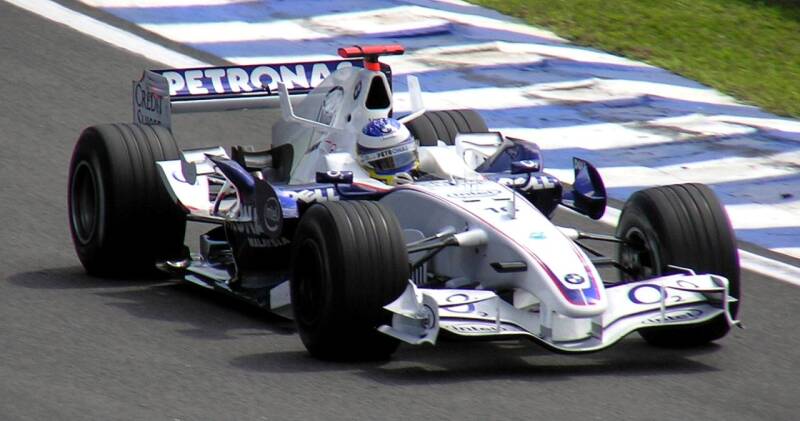
The BMW Sauber F1.06 (originally known as the Sauber C25), also simply known as the BMW F1.06, was the car with which the BMW Sauber team competed in the 2006 Formula One World Championship. It was driven by German Nick Heidfeld, who joined from Williams, and Canadian Jacques Villeneuve, who had spent one season with Sauber before it was bought by BMW. However, Villeneuve was replaced by third driver, Pole Robert Kubica, before the season finished. The year marked the first time that BMW had competed as a full team; previously it had only supplied engines. The chassis was designed by Willy Rampf, Jacky Eeckelaert and Seamus Mullarkey with the powertrain being designed by Heinz Paschen.
This was the first V8-powered Hinwil-based Formula One car since the Sauber C14 in 1995 and also first Hinwil-based Formula One car to utilize other than Ferrari engines since the Ford Cosworth-powered Sauber C15 in the 1996 season.
The 2006 season was treated as very much a transitional year by the team, so the car's level of competitiveness was a pleasant surprise. The F1.06 was a contender for points throughout the season, and its form culminated with two podium finishes. The team eventually finished fifth in the Constructors' Championship, with 36 points. The F1.06 car is the last BMW Sauber car to be developed by Sauber due to team transition.

Nick Heidfeld
Jacques Villeneuve
Robert Kubica
f1.07


2007
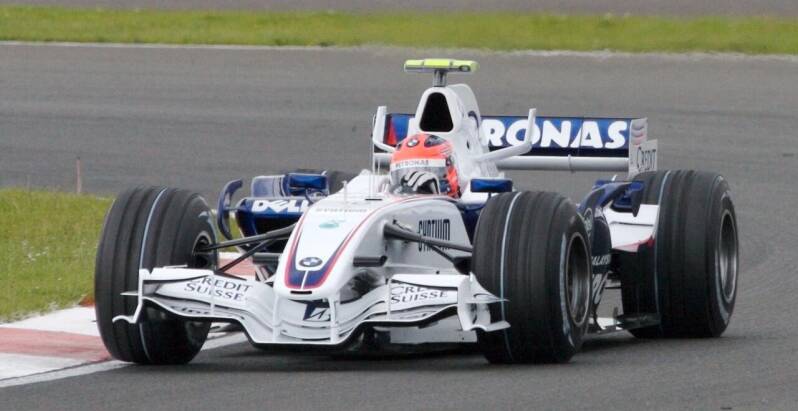
The BMW Sauber F1.07 is a Formula One single-seater racing car built by BMW Sauber for the 2007 Formula One World Championship. The chassis was designed by Willy Rampf, Walter Reidl, Jörg Zander and Willem Toet with the powertrain being designed by Heinz Paschen. The car was the first to have been designed fully by BMW, following their purchase of the former Sauber team. Initial pre-season testing was very positive, with many speculating that BMW could surprise some of the top teams with their performances when the season got underway.
The engine's name, P86/7, is indicative of the fact that it is not a new engine, since it is heavily based on the P86 used in the 2006 F1.06 car. This is a requirement of the homologation rules introduced by the FIA. The BMW Sauber team adopted a seamless shift sequential transmission mechanism, known as QuickShift, for its gearbox.
The car proved to be a highly reliable and competitive package, allowing the newly formed outfit to finish a strong 5th in the Constructors' Championship with 36 points.

Nick Heidfeld
Robert Kubica
Sebastian Vettel
f1.08


2008
The BMW Sauber F1.08 (also known as Sauber C27) was the Formula One racing car with which the BMW Sauber team competed in the 2008 Formula One World Championship. The chassis was designed by Willy Rampf, Walter Reidl, Christoph Zimmermann and Willem Toet with the powertrain being designed by Markus Duesmann. This was the first BMW Sauber to not be designed by Jörg Zander who left the team to go to Honda F1 in January 2008.
As of 2025, the F1.08's win at the Canadian Grand Prix is the only time that a car produced by Sauber Motorsport and the last time that a BMW-powered car has won a Formula One Grand Prix.
The F1.08 lost its performance somewhat relative to Ferrari and McLaren over the remainder of 2008 as they started to focus on the 2009 season. This irritated Robert Kubica who was leading the championship at that time, but both drivers scored podium finishes and kept the team in third place in the Constructors' Championship, scoring more points than in the previous year.

Nick Heidfeld
Robert Kubica
f1.09


2009
The BMW Sauber F1.09 was the Formula One car with which the BMW Sauber team competed in the 2009 Formula One World Championship. The car was launched on 20 January 2009 at Circuit de Valencia in Spain. It was driven by Poland's Robert Kubica and Germany's Nick Heidfeld, both retained from 2008. The chassis was designed by Willy Rampf, Walter Reidl, Christoph Zimmermann and Willem Toet with the powertrain being designed by Markus Duesmann.
As of 2025, this was the last Formula One car powered by a BMW engine and the last Sauber car utilizing with Petronas fuels, as they would supply to Mercedes the following season. The F1.09 was also the last Hinwil-based Formula One car to utilize other than Ferrari engines until the Audi R26 in the 2026 season.
The F1.09 ultimately proved to be disappointing. At times, the drivers could barely scrape through to Q2. Towards the end of the season things began to look up but the damage had been done, and BMW announced that 2009 would be their last season in Formula One. The team eventually finished sixth in the Constructors' Championship.

Robert Kubica
Nick Heidfeld
sauber (2010–2018)
On 27 November 2009, it was announced that Peter Sauber would repurchase the team conditional upon the team receiving a FIA entry for the 2010 season. On 3 December 2009, the FIA confirmed that Sauber had been granted the entry vacated by Toyota Racing following their withdrawal and would be using Ferrari engines. Peter Sauber had said that he had not yet applied for a change of name, so therefore they remained for the 2010 season as BMW Sauber F1 Team despite zero BMW components.
c29


2010
The Sauber C29 (also known as BMW Sauber C29) was a Formula One racing car which was used by the BMW Sauber F1 Team in the 2010 Formula One season. It was unveiled on January 31, at Circuit Ricardo Tormo in Valencia.
This was the first Sauber Formula One car that uses fully fledged Ferrari engines since the Petronas-badged C24 in 2005.
The chassis was designed by Willy Rampf, Christoph Zimmermann, Pierre Waché and Seamus Mullarkey with the car being powered with a customer Ferrari engine.
In the early part of the season, the car demonstrated very poor reliability and it was not until the seventh round of the year that the team scored a point with Kamui Kobayashi taking 10th in Turkey. In the second half of the year, the car gradually improved to a very respectable level and the team finished the season with 44 points, taking eighth in the Constructors' Championship.

Pedro de la Rosa
Nick Heidfeld
Kamui Kobayashi
c30


2011
The Sauber C30 is a Formula One racing car developed by Sauber Motorsport for use in the 2011 Formula One World Championship. As with the previous year's car, the C29, the C30 was powered by a Ferrari engine, but with added capability to house Ferrari's customer KERS system.
The chassis was designed by James Key, Christoph Zimmermann, Pierre Waché and Seamus Mullarkey with the car being powered with a customer Ferrari engine. Unlike the 2010 C29 the C30 was reliable from the start of the season and developments came at a respectable rate, keeping it easily within the top 10. In total, they accumulated the same number of points as the previous season's Sauber C29.
Perez crashed in Q3 in Monaco, injuring him badly enough so that he had to miss the Monaco and subsequent Canadian Grand Prix where former Sauber driver Pedro de la Rosa took his seat and finished twelfth.
After running a near-blank livery in 2010, the team has acquired several sponsors including Jose Cuervo, an investment from Telmex owner Carlos Slim and other Mexican related sponsors; Claro and Telcel.

Kamui Kobayashi
Sergio Pérez
Pedro de la Rosa
c31


2012
The Sauber C31 was a Formula One racing car designed by Sauber for use in the 2012 Formula One World Championship. Technical director James Key announced that he was leaving the team just four days before the C31 was due to be launched at Jerez de la Frontera.
The chassis was designed by James Key, Matt Morris, Pierre Waché and Willem Toet with the car being powered with a customer Ferrari engine.
The C31 achieved its first podium, with Pérez behind the wheel, at the Malaysian Grand Prix. On June 10, Pérez achieved his second podium of the season at the Canadian Grand Prix with third place, while Kobayashi added a ninth place to help Sauber move up to sixth place in the Constructors' Championship. The car proved to be fast and very competitive, though inconsistent to find the set-up in some circuits and, above all, at the time of the race qualifications.

Kamui Kobayashi
Sergio Pérez
c32


2013
The Sauber C32 was a Formula One racing car designed and built by the Sauber team for use in the 2013 Formula One World Championship. It was driven by Mexican Esteban Gutiérrez, making his Formula One debut, and German Nico Hülkenberg, who joined the team from Force India. The car was launched on 2 February 2013.
The C32 was designed by Matt Morris, Pierre Waché and Willem Toet with the car being powered by a customer Ferrari engine. It features distinct narrow sidepods which, according to designer Matt Morris, were inspired by former driver Sergio Pérez's crash at the 2011 Monaco Grand Prix.
In comparison to its predecessor, the Sauber C31, the C32 features a lower nose design. The stepped nose concept used throughout 2012 was abandoned, and the nose was modeled to give it smooth profile. The air vent positioned forward of the cockpit in 2012 was retained.
Overall, Sauber finished 7th in the championship with 57 points, 50 of these coming in the second part of the season, a worse record than previous year's C31, which finished 6th with 126 points and 4 podiums.

Nico Hülkenberg
Esteban Gutiérrez
c33


2014
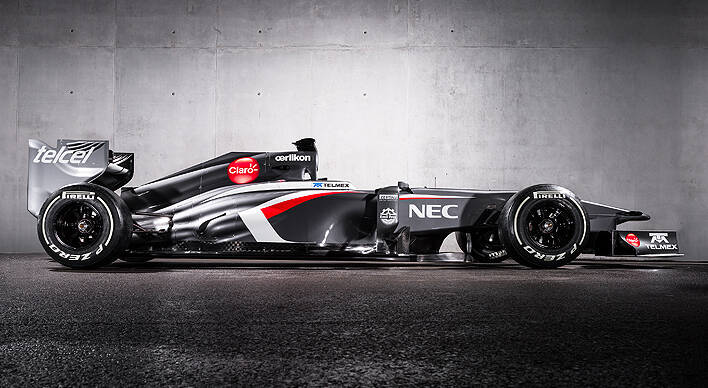
The Sauber C33 is a Formula One racing car designed by Sauber to compete in the 2014 Formula One season. It was driven by Esteban Gutiérrez and Adrian Sutil, who joined the team after Nico Hülkenberg returned to Force India. The C33 was designed to use Ferrari's new 1.6-litre V6 turbocharged engine, the 059/3.
The chassis was designed by Eric Gandelin, Ben Waterhouse and Willem Toet with the car being powered with a customer Ferrari powertrain.
The car was plagued by weight issues early in the season, to the point that, to compensate for this, a tall Sutil (who, relatively speaking, was one of the heaviest drivers in the field) did not eat for two days in a desperate attempt to remain competitive.
Ultimately, the C33 had the unfortunate distinction of being the least competitive Sauber ever built, as Sauber failed to score points for the first time in their history in 2014. In addition, due to the financial status of the team, both drivers were dropped at the end of the season to make way for a new line up of Marcus Ericsson and Felipe Nasr.

Esteban Gutiérrez
Adrian Sutil
c34


2015
The Sauber C34 is a Formula One racing car which Sauber used to compete in the 2015 Formula One season. The C34 was driven by Marcus Ericsson and Felipe Nasr.
The car was launched online on 30 January 2015 on the team's website, and it proved to be a vast improvement over the C33. In the opening round of the season, in Australia, the Saubers qualified in eleventh and sixteenth places, with rookie Felipe Nasr ahead of his teammate Marcus Ericsson. They ended, respectively, in fifth and eighth positions.
At the Singapore Grand Prix, Sauber introduced a new aerodynamic package. The most immediate difference can be found in the shorter nose, quite similar in the shape with the ones of the Williams cars, Red Bulls and McLarens. The car also showed new front and rear wings and a slimmer bodywork; thanks to these upgrades – and the high rate of retirements – Nasr was able to finish in tenth position.
In the last six races, Sauber managed to collect 10 points from a sixth and a ninth place – both results achieved by Nasr – ending the season with a tally of 36 points and 8th place in the World Constructors' Championship.

Marcus Ericsson
Felipe Nasr
c35


2016
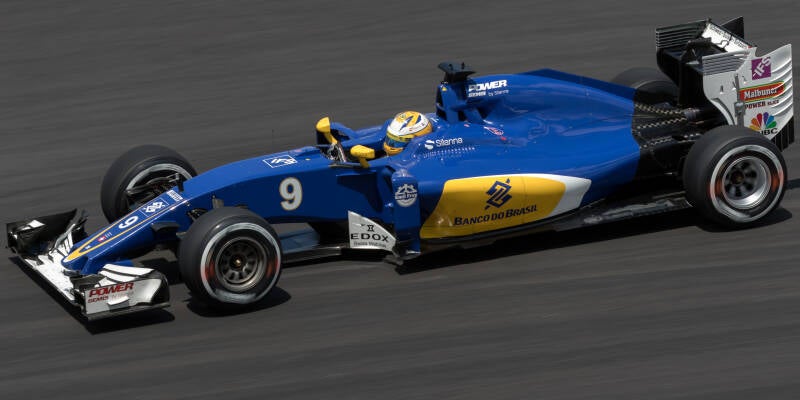
The Sauber C35 is a Formula One racing car designed by Sauber to compete in the 2016 Formula One season. The car was driven by Marcus Ericsson and Felipe Nasr, and used the Ferrari 061 power unit.
The chassis was designed by Mark Smith, Eric Gandelin, Elliot Dason-Barber and Seamus Mullarkey with the car being powered with a customer Ferrari powertrain.
During the first half of the season, the car proved to be less competitive compared to its predecessor due to less development over winter, caused by financial problems of the team.
The team scored its only points of the season during the dramatic Brazilian Grand Prix in very wet conditions. The team also overtook their nearest rivals, Manor, in the constructors' championship when Felipe Nasr crossed the line in 9th, which was enough to give them 10th place in the constructors' championship.
This was the second and final year for Banco do Brasil sponsorship, prior to Nasr leaving the team.

Marcus Ericsson
Felipe Nasr
c36


2017
The Sauber C36 is a Formula One racing car designed and constructed by Sauber to compete in the 2017 Formula One World Championship. The car was driven by Marcus Ericsson and Pascal Wehrlein, who joined the team from Manor Racing to replace outgoing Felipe Nasr.
Intended to be Sauber's last Ferrari powered car before joining Honda as a factory team, the C36 is one of the few cars of F1's turbo hybrid era to have been powered by a year-old power unit. This deal was eventually terminated by Sauber during the 2017 season when team principal Monisha Kaltenborn was replaced by new team owners Longbow Finance. The lowly finishing position, combined with years of financial neglect, led to the team's takeover by Finn Rausing, a Swedish billionaire and owner of Longbow Finance.
Wehrlein achieved each of the car's five points, a score which relegated the team to a tenth place finish in the World Constructors Championship for a second consecutive season.
The C36 was not a points contender for the rest of the season, achieving notability only for a strange crash between Wehrlein and Jenson Button at Portier corner at the Monaco Grand Prix. Later in the season at the Malaysian Grand Prix, the C36 fielded Ferrari Academy driver Charles Leclerc in Free Practice 1.

Marcus Ericsson
Antonio Giovinazzi
Pascal Wehrleini
partnership with alfa romeo (2018)
In April 2017, it was confirmed Sauber would end their engine deal with Ferrari and begin a new contract with Honda. However, on 27 July 2017, it was announced that Sauber had cancelled their planned partnership with Honda for 2018 onwards for "strategic reasons". The following day Sauber confirmed their new multi-year agreement with Ferrari for up-to-date engines starting in 2018. On 29 November 2017, Sauber announced that they had signed a multi-year technical and commercial partnership contract with Alfa Romeo, therefore the team was renamed to Alfa Romeo Sauber F1 Team for the 2018 season onwards
c37
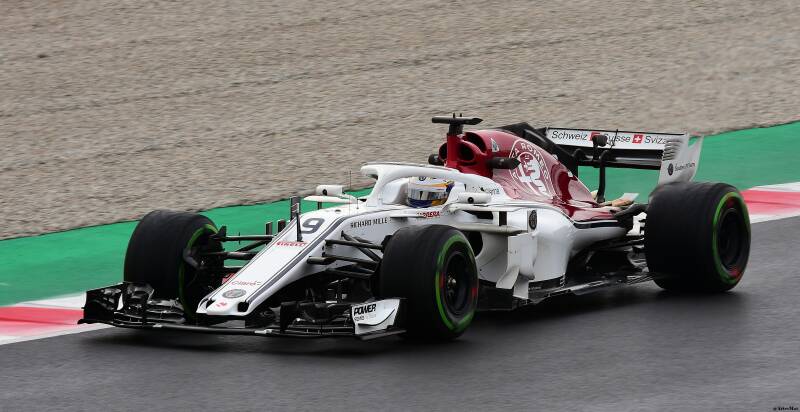


2018
The Sauber C37 is a Formula One racing car designed and constructed by Sauber to compete during the 2018 FIA Formula One World Championship. The car was driven by Marcus Ericsson and reigning Formula 2 champion Charles Leclerc, who replaced Pascal Wehrlein. The C37 made its competitive début at the 2018 Australian Grand Prix and uses a 2018-specification Ferrari engine. This was the last car to be raced under the Sauber name until 2024 as they were renamed as Alfa Romeo for the 2019 season, although the team's structure remained unchanged.
The chassis was designed by Jörg Zander, Luca Furbatto, Ian Wright and Nicolas Hennel with the car being powered with a customer Ferrari powertrain.
The car was originally intended to use an engine supplied by Honda until the team underwent a reorganisation of its management structure and the agreement was abandoned. After using year-old Ferrari engines in 2017, Sauber renegotiated with Ferrari and secured current-specification engines as part of an agreement with sister marque Alfa Romeo.
Sauber finished the season in eighth in the Constructors' Championship with 48 points. Their best finish in 2018 was sixth place courtesy of Leclerc at the Azerbaijan Grand Prix.

Marcus Ericsson
Charles Leclerc
alfa romeo racing/F1 team (2019–2023)
On 1 February 2019, following the multi-year sponsorship agreement established in 2018, Sauber announced that the team would rename to Alfa Romeo Racing, while the ownership, Swiss racing licence, and management structure would remain unchanged. Alfa Romeo itself had no technical involvement with the team – which continued using customer Ferrari power units – with Sauber describing its relationship with the automaker as a "commercial partnership". Other sponsors for the season included Shell, Singha, Axitea, Carrera, and Huski Chocolate.
c38

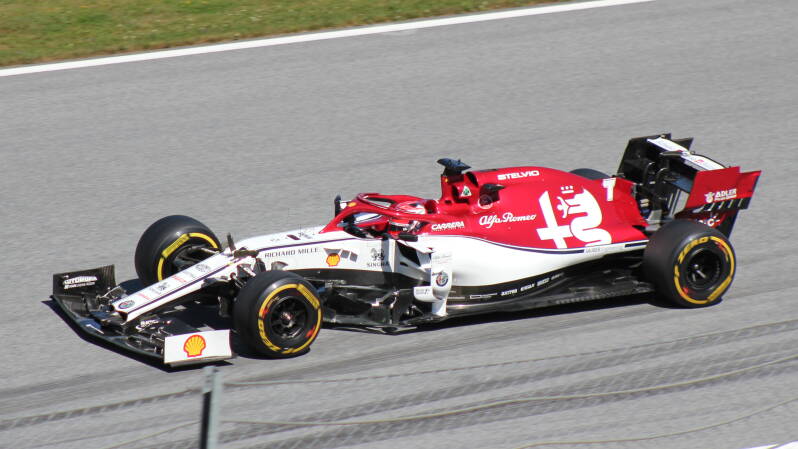

2019
The Alfa Romeo Racing C38 (originally known as the Sauber C38) is a Formula One racing car designed and constructed by Alfa Romeo Racing to compete during the 2019 Formula One World Championship. It is the first Sauber-engineered car to be badged Alfa Romeo following a team renaming deal struck with Sauber Motorsport AG in February 2019. It was Alfa Romeo's first season as a F1 team since 1985. The car was driven by Kimi Räikkönen and Antonio Giovinazzi. The car finished 8th in the Constructors' Championship with 57 points, 43 for Räikkönen and 14 for Giovinazzi.
The chassis was designed by Simone Resta, Luca Furbatto, Ian Wright, Jan Monchaux and Nicolas Hennel with the car being powered with a customer Ferrari powertrain.
The C38's engine is a 1600cc V6 engine, with a single turbocharger. The Energy Recovery System (ERS) is accumulated into a battery pack and deployed via a 120 kW electric motor. The C38 has an 8-speed gearbox, 6-piston Brembo brake callipers, and carbon-composite discs and pads from Carbon Industries. The chassis is a carbon-composite monocoque.

Kimi Räikkönen
Antonio Giovinazzi
c39


2020
The car was planned to make its competitive debut at the 2020 Australian Grand Prix, but this was delayed when the race was cancelled and the next three events in Bahrain, Vietnam and China were postponed in response to the COVID-19 pandemic. The C39 made its debut at the 2020 Austrian Grand Prix.
The chassis was designed by Jan Monchaux, Luca Furbatto, Lucia Conconi, Alessandro Cinelli and Nicolas Hennel with the car being powered with a customer Ferrari powertrain. Following a controversial FIA investigation into Ferrari's 2019 power unit, the 2020 specification suffered a massive drop in horsepower. This severely penalized Sauber's straight-line speed.
Despite the severe power deficit, both drivers maximized chaos during unpredictable races to snatch low-tier points finishes. The team ultimately scraped together 8 points to finish 8th in the Constructors' Championship (with Räikkönen and Giovinazzi scoring 4 points each).

Kimi Räikkönen
Antonio Giovinazzi
c41


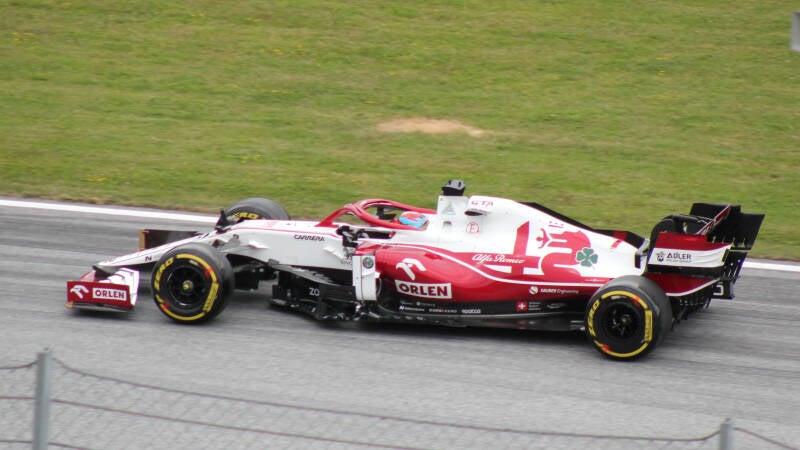
2021
The car is an evolution of its predecessor, the C39. Development of the C40, Alfa's next-generation car, had already begun before the new regulations were pushed to 2022; the designation was retained, with the 2021 car adopting the C41 designation.
Reserve driver Robert Kubica filled in at the Dutch and Italian Grands Prix after Räikkönen tested positive for COVID-19.
2020 cars were carried over into the 2021 season as a cost-savings measure due to the ongoing COVID-19 pandemic. To allow development, the FIA introduced a token system allowing teams to develop only certain areas of their cars. Alfa Romeo spent their tokens on improving the nose of the car, adopting a slimmer design to redirect air over the bargeboards.
While the C41 was vastly more competitive and consistently closer to the midfield than the 2020 car, converting that pace into top-10 finishes proved difficult. The team ultimately finished 9th in the Constructors' Championship with 13 points.

Kimi Räikkönen
Robert Kubica
Antonio Giovinazzi
c42

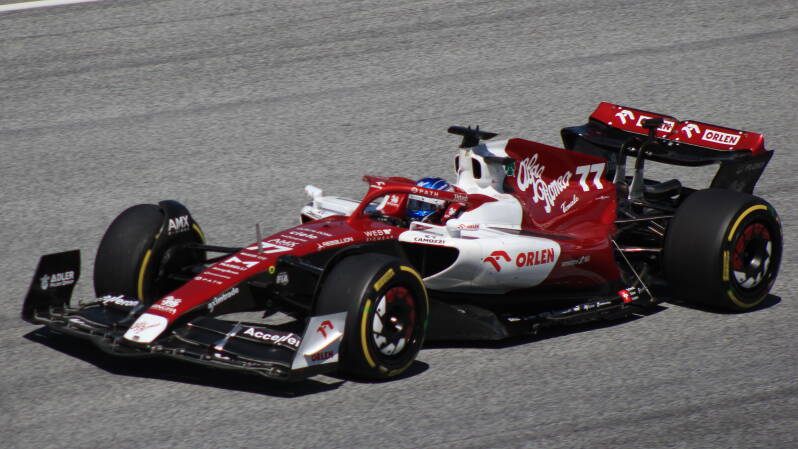
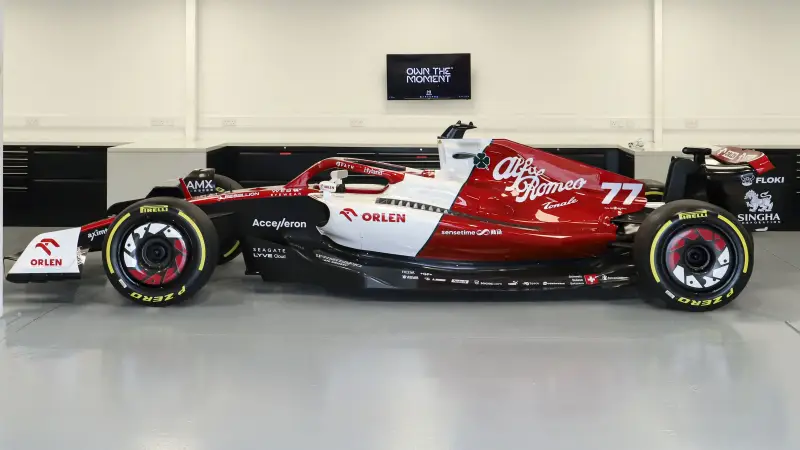
2022
The Alfa Romeo C42 is a Formula One car designed and built by Alfa Romeo to compete in the 2022 Formula One World Championship. The C42 is built to the new generation of technical regulations, originally intended for introduction in 2021.
The car was driven by former Mercedes driver Valtteri Bottas and rookie Zhou Guanyu.
The C42 follows the C41, which in turn follows the C39. The new-generation car had been internally allocated the designation C40 in anticipation of new regulations for the 2021 season. When these were delayed because of the COVID-19 pandemic, a new car, the C41, had to be developed based on the C39 for the interim regulations. However, ahead of the car's unveiling, Alfa Romeo stated that the car would not carry the C40 but instead carry the C42 designation to avoid the sequence of C39, C41, C40, which could have been confusing.
The C42 was the only car to weigh less than the original minimum weight requirement of 795 kg. Several other teams lobbied the FIA to increase the minimum weight, with a compromise reached to raise the minimum weight limit to 798 kg.
Alfa Romeo finished P7 in the constructors' championship, but ultimately claimed P6 for the first time since 2012 (when the team was competing as Sauber).

Zhou Guanyu
Valtteri Bottas
c43
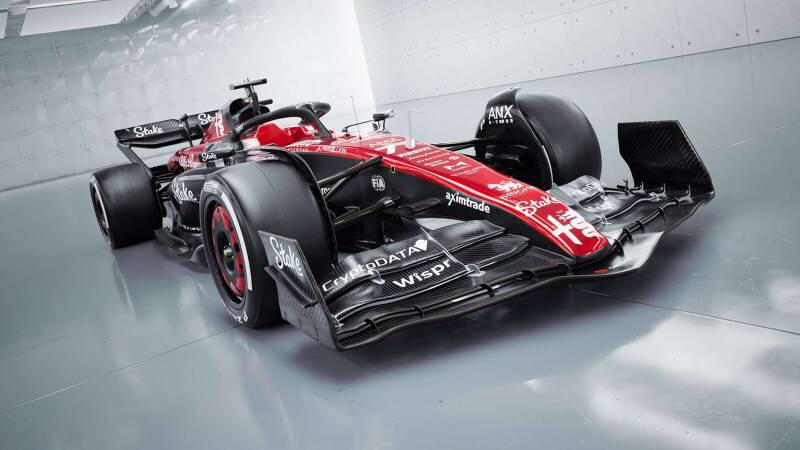

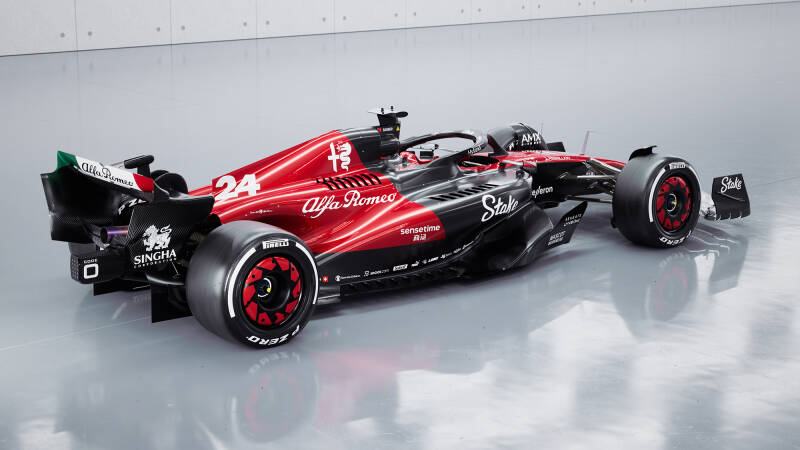
2023
On 26 August 2022, Alfa Romeo announced that they would leave Formula One at the end of 2023, ending their partnership with Sauber, making the C43 the last Sauber-engineered car to be badged as an Alfa Romeo. On 20 January 2023, it was announced that the C43 would be launched on 7 February.
The car donned a new red-and-black livery, representing the departure of the previous year's title sponsor (Orlen Unipetrol) and the entry of global digital casino Stake.com taking said role.
The Alfa Romeo C43 was an evolutionary design overseen by Technical Director Jan Monchaux. It aimed to correct the reliability issues and rear-end instabilities of its predecessor, the C42. Following the trend pioneered by Red Bull Racing, the C43 moved to heavily undercut sidepods with an aggressive "waterslide" ramp profile.
The 2023 championship proved to be a difficult campaign for the Hinwil squad, characterized by a highly competitive midfield where margins were razor-thin. The team finished 9th overall with 16 points.

Zhou Guanyu
Valtteri Bottas
kick sauber (2024–2025)
Sauber officially lost its Alfa Romeo sponsorship due to transitioning to the Audi factory team from 2026 onwards. Due to this, Sauber's links with Ferrari became weaker, with the Haas team effectively assuming Sauber's role as Ferrari's new satellite team. Sauber entered as Stake F1 Team Kick Sauber (but operated as Stake F1 Team on a day-to-day basis), continuing the sponsorship deals signed by Alfa Romeo with Stake and Kick in the previous season. In countries where gambling advertisement is disallowed, the team competed as Kick Sauber F1 Team and replaced all Stake logos on their car with Kick logos, just as they had done in 2023. Kick also acquired the naming rights of the chassis for two seasons, with the 2024 car named as Kick Sauber C44.
c44

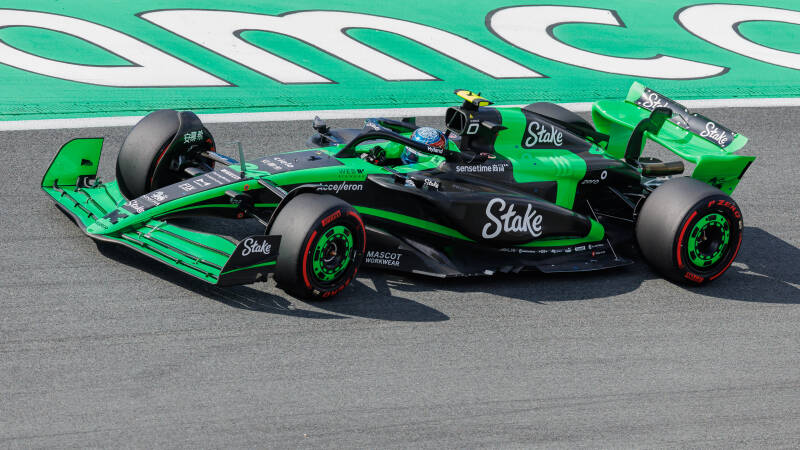
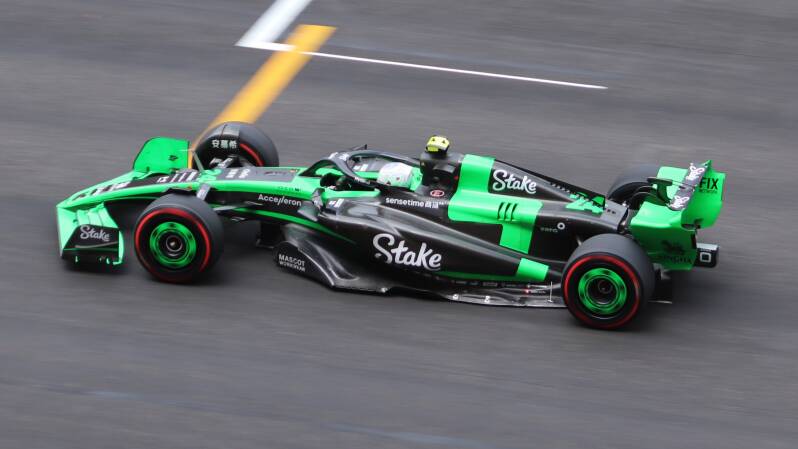
2024
The Kick Sauber C44 is a Formula One car designed and constructed by Stake F1 Team Kick Sauber to compete in the 2024 Formula One World Championship. The car was driven by Valtteri Bottas and Zhou Guanyu, both in their third and final year with the team. The C44 was the first chassis to re-inherit the Sauber name after the team's naming rights partnership with Alfa Romeo ended. While substantially different than the Alfa Romeo C43, the car experienced poor reliability and regressed during the season after upgrades repeatedly failed to address fundamental issues.
The C44 was the first Sauber design to be led by James Key, who reunited with then-CEO Andreas Seidl after his dismissal from McLaren. He inherited a design started by longtime Sauber designer Jan Monchaux, who was replaced by Key in August of 2023.
The C44 relegated Sauber to a last place finish in the World Constructor's Championship for the first time since 2017, scoring four total points in the penultimate race of the season at the Qatar Grand Prix.

Zhou Guanyu
Valtteri Bottas
c45


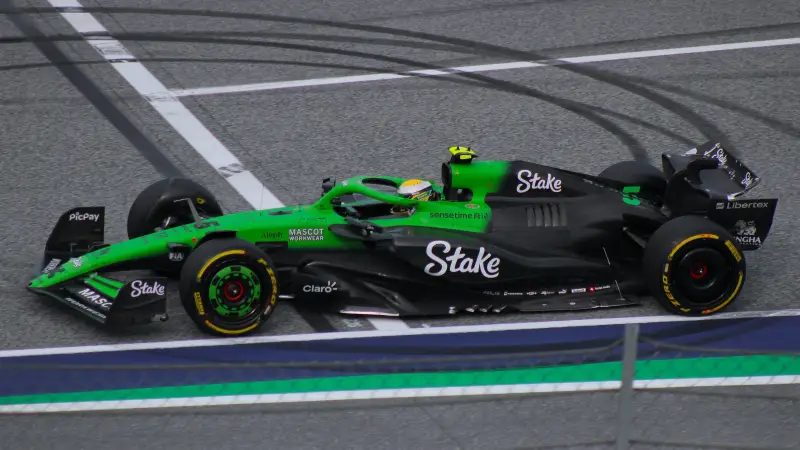
2025
The Kick Sauber C45 is a Formula One car designed and constructed by Stake F1 Team Kick Sauber to compete in the 2025 Formula One World Championship. It was driven by Gabriel Bortoleto and Nico Hülkenberg in the team's final year before becoming the Audi factory team in 2026.
Designed as an evolution of the Kick Sauber C44, a series of successive upgrades starting at the Spanish Grand Prix significantly increased the team's competitiveness. After scoring three consecutive points finishes, Hülkenberg achieved the team's first podium since 2012 at the 2025 British Grand Prix. The C45 achieved more points in its first race than its predecessor scored throughout the entire 2024 season.
During the Great Britain mixed-condition race with heavy rain, Hülkenberg held off Lewis Hamilton in the final stages to finish on the podium in third position. This result was his maiden podium after 239 Formula 1 starts, ending the longest historical streak of race starts without a podium finish. This was also the team's first podium in thirteen years, ending a drought dating back to the 2012 Japanese Grand Prix.

Gabriel Bortoleto
Nico Hülkenberg
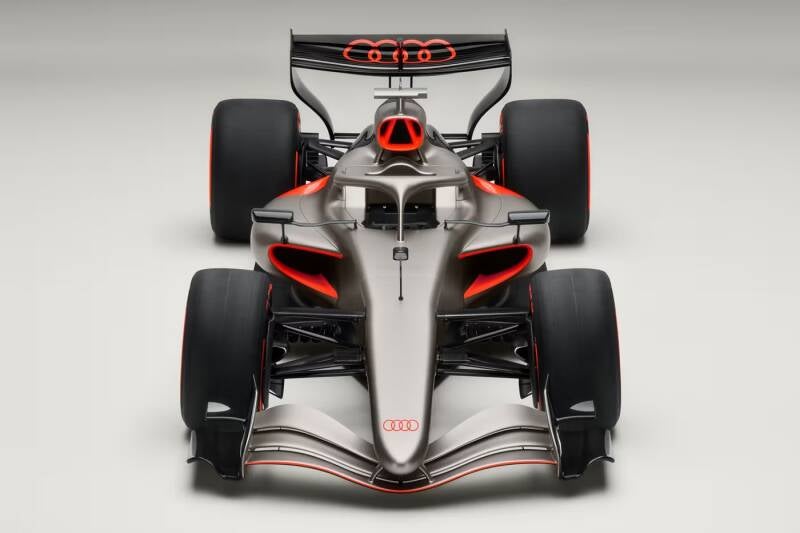
audi factory team (2026–)
On 26 October 2022, it was announced that Sauber will compete as the Audi factory team from 2026 and will use Audi's power unit, thus ended a sixteen-year customer engine relationship with Ferrari since the 2010 season.
In January 2023, Audi announced the acquisition of a minority stake in the Sauber Group. On 8 March 2024, the Audi Group confirmed a full takeover of Sauber. Former McLaren team principal Andreas Seidl was planned to continue as CEO, additionally taking over the role of team principal from Alessandro Alunni Bravi. However, he was replaced by former Ferrari team principal Mattia Binotto starting from 1 August 2024. Red Bull sporting director Jonathan Wheatley was expected to join in the summer of 2025, having left Red Bull at the end of 2024 and having planned to go on gardening leave in the start of 2025. However, he joined earlier on 1 April 2025 following a deal struck for his earlier release to Sauber.
Prior to World War II, Audi's predecessor Auto Union contested Grand Prix motor racing from 1935 to 1939.
Audi debuted at the season-opening Australian Grand Prix in 2026 with the R26, designed for new chassis and power unit regulations. Gabriel Bortoleto and Nico Hülkenberg qualified 10th and 11th respectively. Bortoleto finished the race in 9th place, scoring Audi's first ever points in Formula One.



Create Your Own Website With JouwWeb