


Minardi was an Italian automobile racing team and constructor founded in Faenza in 1979 by Giancarlo Minardi. It competed in the Formula One World Championship from 1985 until 2005 with little success, nevertheless acquiring a loyal following of fans. In 2001, to save the team from folding, Minardi sold it to Australian businessman Paul Stoddart, who ran the team for five years before selling it on to Red Bull GmbH in 2005 who renamed it Scuderia Toro Rosso. Initially called "M" (short for Minardi) then a number, from 2001, all of Minardi chassis were called "PS", the PS being the initials of team owner, Paul Stoddart.

In the 21 seasons, Minardi entered 37 drivers. Thirteen had Italian nationality (nine of whom raced during the time the team was owned by Giancarlo Minardi), the others came with 13 different nationalities (discounting Doornbos racing under a Monaco license in 2005). Martini holds the record for more starts with the team with 103 Grands Prix, followed by Gianni Morbidelli and Marc Gené with 33 starts.
Before Minardi's demise, the team was particularly well-liked within Formula One circles for its friendliness, accessibility, and lack of corporate culture. On the track, their cars were regarded by many as well-designed for their tiny budget, their low position recognised as a result of a lack of funds (and engine power) rather than a poor car. They also resisted employing pay-drivers more than most other financially constrained teams. Former Minardi drivers include double World Champion Fernando Alonso, Grand Prix winners Alessandro Nannini, Giancarlo Fisichella, Jarno Trulli and Mark Webber; CART IndyCar World Series double champion Alessandro Zanardi and race winners Justin Wilson and Christian Fittipaldi; and 24 Hours of Le Mans overall winners Michele Alboreto, Pierluigi Martini, and Marc Gené.
In the early 1970s, Giancarlo Minardi took over management of the local racing team Scuderia del Passatore. He quickly made his mark, with the team finishing 2nd in the 1972 Italian Formula Italia championship. The next year, Minardi’s driver Giancarlo Martini won the championship.
In the mid-1970s, the team was renamed Scuderia Everest after gaining sponsorship from Italian company Everest. During this period, Minardi oversaw a succession of talented drivers including Elio De Angelis, Clay Regazzoni, and Michele Alboreto.
By 1980, the Everest sponsorship had ended. However, Giancarlo Minardi decided to continue on his own under a new guise – the Minardi F1 Team was born.
gm75


The Minardi family has a longstanding involvement in motorsport. Giancarlo Minardi's grandfather had a Fiat dealership in Faenza since 1927, while his father, Giovanni Minardi, competed in his own cars in the late 1940s.
The first Minardi car ever was the GM75 built by Giovanni Minardi: it had a 6 cylinder engine designed by Oberdan Golfieri and built by Antonio Lotti. Rino Ferniani drove it at the Circuito del Garda, retiring when he was leading the race.
minardi formula one (1985–1993)
During 1984, Minardi took the decision to enter Formula One the following year. Caliri designed the M184, the team's prototype Formula One car (intended as a dual purpose design for the new Formula 3000) around Alfa Romeo's V8 turbocharged engine but when engineer Carlo Chiti left Alfa Romeo to found Motori Moderni, Minardi became the only customer for his new V6 engine design. The engine was not ready for the start of the 1985 season, so the team converted their M185 chassis to accept a Cosworth DFV engine for the first two races. The single car team was unsuccessful in its first year, scoring no points. The new engine was underpowered and driver Pierluigi Martini finished only two races, although he was also classified 11th at the German Grand Prix despite stopping with engine problems. Martini's best position was 8th in the 1985 Australian Grand Prix, behind Huub Rothengatter in an Osella.
m185


1985
The Minardi M185 was a Formula One car, designed by Giacomo Caliri and used by Minardi for use in the 1985 season. It was an unreliable car and only finished three races and did not score any points for the team.
The M185 was updated by Caliri for the 1986 season and was designated the Minardi M185B. A major change, to comply with new regulations, was a reduction in the size of the fuel tank, from the 220-litre tank of 1985 to 195-litres. The front track was also reduced fractionally.
On board was a Motori Moderni 1499 cc , 90° V6, turbo engine.

Andrea de Cesaris
Alessandro Nannini
Pierluigi Martini
m186


1986
The Minardi M186 was a Formula One car, designed for Minardi by Giacomo Caliri for use in the 1986 season. Introduced partway through the year and driven by Andrea de Cesaris, it was an unreliable car and only finished one race.
Designed by Giacomo Caliri, only one example of the M186 was built for the Minardi team. It had a carbon fibre monocoque and was powered by the Motori Moderni V6 engine, which had been used in the M186's predecessor, the Minardi M185B.
The M186 was introduced partway through the 1986 Formula One season, at the Hungarian Grand Prix.
The M186 retained the black and yellow colour scheme from the previous season. The main sponsors were the footwear brand Simod and fashion company Gilmar, both from Italy.

Andrea de Cesaris
Alessandro Nannini
m187
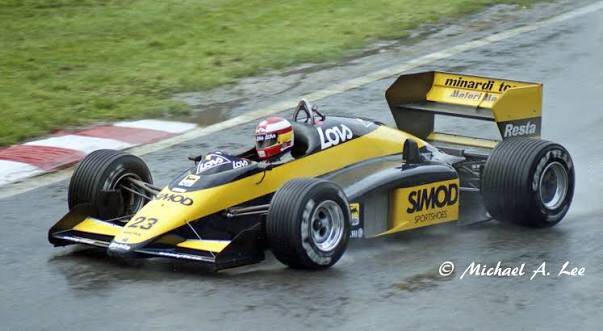


1987
The Minardi M187 was a Formula One car designed by Giacomo Caliri built by Minardi for the 1987 Formula One season. The car was driven by Spanish driver Adrian Campos and Italian Alessandro Nannini. Using the M187, Minardi scored no points during the course of the season.
Nannini was consistently better performed than both the car and the overweight, underpowered (800 bhp) Motori Moderni V6 turbo. He was let down by the car and finished only three races during the season.
The M187 was the last Minardi to use the Motori Moderni engine. The team's replacement car for 1988, the Minardi M188, would use the naturally aspirated customer Ford-Cosworth DFZ V8 engine.
The M187 retained the black and yellow colour scheme from the previous seasons, with sponsorship from Simod. The signing of Campos as a driver also brought sponsorship from the Spanish jeans company Lois.

Adrian Campos
Alessandro Nannini
m188


1988
The Minardi M188 was a Formula One car designed by Giacomo Caliri and Aldo Costa built by Minardi for the 1988 Formula One season. The car was driven by Spanish driver Adrian Campos, Italian Pierluigi Martini, and Spanish driver Luis Pérez-Sala.
In 1988, ahead of the ban in turbo engines for the 1989 season, Minardi changed their engine from the Motori Moderni V6 turbo to the normally aspirated Cosworth DFZ. In early 1989, the team briefly tested the Carlo Chiti-designed boxer 12-cylinder Subaru 1235 engine in a modified M188 but it was rejected due to low power and excessive weight.
An upgraded version of the car, dubbed the M188B was used for the first three races of the 1989 season.

Adrian Campos
Luis Pérez-Sala
Pierluigi Martini
m189


1989
The Minardi M189 was a Formula One car, designed for Minardi by Nigel Cowperthwaite for use in the 1989 FIA Formula One World Championship. Introduced partway through the year and driven by Pierluigi Martini and Luis Perez-Sala, it scored several points finishes for the team. Updated as the M189B for the 1990 season, it was used for the first two races of the year before being replaced by the Minardi M190.
Running on Pirelli tyres, it was powered by a Ford Cosworth DFR V8, the upgrade of engine that had been used the previous season in the Minardi M188. Minardi finished the year with six points for 11th in the Constructor's Championship, while Martini was equal 14th, alongside Johnny Herbert, in the Driver's Championship with five points.
When the 1990 season began, Minardi's new car was still being completed so the M189 was updated to an M189B spec and pressed into service for the first two races of the year.

Pierluigi Martini
Luis Perez-Sala
Paolo Barilla
m190


1990
The Minardi M190 was a Formula One car designed by Aldo Costa and Tomasso Carletti and built by Minardi for the 1990 Formula One season. The car was powered by the Cosworth DFR V8 engine and ran on Pirelli tyres. It failed to score any points for Minardi.
The Minardi M190 was the last Faenza-based Formula One car to run on Pirelli tyres until Toro Rosso STR6 in 2011.
Minardi had used the M189 for the first two races of the season but without finishing in the points, before the M190 debuted in the third race of the season, the San Marino Grand Prix. The M190 did not score any points for Minardi in the Constructors' Championship. Its best result was Martini's 8th place at Japan.
The M190 kept its yellow, black and white diagonal striped livery from 1989. The departure of Luis Pérez-Sala also meant Lois left as the main sponsor, after three seasons, being replaced by Italian woodwoorking company SCM Group.

Pierluigi Martini
Paolo Barilla
Gianni Morbidelli
m191


1991
The Minardi M191 was a Formula One car designed by Aldo Costa and Rene Hilhorst and built by Minardi for the 1991 Formula One season. The car was powered by the Ferrari V12 engine and ran on Goodyear tyres. Its best finish in a race was 4th (twice).
The Minardi M191 was the last Faenza-based Formula One car to run on Ferrari engines until the Toro Rosso STR2 in 2007.
For the 1991 season, team owner Giancarlo Minardi arranged a supply of Ferrari V12 engines to replace the Cosworth V8s that it had used since 1988. However, the new engines, designated 036, were actually those used by Ferrari during the 1989 season and had not received any further development. Later in the season, Minardi received 037 specification engines, which were those from Ferrari's 1990 car.
The team used an updated M191, designated the M191B, for the first four races of the 1992 season before it was replaced by the Minardi M192.

Pierluigi Martini
Christian Fittipaldi
Roberto Moreno
Gianni Morbidelli
m192
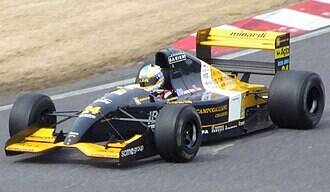


1992
The Minardi M192 was a Formula One car designed by Aldo Costa and built by the Minardi team for the 1992 Formula One season. The car was powered by the Lamborghini V12 engine and ran on Goodyear tyres.
First raced in the San Marino Grand Prix, the M192's best finish was when Christian Fittipaldi drove it to 6th place at the Japanese Grand Prix. This earned Minardi its first and only point of the season.
Following the 1991 season, in which Minardi scored six points for seventh place in the Constructor's Championship, a number of changes were implemented. In particular, the expensive Ferrari V12s it had used had been replaced with a supply of Lamborghini 3512 V12 engines for 1992. It had a capacity of 3493 cubic centimetres and was rated as having 730 brake horsepower. The capacity of the fuel tank was 220 litres.
For financial reasons, there was limited development through the course of the year. The M192 was noted for suffering understeer.

Christian Fittipaldi
Alessandro Zanardi
Gianni Morbidelli
m193


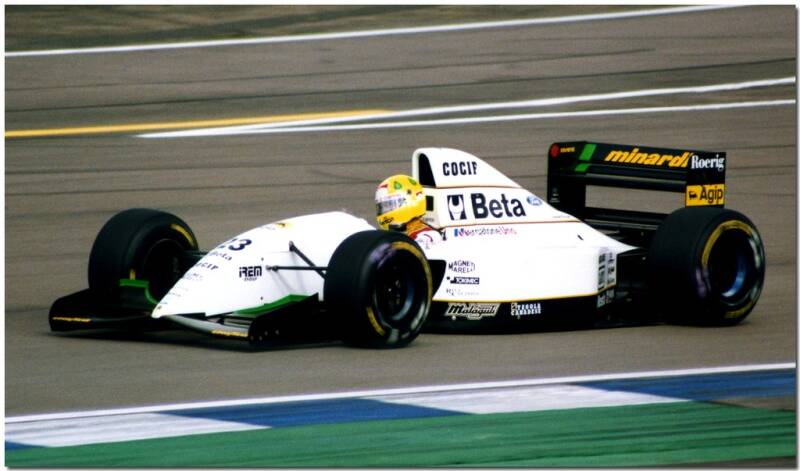
1993
The Minardi M193 was a Formula One car designed by Aldo Costa and Gustav Brunner and built by Minardi for the 1993 Formula One season. Drivers of the car included Christian Fittipaldi (who flipped his car when he collided with teammate Pierluigi Martini at the finish of the Italian Grand Prix), Martini and former Ferrari driver and 5 time grand prix winner Michele Alboreto. Using the M193, Minardi scored 7 points to finish 8th in the 1993 Constructors' Championship.
An updated version of the car, the M193B, was used for the 1994 season, until the 1994 Canadian Grand Prix, when the Minardi M194 was introduced.

Christian Fittipaldi
Jean-Marc Gounon
Fabrizio Barbazza
Pierluigi Martini
Michele Alboreto
minardi, scuderia Italia and fondmetal (1994–2000)
As the number of small teams shrank, Minardi slipped from the mid-field towards the back of the grid. Money woes hit and in 1994 Minardi merged with BMS Scuderia Italia in an effort to survive. Giancarlo Minardi retained 14.5% with the remaining 85.5% distributed between the Scuderia Italia investors (Emilio Gnutti, Giuseppe Lucchini and Vittorio Palazzani) and Defendente Marniga.
In 1994, Martini finished 5th at both the 1994 Spanish Grand Prix and 1994 French Grand Prix, while Michele Alboreto scored his last point in Formula 1 with a 6th place in the 1994 Monaco Grand Prix. Acknowledging that the team was struggling, Bernie Ecclestone spoke to Flavio Briatore, who agreed to buy a share in the team in 1995.
In 1996, Italian businessman Gabriele Rumi, former owner of the Fondmetal team switched his sponsorship support from Tyrrell to Minardi. He gradually increased his interest in the Faenza outfit, becoming co-owner and chairman. In 1997, Minardi teamed up with engine manufacturer Brian Hart.
For the 2000 season the team were forced to use 1998-spec Ford Zetec-R V10 engines, which were rebadged as Fondmetal engines in deference to his financial input. However, Rumi's poor health forced him to withdraw his backing at the end of the season.
m194

1994


The Minardi M194 was a Formula One car designed by Aldo Costa and Gustav Brunner and built by Minardi for the 1994 season. It was introduced at that year's Canadian Grand Prix to replace the Minardi M193B. The car was again powered by the Ford HBD V8 engine.
Minardi team drivers during 1994 were Pierluigi Martini and former Grand Prix winner Michele Alboreto. The team's test driver was Luca Badoer.
The M194 would only score two points during its 11 races, both when Martini finished in 5th place at the car's second race, the French Grand Prix. The team in fact scored more points in 1994 (3 points) using the M193B than with the M194. The combined 5 point total saw Minardi only finish tenth in the Constructors' Championship.
The M194 was replaced for the 1995 season by the Minardi M195. Alboreto retired and was replaced by test driver Badoer.
The M194 had a blue, orange and white livery, with main sponsorship from Lucchini and Beta Tools.
During the British Grand Prix, the car ran with the words "Italia IN - Ireland OUT", in response to the elimination of Ireland from the 1994 FIFA World Cup and the provocation from Eddie Jordan in the previous race.

Pierluigi Martini
Michele Alboreto
m195/m195b

1995-1996


m195b
The Minardi M195 was a Formula One car designed by Aldo Costa for the Minardi team. The original M195 was used in the 1995 Formula One World Championship while an updated version, the M195B, was used in the 1996 Championship.
The M195 had been designed to fit a Mugen-Honda engine, as Minardi had been expecting to run Mugen-Honda engines during the 1995 season. A last-minute decision from Mugen to supply Ligier left Minardi struggling to adapt their car to take a Ford Motor Company ED engine. Giancarlo Minardi, the team's owner, threatened legal action over the affair. Briatore paid $1 million to Minardi to compensate them for the loss of the Mugen-Honda engines.
The car was upgraded for 1996, with the main visible difference being higher cockpit sides per new rules on driver safety. Pedro Lamy took seat 20; Giancarlo Fisichella, then Tarso Marques, and finally Giovanni Lavaggi took seat 21. The M195B scored no championship points.

Pierluigi Martini
Luca Badoer
Pedro Lamy
Giancarlo Fisichella
Tarso Marques
Giovanni Lavaggi
m197


1997
The Minardi M197 was the car with which the Minardi Formula One team competed in the 1997 Formula One season.
The M197 was developed by Minardi chief engineer Gabriele Tredozi, head of the drawing office Mauro Gennaro, and lead aerodynamicist Mariano Alperin. The M197 was developed heavily at Fondmetal's wind tunnel in Ferrara, Italy. Davide Colombo also joined the aerodynamics team from F3000. Although design and development work had begun in mid-1996, the decision to use Hart V8 engines for 1997 was made late leading to extensive redesign work on the car in preparation for the first Grand Prix.
The M197 featured a return to Minardi's colour scheme of black, yellow and white, used from 1988 to 1992. Fondmetal was one of the major sponsors, along with Mild Seven (brought by Katayama) and Roces.
Minardi used the 'Mild Seven' logos, except at the French, British and German Grands Prix.
The team were unclassified in the Constructors' Championship, with no points. They were classified ahead of the Lola team, who withdrew from the championship after the first Grand Prix.

Ukyo Katayama
Jarno Trulli
Tarso Marques
m198
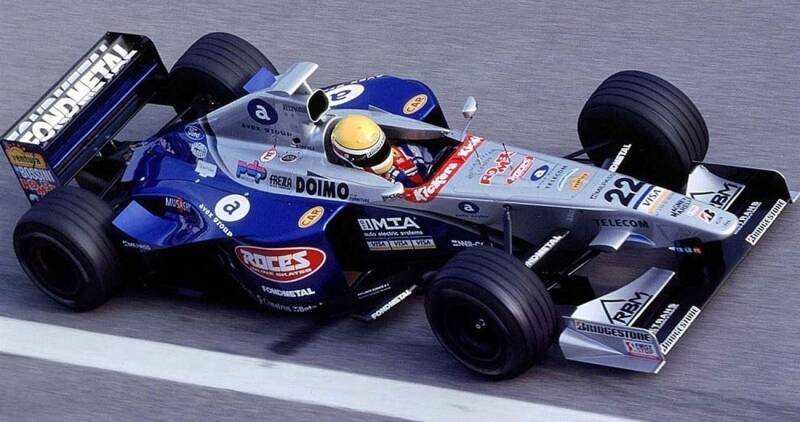


1998
The Minardi M198 was the car with which the Minardi team competed in the 1998 Formula One World Championship. This was the final Minardi car to use the "M1xx" suffix designation.
The M198 featured a Ford powered Cosworth V10 engine, upgrading from the previous seasons Hart V8.
Reliability was an issue with the M198, as were a number of accidents. The car failed to finish 18 times. The highlight of the M198 was Nakano's 7th place finish at the 1998 Canadian Grand Prix. This led Minardi to finish ahead of Tyrrell in the 1998 Constructors' Championship, despite both teams failing to score any points.

Shinji Nakano
Esteban Tuero
m01


1999
The Minardi M01 was the car with which the Minardi Formula One team competed in the 1999 Formula One World Championship. It was driven by Italian Luca Badoer, who had previously driven for the team in 1995, and Spaniard Marc Gené, with Frenchman Stéphane Sarrazin deputising for Badoer at the Brazilian Grand Prix.
The Minardi M01 was developed by Gustav Brunner, formerly of Scuderia Ferrari, and long time chief engineer Gabriele Tredozi. The M01 was a completely new design and featured no parts from any former Minardi cars. The M01 was a pioneer of magnesium transmission casing use. The M01 utilised a Ford VJ series V10 engine, alongside electronics from Magneti Marelli.
The M01 would see Minardi finish in 10th place in the Constructors Championship standings with 1 point, equal with Arrows Grand Prix.

Luca Badoer
Stéphane Sarrazin
Marc Gené
m02


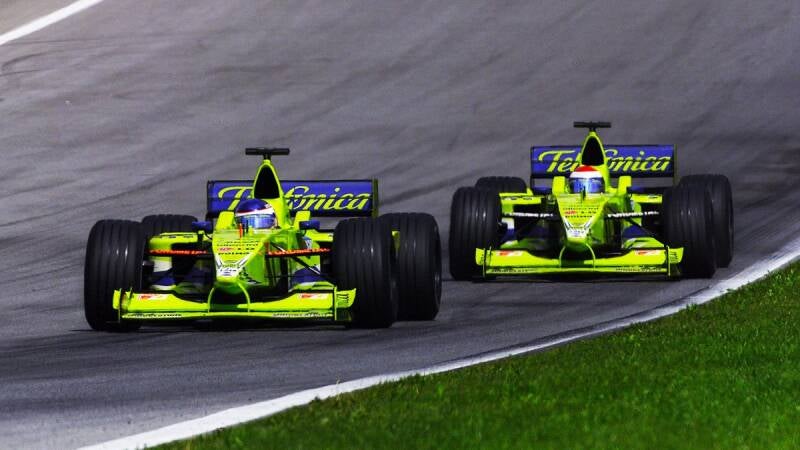
2000
The M02 was designed by Gustav Brunner. The car was a clear development from the M01 featuring new pointed nose cone, compact sides and high exhausts. The M02 developed the titanium cased gearbox from 1999 even further, which helped with weight. The M02 was the first F1 car to adopt set down brake callipers in a seasonal development. The M02 continued using the Ford Cosworth V10 engine which was the same power unit from 1998. It was badged Fondmetal.
The M02 eventually finished a de facto tenth in the Constructors' Championship, with no points but ahead of Prost due to a better finishing record. The team therefore qualified for some of the sport's television revenues in 2001.
For 2000, Minardi had extensive financial backing from Telefonica, which became the title sponsors for the season. The cars were painted in a bold fluorescent yellow finish to reference the partnership.

Marc Gené
Gastón Mazzacane
european minardi (2001–2005)
The team, now near collapse, was purchased by Australian businessman Paul Stoddart in early 2001, merging it with his European Racing Formula 3000 team. That season saw Fernando Alonso make his F1 debut for the team at the age of 19; though he (and the team) failed to score any points that year, his performance was impressive enough that the reborn Renault F1 team signed him for 2002.
During the season the team used Asiatech branded engines (formerly Peugeot), the rest of the season did not yield any further points for the team. The team finished above the newly debuted Toyota factory team who arguably had a much more sizable budget for the debut campaign than Minardi's budgets over several seasons combined. Minardi also finished ahead of the Arrows team who went bankrupt halfway through the season due to mounting debts and several mounting court cases against them.
From 2003 until their final season in 2005, Minardi used Ford Cosworth/Cosworth branded engines due to Asiatech folding at the end of the previous season. The Cosworth engines though not very reliable did help Minardi to some decent points scoring positions now and again.
ps01


2001
The Minardi PS01 (originally known as Minardi M03 and unofficially known as European Minardi PS01) was the car with which the Minardi team competed in the 2001 Formula One World Championship. It was initially driven by Brazilian Tarso Marques, who returned to the team after last driving an F1 car in 1997, and Fernando Alonso, a Spanish rookie who had graduated from Formula 3000 and was in a long-term contract to Flavio Briatore's driver management scheme.
The car was a tidy, efficient design by Gustav Brunner, but it was hamstrung by a lack of testing and horsepower from an elderly engine (which was badged "European", after Stoddart's aviation company).
The team also raced an updated car, featuring a revised rear end and gearbox, from the Belgian GP onwards. This chassis was designated as the Minardi PS01B. Marques first used the B-spec version already in the Hungarian GP.

Fernando Alonso
Alex Yoong
Tarso Marques
ps02
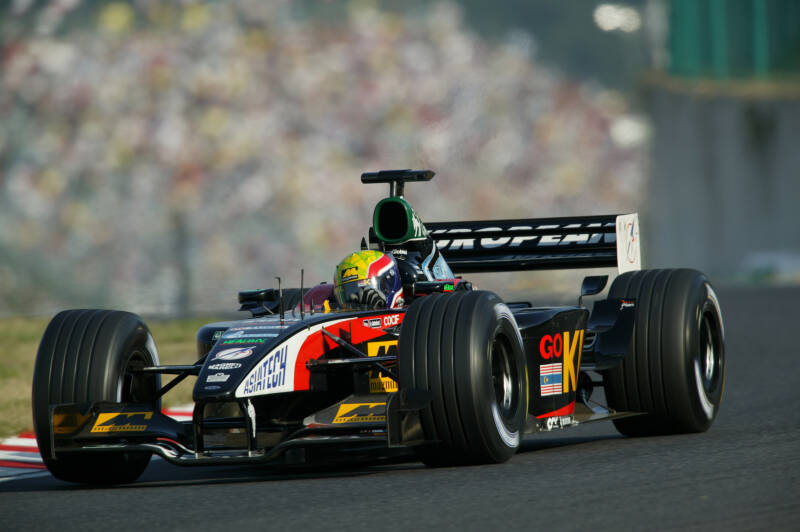
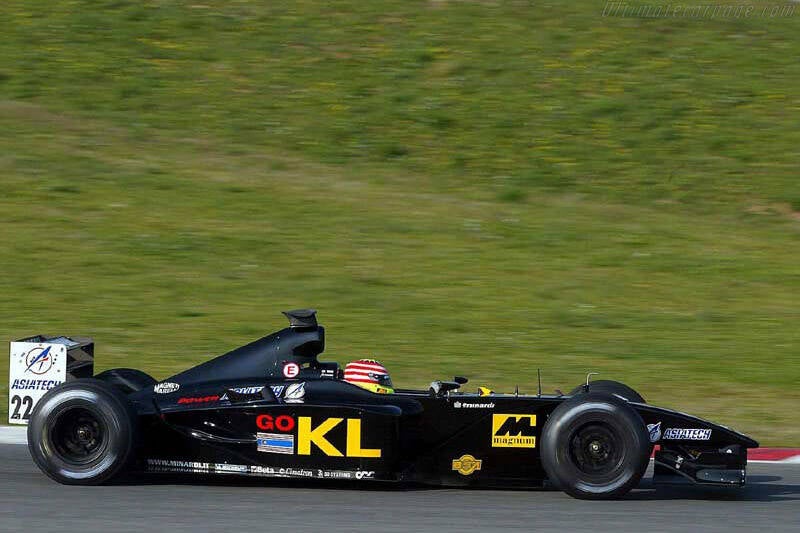

2002
The PS02 was designed by technical director Gabriele Tredozi and chief aerodynamicist Loic Bigois, who had joined the team from the now defunct Prost team. The car was recognised as a significant step forward from the PS01, and the team utilised extensive wind tunnel testing in Italy and the United Kingdom.
The car utilised the Minardi's unique titanium cased gearbox, and changed to a pushrod from pullrod suspension for the first time. The PS02 featured the new Asiatech AT02 V10 engine which would be dropped for the 2003 season in favour of Cosworth. The sidepod area design of the PS02 was quite similar to that of the Arrows A23.
The PS02 suffered from a total of 14 race retirements, of which 4 were related to the Asiatech V10. Additionally, rookie Yoong failed to qualify the car on three occasions, falling foul of the 107% rule.
Minardi finished the season 9th in the Constructors' Championship, equal on points with newly-richest Toyota works team and now defunct Arrows Grand Prix.

Alex Yoong
Anthony Davidson
Mark Webber
ps03


2003
The Minardi PS03 was the car with which the Minardi team competed in the 2003 Formula One World Championship.
Minardi announced that for the 2003 season, veteran Dutch driver Jos Verstappen and rookie Justin Wilson would race for the team, replacing Alex Yoong who went to ChampCar and Mark Webber who joined Jaguar Racing.
Previous engine supplier Asiatech had gone out of business, and discussions with Ferrari to provide engines were ongoing through late 2002. Ultimately, the team went with Cosworth engines as the £15million lease fee for Ferrari engines was too great. The teams supply issues were apparent again, after Michelin stepped away in November 2002 as tyre supplier, with Jos Verstappen arriving to test in Valencia and Minardi had no tyres for the PS03.
In June 2003, owner Stoddart had purchased five Arrows A23 race cars following the teams administration. There was speculation that the cars were of higher quality than the PS03 and they may run in the Minardi colours for 2004.

Justin Wilson
Nicolas Kiesa
Jos Verstappen
ps04

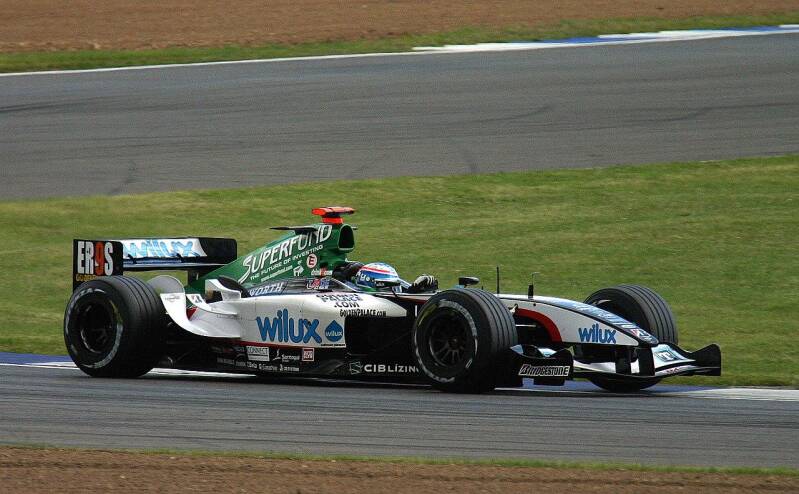

2004
The Minardi PS04B was a Formula One race car used by Minardi Cosworth in the 2004 Formula One season. For 2005 Minardi used a PS04B chassis for the first three races of the season before they made a new PS05 chassis due to assembly problems
In 2003 all of the Arrows A23 chassis and the full Arrows Grand Prix International intellectual property rights were bought by Minardi. The Arrows A23 was renamed the Minardi PS04 and in back-to-back tests it was found superior to the Minardi's PS03. Minardi however decided that they could not run a "pure-Arrows" and hence used the Arrows intellectual property, which included the new designs for a proposed Arrows A24 and the best elements from the PS03 and the Arrows A23/PS04 to develop the Minardi PS04B for the 2004 season.

Gianmaria Bruni
Patrick Friesacher
Zsolt Baumgartner
Christijan Albers
ps05


2005
The Minardi PS05 is a Formula One racing car used by Minardi F1 Team during the 2005 season. It failed to be much of an improvement over its predecessor, as the team finished last in the standings for the third consecutive season. The car was launched on 15 April 2005 at Mugello in Italy.
The PS05 was designed by Gabriele Tredozi and Andrea Rocchetto and was driven by rookies Christijan Albers, Patrick Friesacher (until the British Grand Prix) and Robert Doornbos (from the German Grand Prix onwards). It was the last Formula One car developed by Minardi before the sale of the team, which from 2006 became known as the Red Bull Racing sister team, Scuderia Toro Rosso. It debuted at the San Marino Grand Prix, in the three races beforehand the team used the Minardi PS04B.
The PS05 was Minardi's first completely new car since the PS02.[3] Unlike in the previous two years, the car was designed specifically to be fitted with the Cosworth TJ2005 engine. Team owner Paul Stoddart and founder Gian Carlo Minardi both expected the PS05 to be fighting for positions with the Jordans.
The new Cosworth unit also proved to be much more reliable, as none of the team's retirements were due to engine issues.

Patrick Friesacher
Robert Doornbos
Christijan Albers
red bull purchase
In 2005, Paul Stoddart stated that he would sell Minardi if he could find the right buyer. Stoddart claimed that he had 41 approaches.[11] His criterion for a sale was the ability of a buyer to move the team forward and leave the team based in Faenza. The drinks manufacturer Red Bull GmbH, which already owned another Formula One team, Red Bull Racing, decided to set up a second team to promote drivers who had risen through its young driver programme, Red Bull Driver Search by integrating all Minardi F1 Academy members and resources.
Minardi fans worldwide immediately started an online petition to save the Minardi team name and the team's 20-year heritage in F1 after the news broke. The petition was not successful and the team was renamed Scuderia Toro Rosso for the 2006 season. The greatly increased funding from Red Bull, including the use of the Red Bull chassis, customer Ferrari engines and Red Bull Technology transmissions, gradually led to improved results.
The team was further renamed Scuderia AlphaTauri in 2020 to promote the clothing brand of Red Bull. The team won as AlphaTauri at Monza in 2020, with Pierre Gasly. The team was further renamed again as Visa Cash App RB in 2024.



racing return for minardi
On 1 January 2006, Giancarlo Minardi re-acquired certain rights to use the Minardi name in racing. He also announced that he was licensing the Minardi name to established team GP Racing in the junior Euro Formula 3000 series, to be entitled 'Minardi Team by GP Racing'. The team raced with moderate success, scoring a podium in each leg of the Spa round in June 2006.
For 2007, Minardi Team by GP Racing combined forces with GP2 team Piquet Sports, to form Minardi Piquet Sports. For 2008 the team was known simply as Piquet Sports.
In 2006, Paul Stoddart declared his intention to enter a new team called 'European Minardi F1 Team Ltd' into Formula One beginning in 2008. His application was unsuccessful, with the 12th place on the grid being awarded to Prodrive. Instead, Stoddart turned his attentions to the U.S.-based Champ Car series. On 18 December 2006, it was confirmed that he had purchased a controlling interest in the CTE Racing-HVM Champ Car team and that the team would be renamed Minardi Team USA.
In 2007, the team had reasonable success. Robert Doornbos took two wins and several podium places on his way to third in the series, winning Rookie of the Year honours. When the series folded before its planned 2008 season, Stoddart's involvement ceased, with the team entering the IndyCar Series under the HVM name.
Stoddart retains the right to use the Minardi name for a British-registered company.


Create Your Own Website With JouwWeb