


Jordan Grand Prix was a Formula One constructor that competed from 1991 to 2005. The team was named after Irish businessman and founder Eddie Jordan (1948–2025) and was based at Silverstone, England, but raced with an Irish licence.
In early 2005, the team was sold to Midland Group, who competed for one final season as 'Jordan', before renaming the team as Midland F1 Racing for the 2006 season. Later that same year, it was sold to Dutch car manufacturer, Spyker, to become Spyker F1 for the 2007 season, and then sold again to become Force India in 2008. In 2018, as a result of the financial collapse of the Force India team, and its subsequent buyout by a consortium led by Lawrence Stroll, the team's FIA entry was not transferred, and the Jordan Grand Prix's original entry came to an end. As of 2025 the team competes as the Aston Martin Aramco F1 Team.

Eddie Jordan had a brief stint as a race driver in the late 1970s before founding Eddie Jordan Racing in the early 1980s. The team first came to prominence in the 1983 British Formula Three championship with a duel between one-time Jordan test driver[citation needed] Ayrton Senna and Jordan-Ralt driver Martin Brundle. Brundle was edged out by the Brazilian at the last round of the championship. The team graduated to International Formula 3000 for 1988, winning its first race in the category with Johnny Herbert behind the wheel. In 1989, Jordan won the F3000 drivers' championship with future Formula One star Jean Alesi. The team also ran future F1 drivers such as Martin Donnelly and Eddie Irvine in F3000.
1991
Jordan's success in lower formulae inspired the creation of a Formula One programme for the 1991 season and a change of name to Jordan Grand Prix. The first driver to test a Jordan F1 car was John Watson. Jordan hired Italian veteran Andrea de Cesaris and Belgian Bertrand Gachot to race his first cars, which were powered by Ford. The team had a very solid debut finishing 5th in the Constructors' Championship, with de Cesaris finishing 9th in the Drivers' Championship.
Gachot was sent to prison mid-season for attacking a taxi driver, and was replaced for the Belgian Grand Prix by Michael Schumacher. The team received $150,000 from Mercedes-Benz in return for giving their young German sportscar star experience of Grand Prix racing. Despite Jordan's agreement in principle with Mercedes to retain Schumacher for the remainder of the season, the German driver signed to Benetton-Ford for the following race.
191

1991


The Jordan 191 was a Formula One car designed by Gary Anderson for use by Jordan Grand Prix in its debut season in 1991. Its best finish was in Canada and Mexico, where Andrea de Cesaris drove it to fourth place at both races. Driving the 191 at the 1991 Hungarian Grand Prix, Bertrand Gachot took the fastest lap of the race.
The car had a tidy form with a raised nose and a drooping rear diffuser. Originally designed for the Judd V8, the 191 ended up being powered by a Cosworth-Ford HB V8 engine, Jordan having arranged a customer supply after fortuitously making contact with a senior executive at Cosworth.
On the sponsorship front, after failed negotiations with the cigarette brand Camel that had sponsored Jordan's F3000 team, Jordan signed 7 Up, a soft drink company, as the team's major sponsor. The 7 Up corporate colour was green.
A total of seven 191 chassis were built across the year; one was destroyed in an accident at the British Grand Prix.

Bertrand Gachot
Michael Schumacher
Roberto Moreno
Alessandro Zanardi
Andrea de Cesaris
192

1992


The Jordan 192 was a Formula One car designed by Gary Anderson and used by the Jordan team in the 1992 Formula One World Championship. The number 32 car was driven by Italian Stefano Modena and the number 33 car by Brazilian Maurício Gugelmin, both new to the team.
The design was largely identical to its predecessor with a major difference on its engine cover and front wing.
After a successful debut season in 1991 the team lost their supply of Ford engines due to large debts. Instead Jordan signed a contract to run the Yamaha OX99 3.5L V12, which was supplied for free. One of the problems was that the team had already begun work on the 192 in the expectation that it would continue to run the Ford V8 rather than the much larger Yamaha V12.
Compared to 1991, 1992 was a disastrous season for Jordan. The team struggled badly with reliability issues.
The team did not score a point until the final race of the season in Australia, when Modena finished sixth. With this one point, Jordan placed 11th in the Constructors' Championship.
The 192 was replaced for 1993 by the 193, which was powered by a Hart V10 engine.

Stefano Modena
Maurício Gugelmin
193

1993


The Jordan 193 was the car with which the Jordan team competed in the 1993 Formula One World Championship. The number 14 seat was taken by debutant Rubens Barrichello, while five different drivers occupied the number 15 seat over the course of the season: Ivan Capelli, Thierry Boutsen, Marco Apicella, Emanuele Naspetti and Eddie Irvine.
After a disastrous 1992 season with underpowered and unreliable Yamaha V12 engine, the team took the decision to replace these with Brian Hart's independently built, and smaller V10 engines for 1993. The Hart 1035 engine was rated at around 700 bhp in 1993, and although this was an upgrade on the 660 bhp Yamaha's, it still compared unfavourably to the approximately 780 bhp of the Renault V10's powering the Williams and Ligier's, or the 740 bhp of the Ferrari V12. Though it did put the engine on par with the smaller capacity Ford V8 engines used by Benetton and McLaren (the Cosworth designed and built Ford engines were developments of those previously used by Jordan in their rookie F1 season in 1991).
The team finished equal tenth in the Constructors' Championship with three points.

Rubens Barrichello
Ivan Capelli
Thierry Boutsen
Marco Apicella
Emanuele Naspetti
Eddie Irvine
194


1994
The Jordan 194 was the car with which the Jordan team competed in the 1994 Formula One World Championship.
The engine was a Hart 1035 3.5 V10, a developed version of the engine which had proved promising in 1993. With driver aids such as traction control and active suspension banned for the 1994 season, the car used a conventional semi-automatic gearbox and pushrod double wishbone suspension. The simpler technical regulations of 1994 seemed to benefit Jordan and the 194 recaptured the level of performance seen in the team's debut season, 1991. Indeed, the cut-down airbox and drooping front wing of the 194 recalled the design features of the 191.
At the Italian Grand Prix, Jordan announced an agreement to use factory-supported Peugeot engines in F1 from 1995, meaning the relationship with Hart came to an end.

Rubens Barrichello
Eddie Irvine
Aguri Suzuki
Andrea de Cesaris
195

1995


The Jordan 195 was the Formula One car which the Jordan team competed in the 1995 Formula One World Championship.
The 195 featured a distinctive low nose and highly sculpted sidepods, lending it a very smooth appearance.
When McLaren ended their supply with Peugeot and entered a long term deal for engines from Mercedes, Jordan decided to switch from Hart to Peugeot engines. The engine itself was underpowered and unreliable compared with other competitors.
It achieved Jordan's then best-ever result at the Canadian Grand Prix, when Barrichello and Irvine finished second and third respectively behind Jean Alesi's Ferrari. However, the car was not consistently competitive and suffered numerous reliability problems, and the team ended up in sixth place in the Constructors' Championship.

Rubens Barrichello
Eddie Irvine
196


1996
The Jordan 196 was the car with which the Jordan team competed in the 1996 Formula One World Championship.
Jordan started the year with high expectations following a generally encouraging, if unreliable, showing in 1995. The team was in its second year with works Peugeot engines, and had also secured a lucrative sponsorship deal with Benson & Hedges that saw the cars turn gold for the majority of the 1996 season.
However, the team still proved unable to score the elusive first win. Indeed, 1996 was a barren season with no podium finishes from either driver, although the team did score one more point than in 1995. The team eventually finished fifth in the Constructors' Championship, with 22 points.

Rubens Barrichello
Martin Brundle
197


1997
After a disappointing 1996 season, Eddie Jordan opted to replace Rubens Barrichello and Martin Brundle with two young, inexperienced drivers — German rookie Ralf Schumacher, younger brother of double World Champion Michael Schumacher, and Italy's Giancarlo Fisichella, who had driven eight races for Minardi in 1996.
The car was powered by the 3-litre Peugeot A14 V10 engine and ran on Goodyear tyres. Fuel was supplied by Total.
The 197 stood out with its bright yellow livery featuring a snake mascot, dubbed "Hissing Sid". The car had a snake's eye and fang painted on either side of the nosecone, forked tongues that extended along the sides from the nosecone to the driver's cockpit, and numerous scale effects on other parts of the car.

Ralf Schumacher
Giancarlo Fisichella
198

1998


The Jordan 198 was the Formula One car with which the Jordan team competed in the 1998 Formula One World Championship. It was driven by 1996 World Champion Damon Hill, who had moved from Arrows, and Ralf Schumacher, who was in his second season with the team. Test driver Pedro de la Rosa also drove the Jordan 198 during test sessions in 1998.
The 198 ran promisingly in pre-season testing, however the car struggled in the early part of the season. Damon Hill complained of understeer and the Mugen Honda engine was down on power. After Jordan failed to score a point in the first half of the season, Gary Anderson left the team and Eddie Jordan hired Mike Gascoyne to rework the car. Numerous improvements were made to the 198's suspension, front wing and floor, while Mugen developed the engine. Further tyre development work by Goodyear enabled the team to enjoy a resurgence, scoring points in every race bar one in the second half of the season. The team ultimately finished fourth in the Constructors' Championship with 34 points, four behind Williams in third and one ahead of Benetton in fifth.
For the third consecutive year, Benson & Hedges was the team's main sponsor. The 198 featured a bright yellow "hornet" livery, with a hornet's eye and head painted on the either side of the nosecone; wings and stripes on the side of the car.

Damon Hill
Ralf Schumacher
199


1999
The Jordan 199 was the car with which the Jordan team competed in the 1999 Formula One World Championship. It was designed by technical director Mike Gascoyne and his assistant Tim Holloway.
It proved to be Jordan's most successful car in its fifteen-year history, scoring two wins, a pole position and third place in the Constructors' Championship. Frentzen also had a realistic shot of winning the Drivers' Championship, in what would prove to be his most successful season as well. For Hill the year was not so good for he was comprehensively out-performed throughout the season by Frentzen.
The 199 was a developed version of the Jordan 198 but featured better aerodynamics after extensive wind tunnel work. The car used a mid-mounted, naturally aspirated Mugen-Honda MF-301HD 3.0 L V10 engine, Elf fuel and oil, Penske shock absorbers, Brembo carbon disc brakes, Bridgestone tyres and their own six-speed sequential semi-automatic gearbox.

Damon Hill
Heinz-Harald Frentzen
ej10/ej10b

2000


The Jordan EJ10, and an updated version, the EJ10B, was the car with which the Jordan team competed in the 2000 Formula One season.
The chassis number was changed from its traditional format of the 19x into EJxx. The car named EJ10, EJ was the initials for Eddie Jordan while 10 refers to the team's tenth season in Formula One.
After their successful 1999 campaign ended in a third-place finish in the constructors' championship, 2000 was seen as a massive disappointment. Although the car showed flashes of promise and usually competed for "best of the rest" honours after the dominant Ferrari and McLaren teams, the car proved disappointingly unreliable, only finishing 15 times out of a possible 34. In the end, the team slipped to sixth overall in the constructors' championship with just 17 points scored. The high points were Heinz-Harald Frentzen's two podiums at Interlagos and Indianapolis, and three front-row starting positions. In addition to the reliability problems of the EJ10, several points were also lost through incidents - including Frentzen crashing out late on from second place at Monte Carlo, and both cars being eliminated in a six-car pile-up on the opening lap at Monza.
During the course of the season, the team announced a works Honda engine deal for 2001, putting it in direct competition with BAR. The car's designer, Mike Gascoyne, was also placed on gardening leave during the season after he expressed a desire to join Benetton the following year.
Eddie Jordan later marketed a drink called EJ-10.

Heinz-Harald Frentzen
Jarno Trulli
ej11


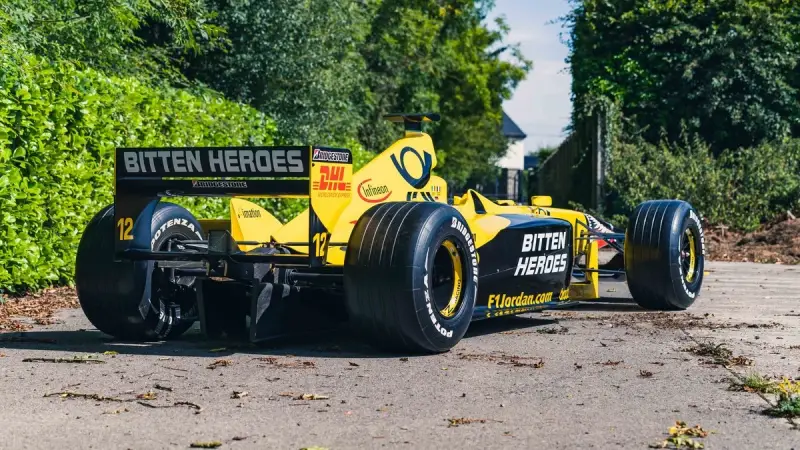
2001
The car was different from its disappointing predecessor, the Jordan EJ10. The EJ11 now had seven gears instead of the previous car's six, and also featured a much higher nose (resulting in a shark-based livery). But, most notably, the team now had full-works Honda engines (the same engine as it was used by BAR 003), replacing the Mugen Honda engines used for the previous three years. This put the team into direct competition with fellow-Honda users British American Racing.
Jordan finished 5th in the Constructors' Championship with 19 points. While the EJ11 failed to secure a podium finish, it showed incredible raw speed across several weekends. The team experienced a highly turbulent year with its drivers. Due to injuries, political fallouts, and mid-season contracts, four drivers raced the EJ11 in official Grands Prix.

Heinz-Harald Frentzen
Ricardo Zonta
Jean Alesi
Jarno Trulli
ej12

2002


The Jordan EJ12 was the car with which the Jordan team competed in the 2002 Formula One World Championship. The car was driven by Italian Giancarlo Fisichella, who returned to the team after four seasons at Benetton, and Japanese debutant Takuma Sato.
The EJ12 incorporated heavy design revisions to the front of the chassis compared to the preceding EJ11, therefore requiring a re-packaged front suspension system. New materials and production techniques were utilised in the chassis to further reduce weight and the centre of gravity position, with the revised side-pods making the side impact structures smaller, but more efficient.
Due to a drop in sponsorship money the team slipped backwards. Fisichella often exceeded the car's abilities in qualifying, a sixth place on the grid for Montreal surprising many onlookers. However, it was not enough to retain the works Honda package, with the Japanese manufacturer having long announced before the end of the season that they would be concentrating solely on their partnership with BAR from 2003 onwards.
DHL become the team's co-main sponsor, along with Benson & Hedges. DHL's sponsorship of the team lasted only a year.

Giancarlo Fisichella
Takuma Sato
ej13


2003
The car was designed by Gary Anderson and Nicolò Petrucci and driven by Giancarlo Fisichella, Ralph Firman and Zsolt Baumgartner who replaced Firman who was injured for two races.
The team slumped due to lack of sponsorship and Honda left Jordan to concentrate on their partnership with BAR. Jordan had to make do with 2002-specification Cosworth CR-4 engines badged as Ford RS1, and the season was not regarded as a success.
Despite beating only Minardi to rank 9th in the standings, Jordan won in 2003. The victory came under extraordinary circumstances in the 2003 Brazilian Grand Prix which took place in torrential weather conditions. Aside from the unlikely win, neither Fisichella or new teammate Ralph Firman were able to have any sort of success in their Jordans. After Firman was injured in practice for the 2003 Hungarian Grand Prix Jordan fielded the first ever Hungarian Formula One driver, Zsolt Baumgartner.

Giancarlo Fisichella
Ralph Firman
Zsolt Baumgartner
ej14


2004
The Jordan EJ14 was the car with which the Jordan team competed in the 2004 Formula One season. The car was driven by Nick Heidfeld, Giorgio Pantano and Timo Glock.
The car itself was not a totally new car; instead it was a major upgrade of the previous year's uncompetitive EJ13. The chassis itself was modified and combined with a new aerodynamic package and more powerful Ford-badged Cosworth engine. It also had a return to a single-keel suspension layout. However, the team's small budget meant that little or no testing of the cars was carried out, both before the season and during it. Unsurprisingly, the car was just as uncompetitive as its predecessor. The lack of speed was blamed on a lack of power coming from the Cosworth engine, which the team claimed was not the same as those being used by Jaguar, Ford's works team.
The car's performance and reliability were generally poor all year. A total of 5 points were scored all year and the team's future was put into doubt late in the season when Ford announced it was withdrawing from F1, leaving the team with no engines for the following year. For a while it appeared that the team would close immediately after the final race of the season. Only a late deal to run Toyota engines for 2005 saved the team.

Nick Heidfeld
Giorgio Pantano
Timo Glock

After Ford's decision to put Cosworth up for sale, Jordan had been left without an engine deal for 2005. However, at short notice, Toyota agreed to supply Jordan with customer RVX-05 engines identical to those in the works Toyota cars as a paid lease agreement instead of free of charge. In 2005 after a constructors' meeting at Heathrow, Bernie Ecclestone introduced Alex Schnaider to Eddie Jordan. Six weeks later Eddie Jordan had sold the team to the Midland Group for $60 million. The day the deal was signed Eddie sat in Ian Phillips' office and was in tears.
Tiago Monteiro at the 2005 United States Grand Prix.
The Jordan name was retained for the 2005 season, before being changed to Midland MF1 Racing for the 2006 season. Throughout 2005, journalists questioned whether Midland were in Formula One for the long haul. Rumours circulated throughout the season that the team was for sale, and that former driver Eddie Irvine was interested in buying them.
ej15


2005
The Jordan EJ15 was the fifteenth and last Jordan Formula One car. It was used by the team to compete in the 2005 Formula One season. The car was driven by Tiago Monteiro and Narain Karthikeyan.
Jordan had been left without an engine deal for the 2005 season after the Ford Motor Company's decision to put their engine supplier Cosworth up for sale. However, at short notice, Toyota agreed to supply Jordan with engines identical to those used by their own Formula One team and thus Jordan became the first-ever Toyota F1 customer team and also Magneti Marelli electronic control unit (ECU) packages. At the beginning of 2005, the team was sold to Midland Group.
Jordan used an updated EJ15B chassis for the final five races of the year. Monteiro gave the B spec chassis its debut in Italy whilst Karthikeyan still had the previous model. For the following race in Belgium, both drivers used EJ15Bs, and they would both see out the remainder of the season with the new chassis.

Tiago Monteiro
Narain Karthikeyan


Create Your Own Website With JouwWeb