


Eifelland was a German Formula One team, named after its owner Günther Hennerici's caravan manufacturing company. The name Eifelland was chosen after the Eifel mountains where Hennerici was born, which are located close to the Nürburgring.
Günther's twin brother, Heinz Hennerici, was a World War II tank commander who lost his left arm in combat. The accident didn't prevent him from becoming a rather successful touring car racing driver, eventually competing in the Nürburgring 24 Hours. The Hennerici brothers were also instrumental in the establishment of the Automobil-Club Mayen. In 1970 Günther married Hannelore Werner, one of the few female Formula 2 and sports car drivers around at the time.
In 1971 Günther Hennerici decided to expand his activities to motor racing and founded his own team, Eifelland. Official name: Team Eifelland Caravans. Initially the team competed mostly in Formula Three, with drivers such as Willi Deutsch, Gerd Koppenhauser, Erwin Derichs, Hans Hargarten and Werner herself.
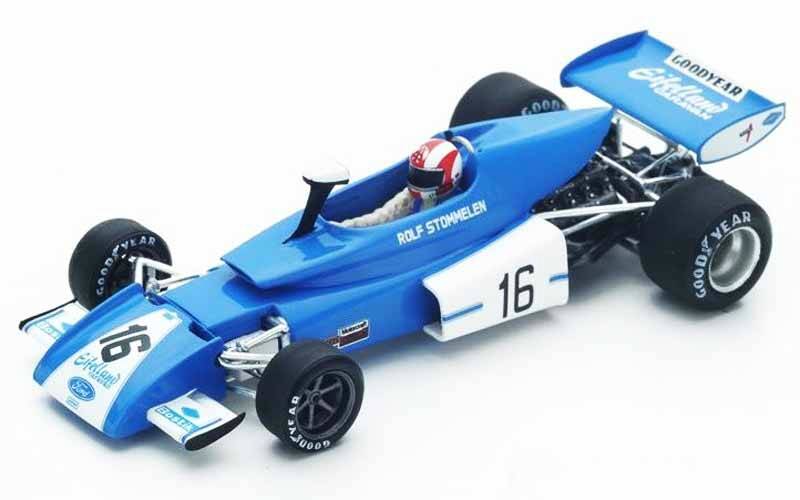
In 1972 he chose to graduate to Formula One and field one single car with Rolf Stommelen at the wheel. The car was based on a March 721 Formula One car, redesigned by German designer Luigi Colani in his typical rounded aerodynamic style, and presented some innovative features. An air intake in front of the driver would guide the air around the cockpit to the engine, and one single rear view mirror was mounted in front of the driver.
Although reasonably reliable, the car suffered from overheating and scarce downforce. Stomelen's best results were two top-ten finishes at the 1972 Monaco Grand Prix and the 1972 British Grand Prix, and at the end of the 1972 Formula One season the team decided to focus exclusively on Formula Three.
Due to the lack of competitive results and mounting financial pressure, Eifelland withdrew from Formula One after the 1972 season. Henerici also ceased his sponsorship of Stommelen's racing efforts, and the car itself was returned to March specification. The team was disbanded, and Eifelland never returned to Grand Prix racing.
After a couple of unsuccessful seasons, in 1974 Hennerici sold the team and his caravan company and retired.

Despite its lack of success, Eifelland is remembered for its ambitious but flawed attempt to bring industrial design into Formula One. The futuristic Colani bodywork remains a curiosity in F1 history, and the project stands as an example of the experimental nature of the sport in the 1970s.
Stommelen went on to continue his racing career with other teams in Formula One and sports car racing. The Eifelland Type 21 chassis still exists and has been displayed at historic racing events.
E21

1972


Gunther Hennerici bought a March 721 with a Ford Cosworth DFV engine, Hewland gearbox, Goodyear tires, and decided to have it modified by Luigi Colani. The Eiffeland E21 has a very futuristic shape, with a large air intake located in front of the passenger compartment, in which a single rear-view mirror was positioned centrally above, fixed to a showy central support that rose above the cockpit line. Colani's design is based on his theory: "The earth is round, its orbit elliptical, so why this creative and conservative obsession with straight lines?"
While the car looked futuristic on paper, Colani’s lack of traditional motorsport engineering experience backfired immediately during initial testing.
The beautiful, enclosed shell severely restricted airflow. As a result, the car suffered from crippling engine overheating issues and lacked stable downforce. To actually make the car drivable, the team was forced to incrementally strip away Colani’s space-age panels, substituting them with conventional, boxy parts from the original March 721 factory design. By its final race, the car looked far more like a standard March than Colani's original artwork
The Eifelland E21 was driven exclusively by German driver Rolf Stommelen for its entire frontline career. Stommelen dragged the temperamental car through 8 World Championship Grands Prix in 1972. While it was uncompetitive and never scored a single championship point, Stommelen proved its reliability by finishing most races, securing a season-best 10th place at both the Monaco and Italian Grands Prix. The adventure ended at the Austrian GP, where Stommelen finished 15th. It is known that Henerici commissioned designer Len Terry, a former Lotus employee, to design a new car for 1973, but the project never saw the light of day.


Create Your Own Website With JouwWeb