








Talbot is a now dormant automobile marque introduced by British-French company Clément-Talbot. Clément-Talbot was founded in 1903. The first products were cars that were London-assembled mechanical components of French Clément-Bayard cars but the French components were soon replaced by British parts. The brand-name was reduced to Talbot after the first year.
talbot london
In December 1919, Darracq of London with its factory in Suresnes, Paris, bought the entire capital of Clément-Talbot and later bought Sunbeam and renamed itself STD Motors. Those initials referred to Sunbeam, Talbot and Darracq. But in the depth of the Great Depression, STD Motors became unable to pay its debts. Its subsidiaries managed to find buyers and in 1936 STD Motors ceased to exist.
talbot paris under antonio lago
Following the financial collapse of STD Motors and Paris's Automobiles Talbot, Antonio Lago, the Suresnes' manager, arranged a management buyout of the French operation.
Antonio Lago involved Talbot in sports car and Grand Prix racing as well as producing high quality luxury cars. In the postwar world of austerity the French government introduced punitive annual taxation on cars with engines larger than 2.6-litres and Talbot sales were severely restricted. Lago continued the Talbot business until 1958 when the factory doors were closed.
The dormant Talbot marque was sold to Simca. Simca was gradually acquired by Chrysler Corporation between 1963 and 1970 – which effectively brought the two Talbot brands together since Chrysler Europe already owned the Rootes Group.
PSA Peugeot Citroën acquired the still dormant Talbot marque when it bought Chrysler in 1978. PSA Peugeot Citroën began to use a Talbot badge on former Simca and Chrysler/Rootes models.
chrysler/peugeot era (1979–1985)
In August 1978, PSA negotiated a deal with Chrysler to acquire Chrysler Europe for a nominal $1. Although PSA took responsibility for Chrysler Europe's considerable debts and liabilities, the move was a strategic one; acquiring Simca would remove a strong domestic competitor in the French market while gaining access to that company's expertise in small front wheel drive cars; while at the same time the old Rootes operations would give the company a stronger foothold in the United Kingdom – France's biggest export market where both Peugeot and Citroën lagged behind arch rival Renault.
The last remaining car produced by the Rootes group, the Chrysler (previously Hillman) Avenger, remained in production as a Talbot until the end of 1981; production of the Avenger-derived Talbot Sunbeam also ended in 1981. The entry-level model in the Talbot range from December 1981 onwards was the Talbot Samba, a three-door hatchback based on the Peugeot 104.
1100


1967-1985
The Simca 1100 is a series of French compact family cars – mainly C-segment hatchbacks, but also a compact wagon and popular delivery vans – built for over 15 years by French car-maker Simca, from 1967 through 1982/1985. There was even a very early 'hot hatchback', and a family cross-over: the Matra Simca Rancho. The hatchbacks were replaced by the Simca-Talbot Horizon.
The front-wheel drive Simca 1100 hatchback range, introduced in 1967 was a top seller across Europe, and was said to have influenced Volkswagen to replace its range of rear-engined and rear-drive air-cooled vehicles with a front-engined, front-drive, water cooled cars, leading to the Mk 1 VW Polo, Golf and Passat series.
The Simca 1100 was rebranded as Talbot-Simca for the 1980 model year (introduced in the summer of 1979). For its final year as a passenger car (1981), the Simca name was dropped entirely, and it was sold simply as the Talbot 1100.
chrysler alpine, or simca 1307

alpine

1510

solara
1975-1986
The Chrysler Alpine, or Simca 1307, is a large family car produced by Chrysler Europe and subsequently PSA Peugeot Citroën from 1975 to 1986. Codenamed 'C6' in development, the car was styled in the United Kingdom by Roy Axe and his team at Whitley, and the car was engineered by Simca at Poissy in France.
A modern, front-wheel drive hatchback, it was one of the earliest such cars in the large family class along with the Renault 20/Renault 30 and Volkswagen Passat, and became the 1976 European Car of the Year. It had been in development since 1972.
The model was marketed variously as the Simca 1308 and 1309 models (with larger engines), Chrysler Alpine (UK, Ireland and New Zealand), Dodge Alpine (Colombia), Chrysler 150 (Spanish market), and later Talbot 1510 / Talbot Alpine / Talbot 150 (a facelifted version launched by PSA after its takeover of Chrysler Europe) and Talbot Solara (the saloon version).
Originally the car was powered by 1294 cc and 1442 cc versions of the "Poissy engine" with electronic ignition and a four-speed gearbox. More upmarket models were designated 1308 (1508 in some markets, reflecting the size of the engine) and 1309 (similarly sold as a 1609 in a few markets).
For 1980 the car, which was now sold under the Talbot-brand, received an extensive facelift. The new model, shown at the Frankfurt Show, was known as the Talbot 1510 (the Talbot Alpine name was used in the UK).
sunbeam


1977-1981
The Chrysler Sunbeam is a small supermini three-door hatchback manufactured by Chrysler Europe at the former Rootes Group factory in Linwood, Scotland, from 1977 to 1981. After the takeover of Chrysler's European operations by PSA, the model was renamed Talbot Sunbeam and continued in production until 1981. A Talbot Sunbeam Lotus version was successful in rallying and won the World Rally Championship manufacturers' title for Talbot in 1981.
The Sunbeam was, unlike the larger Horizon and Alpine models that were launched by Chrysler in the mid to late 1970s, never sold in France as a Simca. Although it was targeted at the supermini class, the Sunbeam's Avenger underpinnings meant that it was slightly larger than its intended rivals, potentially overlapping with Chrysler's own Horizon model. For this reason, the Sunbeam was only available with three-door bodywork, whereas the Horizon was only offered with five doors.
On launch, the Sunbeam was offered in 0.9, 1.3 and 1.6 litre guises and three trim levels "LS", "GL" and the range topping "S".
Even though the end was looming, the Sunbeam was afforded a facelift for its final year in production, gaining flush headlamps and a revised front end. When production finally came to a halt, approximately 200.000 Sunbeams had been manufactured.
horizon


1978-1987
The Chrysler Horizon is a compact hatchback designed by Chrysler Europe, manufactured and marketed for model years 1978-1987 under the Simca, Chrysler and Talbot brands, succeeding both the Simca 1100 and Hillman Avenger, and using a front-wheel drive, transverse-engine layout.
The Horizon became Chrysler Corporation's first successful world car, with the Chrysler Europe project developed in tandem with the American-market Dodge Omni/Plymouth Horizon. While similar in appearance, and in one case even sharing a model name, the European and American Horizons differed substantially.
Featuring transversely mounted Simca-designed 1.1, 1.3 and 1.5-litre "Poissy" OHV engines, 4-speed gearboxes, and torsion-bar suspension, the Horizon was praised for its crisp styling, supple ride, and competent handling.
After Chrysler Europe collapsed in 1978 and was sold to Peugeot, the Horizon was rebadged as a Talbot in 1979. The Horizon was voted European Car of the Year in 1979.
murena


1980-1983
The Matra Murena is a mid-engined, rear wheel drive sports car that was produced from 1980 through 1983 by the French engineering group Matra. The factory was located in the commune of Romorantin-Lanthenay in the department of Loir-et-Cher in central France.
The Murena, whose name is Italian for "Moray", was the successor to the Matra Bagheera, a similar vehicle that resulted from an earlier collaboration between Matra and Simca.
The Murena drew heavily from the corporate parts bin, using engines from the Talbot Solara and Talbot Tagora, a transaxle developed by Citroën for their Citroën CX and also used in some Lancia Beta models, Talbot Horizon taillamp clusters fitted with custom lenses, steering rack and front suspension from the Talbot Solara, front indicator and running lights from the Renault 12, and door handles from the Peugeot 505.
Two engines were offered. The base model had a 1.6-litre Poissy engine, while the more powerful version came with a 2.2-litre Type 180. The 2.2-litre engine could also be ordered with a performance package called the "Préparation 142" option that raised the power output from 118 PS to 142 PS.
tagora


1980-1983
The Talbot Tagora is an executive car developed by Chrysler Europe and produced by Peugeot Société Anonyme (PSA). The Tagora was marketed under the Talbot marque after PSA took over Chrysler's European operations in 1979. PSA presented the first production vehicle in 1980 and launched it commercially in 1981. The Tagora fell short of sales expectations, described as a "showroom flop" just a year after its launch, and PSA cancelled the model two years later. Fewer than 20.000 Tagora models were built, all of them at the former Simca factory in Poissy, near Paris, France.
The Tagora was priced to overlap with high-end Peugeot 505 and low-end Citroën CX models, while slotting in beneath the Peugeot 604. Its pricing was also comparable to the Renault 20/30 and Ford Granada.
As with most large cars of its time, the Tagora was a rear-wheel drive vehicle, with a longitudinally mounted engine. There were three engine choices, mated to four- and five-speed manual transmissions or an optional three-speed automatic in the case of the four-cylinder engines.
The available engines were the 2.2-litre type 180 OHC I4 with 115 horsepower, the 2.3-litre XD2S OHV turbodiesel I4 with 80 horsepower and the 2.7-litre PRV OHC V6 with 166 horsepower.
samba


1981-1986
The Talbot Samba is a city car manufactured by the PSA Group in the former Simca factory in Poissy, France, and marketed under the short-lived modern-day Talbot brand from 1981 to 1986. Based on the Peugeot 104, it and the Talbot Express were the only Talbots not inherited from Chrysler Europe, engineered by PSA alone. It was also the last new Talbot car to be launched. Its demise in 1986 was effectively the end of the Talbot brand for passenger cars. Launched initially as a three-door hatchback, it was also for some time the only small car available in a factory-ordered cabrio body style, and the most economical car in Europe.
The engine lineup included three versions of the four cylinder PSA X engine, which the Samba shared with its Peugeot and Citroën siblings, coupled with three trim levels. The base LE and LS came with the 954 cc XV, the GL with the 1124 cc XW and the top-of-the-line GLS with the largest 1360 cc XY engine. The GLS was also available with a five-speed transmission. Power outputs are 45, 50, and 72 PS respectively.
In an effort to make the vehicle stand out in the market against similar rivals, which included its own derivatives, Peugeot added a more glamorous two-door cabriolet to the standard three-door hatchback.

Talbot had two brief spells in Formula One. The 4.5-litre, six-cylinder Talbot-Lago T26 was eligible for F1 competition post-war, and many examples, both factory and private, appeared in the first two years of the F1 World Championship, 1950 and 1951. Talbots came fourth and fifth in the inaugural World Championship race, the 1950 British Grand Prix, piloted by Yves Giraud-Cabantous and Louis Rosier respectively. The move to two-litre F2 regulations for 1952 effectively ended Talbot's F1 spell as a manufacturer.
There was a brief participation in Formula One in the 1981 and 1982 seasons by associating with the Ligier team and using its Matra connection to secure a Matra engine for them, changing official constructor's name to Talbot Ligier in both seasons. The Talbot Ligier team was moderately successful, Jacques Laffite coming fourth in the 1981 championship with two wins.
talbot-lago t26c


1948-1950
The Talbot-Lago T26C was a single-seater racing car designed and developed by French manufacturer Talbot-Lago. It featured a box section chassis, an unsupercharged 4483 cc capacity straight-six engine and a four speed Wilson preselector gearbox. The chassis and gearbox were derived from the company's 1930s racing cars and were similar to those used on their post-war road cars.
For the 1950 Formula One season a version with a more powerful engine was introduced, with revised carburation and twin spark plugs. These variants are known as T26C-DA (for Double Allume, i.e. twin plug).
The T26C made its racing debut in the 1948 Monaco Grand Prix, finishing second in the hands of Louis Chiron. A modified version, the T26C-GS (for Grand Sport), fitted with two-seater bodywork, cycle wings and lights, won the 1950 24 Hours of Le Mans driven by Louis Rosier and Jean-Louis Rosier.
js17

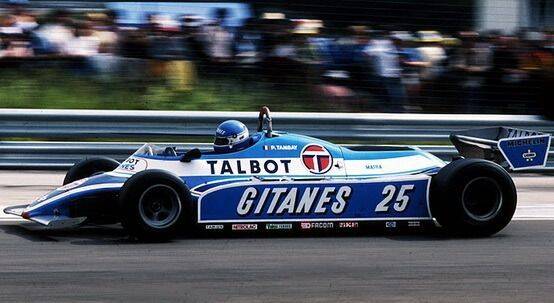

1981
Three decades later, the PSA Group (which had acquired the Talbot brand name) brought the moniker back to F1 by partnering with the French Ligier team. Operating under the official name Équipe Talbot Gitanes Ligier, the team ran distinctive blue and white cars. They were powered by a screaming Matra V12 engine that was officially badged as a "Talbot V12".
The 1981 season was an absolute peak for the partnership. Team leader Jacques Laffite won two Grands Prix (Austria and Canada) driving the highly successful Ligier JS17.
Following a much more difficult 1982 season plagued by the uncompetitive JS19 chassis, PSA pulled out of F1 to redirect their racing budget toward the World Rally Championship (WRC).
the end
The Talbot brand ended in 1987 when its parent company, PSA Peugeot Citroën, decided to phase out the struggling nameplate entirely and focus resources on Peugeot.
The downfall of the historic brand happened in three distinct stages:
1. The Disastrous Chrysler Purchase (1978–1979)
In 1978, the French PSA Group bought the failing European operations of Chrysler (which included the British Rootes Group and French Simca). Looking for a single name to unify these mismatched British and French dealer networks, PSA revived Talbot—a prestigious, historic nameplate that had been dormant for decades. Almost overnight in 1979, every Chrysler and Simca car was rebadged as a Talbot.
2. Collapsing Sales and Labor Strikes (1981–1985)
The rebadging strategy confused consumers, and Talbot quickly suffered from a severe identity crisis.
- Bad Reputation: Quality control issues plagued British production plants like Ryton, hurting customer trust.
- Industrial Unrest: Violent, high-profile strikes at Talbot’s flagship Poissy plant in France severely disrupted production and damaged the brand's public image.
- Cannibalization: Talbot cars were directly competing for the exact same customers as Peugeot's own mainstream models.
-
3. The Final Blow: The Peugeot 205 and 309 (1986–1987)
By 1985, Peugeot had a massive hit on its hands with the Peugeot 205, making the struggling Talbot brand completely redundant. [1]
PSA had fully developed a brand-new hatchback meant to replace the Talbot Horizon, which was set to be launched as the Talbot Arizona. At the very last minute, PSA management realized the Talbot name was commercially dead. They canceled the brand instead, put a Peugeot badge on the new car, and launched it as the Peugeot 309 in late 1985.
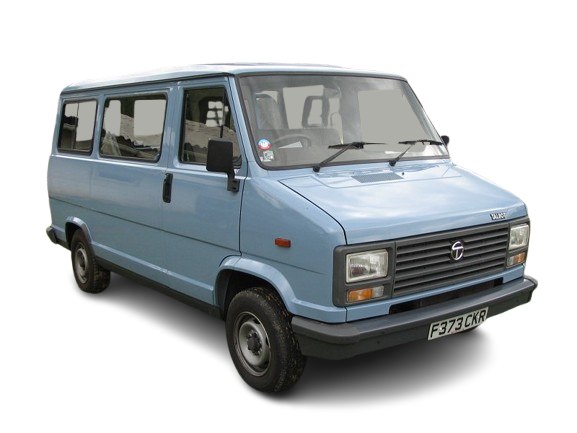
Production of all remaining Talbot passenger cars (the Samba, Horizon, and Solara) was quietly stopped in 1986. The very last vehicle to carry a Talbot badge was the Talbot Express commercial van, which finally ended production in 1994.



Create Your Own Website With JouwWeb