



Simca (Société Industrielle de Mécanique et Carrosserie Automobile; Mechanical and Automotive Body Manufacturing Company) was a French automaker, founded in November 1934 by Fiat S.p.A. and directed from July 1935 to May 1963 by Italian Henri Pigozzi.
Pigozzi acted as a scrap merchant, buying old automobile bodies and sending them to Fiat for recycling. Two years later Pigozzi became Fiat's General Agent in France and in 1926 SAFAF (Société Anonyme Française des Automobiles Fiat) was founded. In 1928, SAFAF started the assembly of Fiat cars in Suresnes near Paris and licensed the production of some parts to local suppliers. By 1934, as many as 30.000 Fiat cars were sold by SAFAF.
The first cars produced were Fiat 508 Balillas and Fiat 518 Arditas, but with Simca-Fiat 6CV and 11CV badges. They were followed during 1936 by the 3CV Simca 5, a version of the Fiat Topolino.
simca 5


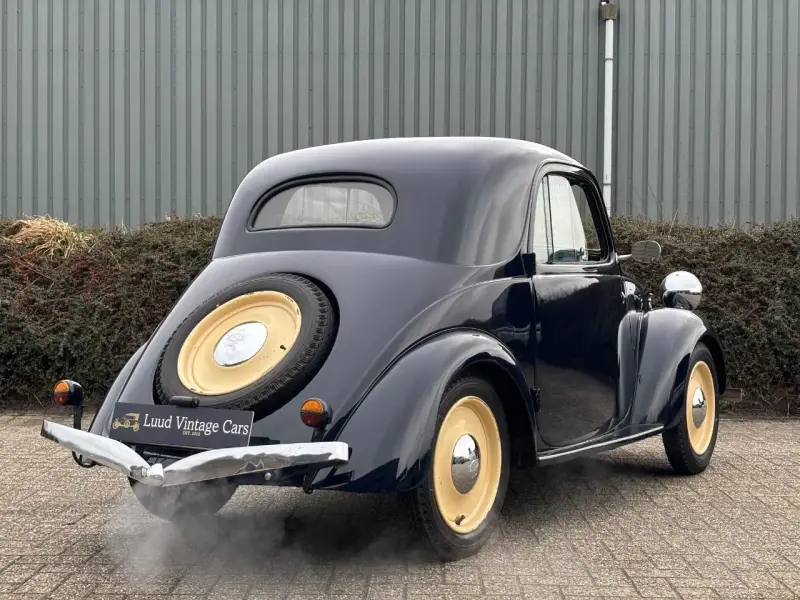
1936-1948
The Simca 5 is a small Franco-Italian passenger car designed by Fiat engineers at Turin and produced in France by Simca from 1936 to 1948. It was virtually identical to the Fiat 500 Topolino on which it was based, but was first presented, at the company's new Nanterre plant, three months ahead of the Fiat equivalent on 10 March 1936.
It had an I4 570 cc engine and was mated to a 4-speed gearbox.
With an engine size that corresponded with the 3CV car tax band the Simca 5, along with its Fiat sibling, could be presented as the "smallest volume production car in the world".
Production of the Simca 5 was slowed (but did not ever cease entirely) by the war and the period of German occupation in the early 1940s, but resumed in 1946. A number were commandeered by the German Army for use as staff cars. 46.472 of the cars had been produced by the time the car was delisted by Simca in 1949. By now it had been replaced on the company's production lines by the similar but partially reskinned and slightly more powerful Simca 6.
simca 6
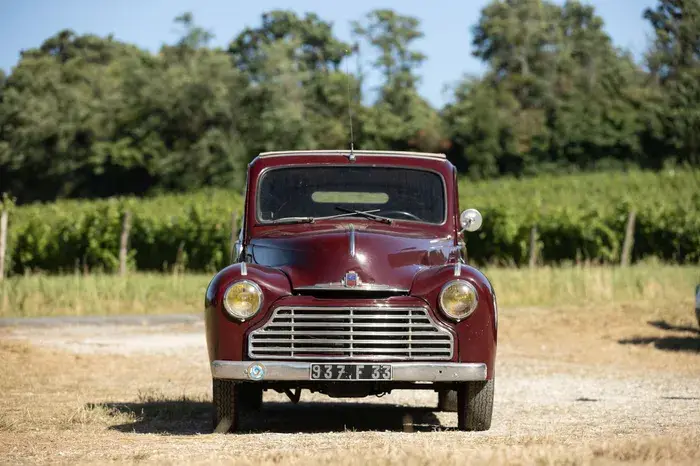

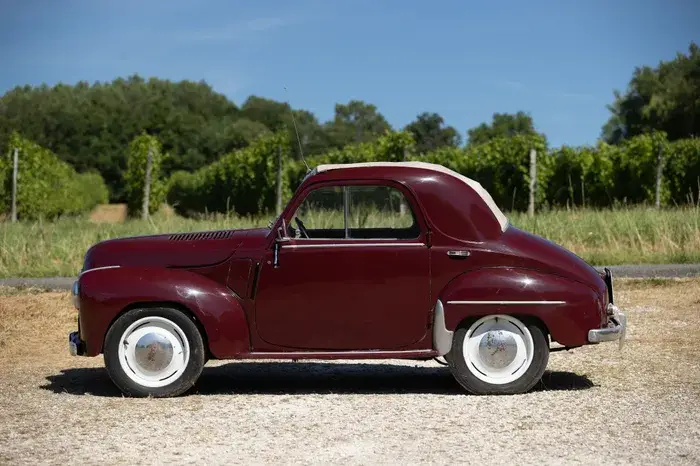

1947-1950
The Simca 6 is a city car and van produced and sold in France by Simca from 1947 until 1950. Simca had been established as a French subsidiary of Fiat and the Simca 6 was developed from the Simca 5 which itself had been a version of Fiat’s Topolino rebadged and manufactured in France as a Simca.
Claimed output from the 569 cm³ engine was boosted from 12 to 16.5 bhp achieved at 4400 rpm. The light-weight 6 inherited its predecessor’s excellent fuel economy, with 5 litres of fuel propelling it over a distance of 108 km. The advertised maximum speed of 90 or 95 km/h also reflected the car’s light build, and was considered excellent for a car of this size and price.
Despite having its first public presentation at the 1947 Motor Show, the car got off to a slow start, with just 11 produced during the closing month of 1947 and 191 during the whole of 1948: during these years the older Simca 5 remained the company's smaller volume model. However, in 1949 the Simca 6 fulfilled its manufacturer's plans and replaced its predecessor. More than 16.000 Simca 6s were produced during its production run which came to an end in 1950.
aronde
The Simca Aronde is an automobile which was manufactured by the French automaker Simca from 1951 to 1964. It was Simca's first original design (earlier models were all to a greater or lesser extent based on Fiats), as well as the company's first unibody car. "Aronde" means "swallow" in Old French and it was chosen as the name for the model because Simca's logo at that time was a stylized swallow.


9 Aronde, 1951-1955
90A Aronde, 1955-1958
Aronde P60, 1958-1964
The first Aronde debuted in the spring of 1951 but initially only a few hundred pre-production cars were distributed to carefully selected "guinea-pig" buyers, and the full production version was finalised only in time for the Paris Motor Show, becoming available for sale in October 1951.
The Aronde was fitted with a front-mounted 1221 cc 44.5 bhp engine from the previous Simca model, the Simca 8.
The only body style offered at the October 1951 launch was a four-door saloon/sedan/berline, but other configurations very soon became available such as the three-door estate.
The 9 Aronde was well received, especially in France. It took only until 17 March 1953 before total production of this model passed 100.000.
The second-generation Aronde debuted in October 1955. The new Aronde was now powered by the ungraded and newly named 1290 cc Flash engine. It produced 45 hp at 4500 rpm or 48 hp at 4800 rpm.
Externally the Aronde for 1956 had an updated 9 Aronde body, with restyled front and rear ends. An Aronde Chatelaine 3-door station wagon and an Aronde Intendante Pick-Up were also offered. In January 1957, the 500.000th Aronde was made, and the cars were now exported even to the United States.
An Aronde Elysee was tested by the British magazine The Motor in 1956 and was recorded as having a top speed of 132.9 km/h and could accelerate from 0-100 km/h in 24 seconds.
The P60 Aronde saloons, presented at the Paris Motor Show in October 1958, came with a new modern-looking body. Mechanically little had changed: more innovative was the wide range of versions and permutations now offered, with customers able to choose from a range of engines offering four different levels of power output (40, 45, 47 or 57 hp) and an options list that even included leather upholstery and a "Simcamatic" clutch.
In line with the manufacturer's determination to offer customers more choice, the Simca Aronde P60 was offered with various names representing various bodytypes.
50's
The 1950s was a decade of growth for Simca, and by 1959 the combined output of the plants at Nanterre and at Poissy had exceeded 225.000 cars, placing the manufacturer in second place among French automakers in volume terms, ahead of Peugeot and Citroën, though still far behind market leader Renault.
The Ford purchase also added the V-8 powered Ford Vedette range to the Simca stable. This model continued to be produced and progressively upgraded until 1962 in France and 1967 in Brazil, but with various names under the Simca badge. An Aronde-powered version was also made in 1957 and called the Ariane which, because it was economical and had a large body, was popular as a taxi.
In 1958, Simca bought the French Talbot-Lago manufacturing company.
vedette

1954-1961


1958-1961
The Simca Vedette is an executive car, manufactured from 1954 to 1961 by French automaker Simca, at their factory in Poissy, France. The Vedette competed in France's large car market at a time when the economy was finally returning to growth and enjoyed moderate success with its American style finished off by the Italian designer Rapi. It was marketed with different model names according to trim and equipment levels. The Vedette was Simca's largest model at that time, and it went on to spawn a more economical version, the Simca Ariane.
The car was powered by an unusually small 2351 cc sidevalve V8 engine called Aquilon ("North wind") in France, derived from Ford's Flathead engine family. It produced 75 hp for the first generation. Power was transferred to the rear live axle through a three-speed manual transmission with column shift.
After three years in production, the Vedettes were given new names and a new, elongated body, with a more ornate front end and large tailfins, making the cars even more American-looking than before. The engine was uprated to 84 hp (now called Aquilon 84). The three-year-old body of the previous Vedette nevertheless continued in production but it lost its V8 2.4-litre engine. In April 1957, fitted with the 1.3 L Aronde engine, the old body now clothed a new model in the Simca range, the Simca Ariane.
French production of the V8-engined cars ended in the summer of 1961, by which time 173.288 had been produced. Simca would not return to the luxury executive car market in Europe until 1970, when production of the Chrysler 160, 180, and 2 Litre started.
ariane


1957-1963
The Simca Ariane is a large family saloon car produced by French automaker Simca between 1957 and 1963 at their Poissy factory. It became famously known for its unique manufacturing formula: combining a large, heavy vehicle body with a small, economical engine to drastically reduce tax costs for buyers. Over its six-year production run, Simca manufactured 166,363 units of the Ariane.
Simca used the spacious body shell of the first-generation Simca Vedette—a vehicle line originally developed by Ford France before Simca purchased the Poissy factory in 1954. Rather than keeping a thirsty V8, Simca fitted the body with a modest 1.3-liter (1290cc) "Flash" 4-cylinder engine borrowed from their smaller Simca Aronde.
The standard Ariane was notoriously slow. It produced just 47 to 62 horsepower depending on the production year. The vehicle topped out between 120 km/h and 126 km/h.
The Ariane was highly favored by Parisian taxi drivers who desperately needed a large, comfortable cabin for luggage and passengers but required the low fuel and tax expenses of a small sedan. It bridged the gap between economy and comfort, keeping Simca highly competitive against rivals Peugeot and Citroën during the late 1950s. Production finally ceased in 1963 to clear a path for the modern Simca 1300 and 1500 lines.

In 1958, the American car manufacturer Chrysler, which wanted to enter the European car market, bought 15% of Simca from Ford in a deal which Henry Ford II was later reported as having publicly regretted. At this stage, however, the dominant shareholder remained Fiat S.p.A., and their influence is apparent in the engineering and design of Simcas of that period such as the 1000 and 1300 models introduced respectively in 1961 and 1963. However, in 1963 Chrysler increased their stake to a controlling 64% by purchasing stock from Fiat, and they subsequently extended that holding further to 77%. Even in 1971 Fiat retained a 19% holding, but by now they had long ceased to play an active role in the business.
Also, in 1964 Chrysler bought the British manufacturer Rootes thus putting together the basis of Chrysler Europe. All the Simca models manufactured after 1967 had the Chrysler pentastar logo as well as Simca badging.
1000

1961-1978


The Simca 1000, or Simca Mille in French, is a small, boxy rear-engined four-door saloon, manufactured for 18 years by French automaker Simca, from 1961 to 1978.
The "Simca Mille" was inexpensive and, at the time of launch, quite modern, with a brand-new inline-four water-cooled "Poissy engine" of (at this stage) 944 cc. Initially, cars could be ordered in one of three colours (red/rouge tison, egg-shell blue/bleu pervenche or off-white/gris-princesse). However, the show stand featured two additional body colours and the range of colours available to customers was soon expanded.
The interior was considered "surprisingly" spacious for this class of car, with plenty of space for four, although the luggage locker under the front hood/bonnet offered only limited space.
Over the course of time, the 1000 was available in a number of versions featuring different equipment levels and variations of the original Type 315 engine. Power output ranged from 31ps to 74ps for the 1000 Rallye GT.
The Simca 1000 became a popular car in France, and to some extent also in export markets. In its 17 years of production, almost 2 million were sold.
1000 coupé/1200s

1962-1971


1200s
The Simca Coupé 1000 and its successor, the Simca 1200S are small, rear-engined two-door coupés (described by one well informed commentator as “Pseudo-sportives”) which were produced by Simca between 1962 and 1971. Simca also provided the engine and the mechanical underpinnings while the bodies were built in Turin by Bertone before being transferred for final assembly to Simca's Poissy plant and an assembly plant in Rotterdam (1200S only) on specially configured trains.
Despite sharing its chassis and mechanical elements with the boxy Simca 1000 saloon, the Coupé was able to offer superior road holding and performance because its centre of gravity was lower and its shape more aerodynamic.
In the French market, where the great majority of the cars would be sold, the Simca Coupé 1000 was pitched squarely against the Renault Floride.
The water-cooled 4-cylinder 944 cc engine shared its dimensions and basic layout with the engine fitted in the saloon, but the Coupé engine featured a higher compression ratio and provided a maximum 52 hp of claimed output (as against 45 hp in the saloon). A maximum speed of 140 km/h was listed (as against 125 km/h for the saloon).
In 1967 Bertone was commissioned to upgrade the body creating the 1200s. At the back, the engine was now replaced by a four-cylinder in-line water-cooled 1204 cc unit which would later find its way into versions of the Simca 1100. The car was renamed as the Simca 1200S, and in this form, supported by two carburetors, the engine produced a maximum 80 hp of power, allowing Simca to claim a top speed of 175 km/h.
In 1968 a further upgrade saw the claimed power increased to 85 hp and the claimed top speed to 179 km/h.
The 1960s was a decade of growing prosperity in France. By the time production of the 1200S ended in 1971, approximately 25,000 of its bodies had made the train journey, mounted on their sides in two rows, on the specially configured railway wagons from Bertone's workshops in Turin to Simca's plant at Poissy and for transformation into completed cars. The Simca 1200S was not immediately replaced, although the Matra Bagheera launched in 1973 can be seen as a belated replacement.
1300/1500
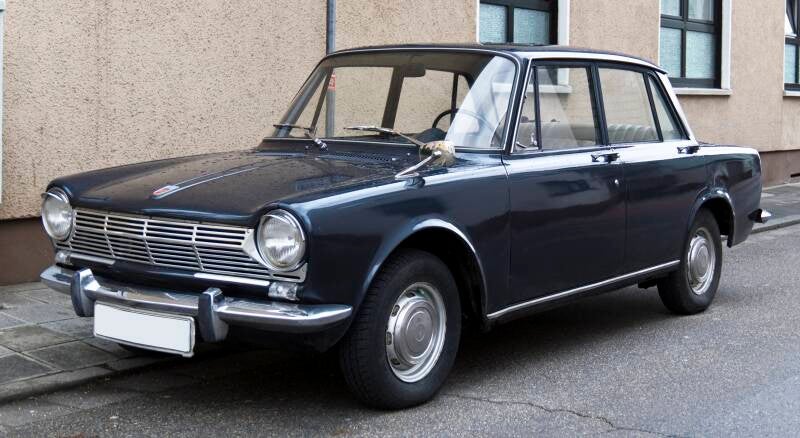
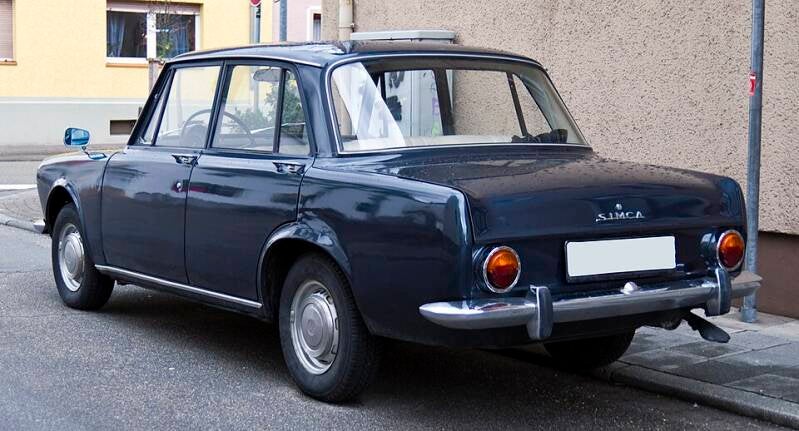

1963-1966
The Simca 1300 and Simca 1500 are large family cars manufactured by the French automaker Simca in its Poissy factory from 1963 to 1966 and between 1966 and 1975 in revamped versions, as the Simca 1301 and 1501.
The two models were essentially versions of the same car, fitted with either a 1.3-litre or 1.5-litre engine, hence the model names. Apart from different engines and differences in standard equipment, the models were for the most part identical, bar some styling details such as grille or bumpers.
This model series replaced the popular, long-running Simca Aronde and was initially available only with a 4-door saloon body, but in 1964 the 1500 gained an estate version (1300 estate followed in 1965).
While being quite popular, especially in France and Germany, those Simcas can be remembered for some quirks regarding both series. The 1300/1500 came with column shift for left-hand drive markets, but the right-hand drive versions were converted to floor shift.
Moreover, the 1500 GLA model, which was initially the sole in the range featuring automatic transmission, was at first available in metallic brown only. A similar situation concerned the interior carpets, which would come deep red regardless of the exterior color.
1301-1501


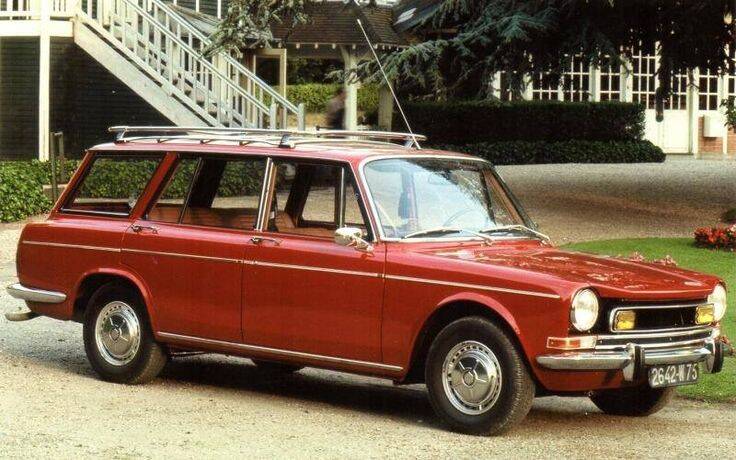
1966-1975
The Simca 1301 and Simca 1501 are two related automobiles which were produced by the French automaker Simca from 1966 to 1975. As a replacement to the older 1300 and 1500 models, the 1301 and 1501 models were first announced to the public in October 1966.
Compared to the two predecessors, the 1301 and 1501 kept the same chassis design and general shape, although the models were modernised with facelifted front and rear ends. They are both characterised by the same 3 square four door saloon and 2 square 4 door wagon body styles. The most obvious design differences with the 1300 and 1500 models were in the front and rear ends of the car.
At first, the engines used were the same from the 1300 and 1500 models, although they had in part been updated. The 1301 was equipped with the 1290 cc, 4-cylinder "Rush" engine from the 1300. It was capable of delivering 54 hp and allowed the car to reach a top speed of 135 km/h. Similarly, the Simca 1501 was equipped with the Type 342 engine of the 1500, a 1475 cc 4-cylinder originally powered by a single barrel carburettor, and capable of delivering 69 hp. The maximum speed for the 1501 was improved slightly, reaching 147 km/h in its earliest rendition.

Simca do Brasil was the Brazilian subsidiary of the now defunct French automaker Simca. It started out in the late 1950s assembling the Simca Vedette imported in kit form from France and selling it in three versions, the Chambord, Présidence and Rallye. Later the company manufactured the radically restyled Esplanada with improved engines and, with increasing control by the Chrysler Corporation over the French concern, was taken over with the American car giant becoming its majority shareholder. During its ten years of market presence Simca defended its market share against fierce competition from Volkswagen, Ford, Chevrolet and Willys. The brand disappeared from the Brazilian market in the late 1960s following a strategic decision by its owners Chrysler.
esplanada


1966-1969
The Simca Esplanada is a large car manufactured by Simca do Brasil in Brazil from 1966 to 1969. It was manufactured at Simca do Brasil's São Bernardo do Campo factory. Launched at the 1966 Salão do Automóvel in São Paulo, it replaced the Simca Chambord and related models. The basic platform of the Esplanada can be traced back through the French-built Simca Vedette to the Ford Vedette. Though the Chambord's engine and central section were retained, the Esplanada featured radically restyled front and rear ends
The Emi-Sul engine was derived from the Ford Motor Company flathead V8 of 1932, thanks to the use of Zora Arkus-Duntov's "Ardun" hemispherical cylinder heads. This iteration was the last version of that design to be built for a production car.
The production of the Esplanada ceased in 1969 when Chrysler introduced the larger Dodge Dart to the Brazilian market. Total production: 17.449 cars.
1100

1967-1985


The Simca 1100 is a series of French compact family cars – mainly C-segment hatchbacks, but also a compact wagon and popular delivery vans – built for over 15 years by French car-maker Simca, from 1967 through 1982/1985. There was even a very early 'hot hatchback', and a family cross-over: the Matra Simca Rancho. The hatchbacks were replaced by the Simca-Talbot Horizon.
The 1967 Simca 1100 series was historically significant for combining numerous modern design features – in affordable cars with numerous available engines. The 1100 series were among the first unibody family hatchbacks and compact estates to integrate a transversely mounted engine and front-wheel drive with all-around, modern independent suspension with anti-roll bars (double wishbones up front, and rear semi-trailing arms), disc brakes, rack and pinion steering, and folding rear seats for maximum space utilisation and practicality.
The front-wheel drive Simca 1100 hatchback range, introduced in 1967 was a top seller across Europe, and was said to have influenced Volkswagen to replace its range of rear-engined and rear-drive air-cooled vehicles with a front-engined, front-drive, water cooled cars, leading to the Mk 1 VW Polo, Golf and Passat series.
One of the cars with the strongest claim as "the first Hot Hatch" was the Simca 1100 Ti, available from 1974, with 82 horsepower – over 40% more power than the standard 58 hp – which dramatically improved performance. It sent the car's top speed over 160 km/h for the first time, to 169 km/h, and gave it a 0–100 km/h acceleration in 12 seconds.
A total of 2.2 million cars were produced. The replacement for the 1100, the C2 project, was unveiled at the end of 1977 as the Chrysler Horizon - Chrysler's "world car" - and was an enormous success in the United States, where it sold as the Dodge Omni and Plymouth Horizon.
chrysler 180

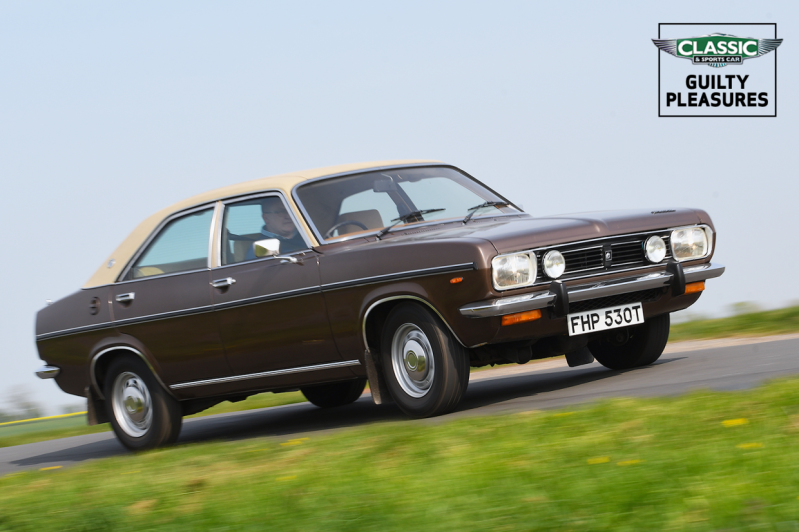
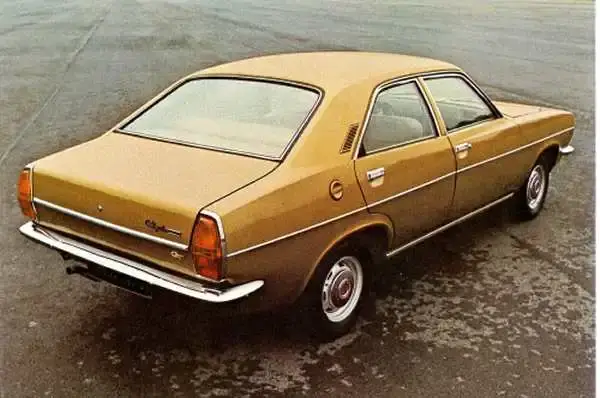
1970-1982
The Chrysler 180 was the base name for a series of large saloon cars produced by Chrysler Europe. Resulting from joining the development efforts of Rootes Group and Simca, the car was produced from 1970 to 1975 in Poissy, France, and later in Chrysler's subsidiary Barreiros' factory in Spain. The Chrysler 180 was also the base for the medium-sized model built by Chrysler Australia, the Chrysler Centura.
Depending on the engine, the cars were marketed as Chrysler 160/180/2 litre, and since 1977 in France and rest of continental Europe as Chrysler-Simca 1609/1610/2 litres.
The 160 featured the 1632 cc unit, while the 180 came with the 1812 cc one. However, the 160 GT model came equipped with the larger engine. The 160 has 80 PS while the 160 GT and 180 have 97 PS After the takeover of Chrysler Europe by PSA Peugeot Citroën, the continental Europe models were renamed Talbot 1610/2 litres for 1979 and 1980 model years, after which the model was discontinued in Europe with the exception of Spain, where a diesel model was sold until 1982.
The large, American-inspired Chrysler fared quite poorly in the principal European markets. The replacement for the car was developed by Chrysler Europe under the codename C9 and was finally launched by PSA as the even more ill-fated Talbot Tagora.
matra bagheera


1973-1980
The Matra Bagheera is a sports car built by the automotive division of the French engineering group Matra from 1973 to 1980, in cooperation with automaker Simca. It was marketed as the Matra-Simca Bagheera until its final year of production, when its designation was changed to the Talbot-Matra Bagheera following Chrysler Europe's demise and subsequent takeover by PSA.
Eleven prototypes were built and used for road-testing in environments ranging from Saharan Mauritania to Lapland, as well as for crash-testing. The public release of the car took place at the 1973 24 Heures du Mans. At the same time Simca had arranged to have 500 yellow Bagheeras available at their dealers across France. Towards the end of 1973, production levels had reached 65 cars per day. In June 1974, within eighteen months of its release, more than 10.000 Bagheeras had been sold.
The Bagheera won the 1973 Style Auto Award, beating out competition that included the Lancia Stratos, Lancia Beta coupé and Ferrari Dino 308 GT4.
The 19 panels that made up the Bagheera's body were made of fiberglass-reinforced polyester, which were then attached to the chassis.
The only engine offered at first was the 1294 cc "Poissy engine" from Simca's 1100 Ti model. In the Bagheera this ohv straight-4 engine developed 84 hp at 6000 rpm, two more horsepower than in the 1100 Ti. The transversely mounted engine was paired with the 4-speed manual transaxle from the 1100.
In 1976 a larger version of the same engine became available when the 1442 cc engine from the Simca 1308 GT was added to the lineup. The first Bagheera to use this engine was the newly introduced `S' version. Changes were also made to the carburation. A 4-speed manual was still the only transmission offered.
1307/1308/1309/1510


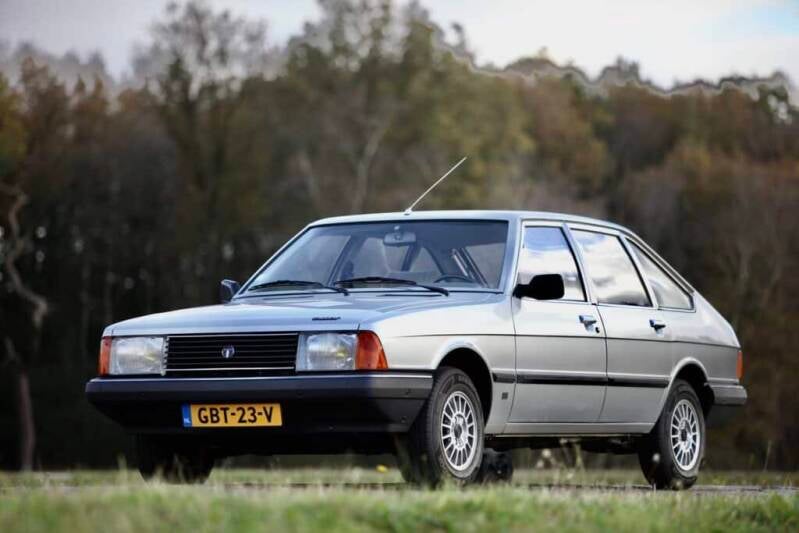
1975-1986
The Chrysler Alpine, or Simca 1307, is a large family car produced by Chrysler Europe and subsequently PSA Peugeot Citroën from 1975 to 1986. Codenamed 'C6' in development, the car was styled in the United Kingdom by Roy Axe and his team at Whitley, and the car was engineered by Simca at Poissy in France.
A modern, front-wheel drive hatchback, it was one of the earliest such cars in the large family class along with the Renault 20/Renault 30 and Volkswagen Passat, and became the 1976 European Car of the Year. It had been in development since 1972.
Originally the car was powered by 1294 cc and 1442 cc versions of the "Poissy engine" with electronic ignition and a four-speed gearbox. From launch it was available in three trim levels: GL, S and GT. More upmarket models were designated 1308 (1508 in some markets, reflecting the size of the engine) and 1309 (similarly sold as a 1609 in a few markets). All of the models replaced the Simca 1301/1501 range in France.
The model was marketed variously as the Simca 1308 and 1309 models (with larger engines), Chrysler Alpine (UK, Ireland and New Zealand), Dodge Alpine (Colombia), Chrysler 150 (Spanish market), and later Talbot 1510 / Talbot Alpine / Talbot 150 (a facelifted version launched by PSA after its takeover of Chrysler Europe) and Talbot Solara (the saloon version).
For 1980 the car, which was now sold under the Talbot-brand, received an extensive facelift. The new model, shown at the Frankfurt Show, was known as the Talbot 1510 (the Talbot Alpine name was used in the UK). It received new front and rear lights. A four-door saloon version, called the Talbot Solara.
The body styling of the Simca 1307 was the direct inspiration for the design of Russian Moskvitch Aleko (1986–2001).

The most successful pre-Chrysler Simca models were the Aronde, the Simca 1000 and the front-engined 1100 compact. During the 1970s Chrysler era, Simca produced the new Chrysler 160/180/2 litre saloon, 1307 range (Chrysler Alpine in the UK) and later the Horizon, (Dodge Omni and Plymouth Horizon in the USA). The 1307 and Horizon were both named European Car of the Year at launch. However, Chrysler's forced marriage of Simca and Rootes was not a happy one - Chrysler Europe collapsed in 1977 and the remains were sold to Peugeot SA the following year for a nominal US$1.00 plus assumption of outstanding debt. The cars sold reasonably well in France, but were outsold by their key Ford, British Leyland and Vauxhall rivals in Britain.
The last remaining Simca and Rootes models were discontinued by the end of 1981, and the Simca-based Alpine and Horizon soldiered on through the first half of the 1980s using the resurrected Talbot badge, which itself had vanished from passenger cars within a decade.
Meanwhile, Peugeot expanded its own brand and made use of the former Simca and Rootes factories for production of its own vehicles, although the Talbot brand survived into the 1990s on commercial vehicles.
Peugeot eventually abandoned the Talbot brand, and the last Simca design was launched as Peugeot 309 (instead of Talbot Arizona as had been originally planned). The Peugeot 309 used Simca engines until October 1991 (some 18 months before the end of production) when they were replaced by PSA's own TU and XU series of engines. The 309 was produced at the former Rootes factory in Ryton-on-Dunsmore, UK, as well as in the Poissy plant.
matra rancho


1977-1984
The Matra Rancho is a leisure activity vehicle created by the French engineering group Matra, in cooperation with the automaker Simca, to capitalize on the off-road trend started by the Range Rover. The Rancho provided an "off-road look" at a lower price.
Designed by Antonis Volanis, the Rancho was based on the pick-up version of Simca's popular supermini, the Simca 1100, using its front structure and a stretched chassis. The rest of the body was made by Matra from fibreglass and polyester, including the mouldings adorning the body, which made it look more "sturdy".
Other elements retained from the 1100 included the dashboard and front seats (identical to the ones found in the Simca 1100 GLS). The Rancho was powered by the 1442 cc, 80 hp version of the "Poissy" straight-four engine.
The Matra-Simca Rancho became the Talbot Matra Rancho and production continued until 1984 (although it remained on sale up to January 1985), reaching 57.792 cars in total.
The Rancho spawned an unlikely successor: the Renault Espace. Matra wanted to replace the Rancho with their prototype of the Espace.
horizon


1978-1987
The Chrysler Horizon is a compact hatchback designed by Chrysler Europe, manufactured and marketed for model years 1978-1987 under the Simca, Chrysler and Talbot brands, succeeding both the Simca 1100 and Hillman Avenger, and using a front-wheel drive, transverse-engine layout.
The Horizon became Chrysler Corporation's first successful world car, with the Chrysler Europe project developed in tandem with the American-market Dodge Omni/Plymouth Horizon. While similar in appearance, and in one case even sharing a model name, the European and American Horizons differed substantially.
The Horizon was voted European Car of the Year in 1979. The Simca 1100 remained in production in France until 1981, being sold for a time as a low cost alternative to the Horizon.
The car featured transversely mounted Simca-designed 1.1, 1.3 and 1.5-litre "Poissy" OHV engines with a 4-speed gearbox. The power range was 59–90 hp.
The Horizon was succeded by the Peugeot 309 as its replacement which originally was intended to be badged as a Talbot Arizona.


Create Your Own Website With JouwWeb