


Rimac Automobili is a Croatian automotive manufacturer headquartered in Sveta Nedelja, Croatia, that develops and produces electric sports cars. Its sister company, Rimac Technology (part of the Rimac Group) also produces drivetrains and battery systems for the automotive businesses.
The company was founded in 2009 by Mate Rimac and now sits under the Bugatti Rimac joint company, which includes both Bugatti Automobiles and Rimac Automobili. Rimac Automobili's first model, the Concept One, was allegedly the world's fastest production electric vehicle, even though only 8 of them were ever produced. During the 88th Geneva International Motor Show in 2018, the company unveiled its second model, the Rimac Nevera. This model also managed to set some groundbreaking world records in the production electric vehicle category, while never publishing the number of produced units.

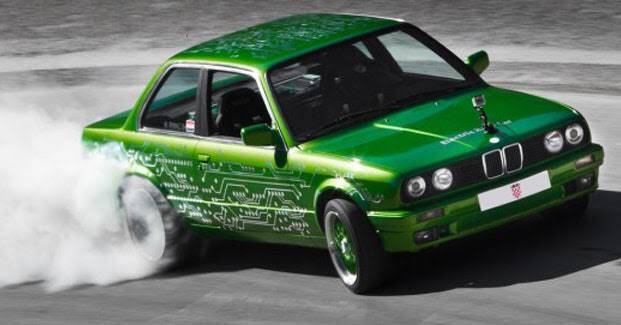

The groundwork for the company was laid in 2007 as a hobby garage activity of Mate Rimac. He converted his BMW 3 Series (E30) to incorporate an electric powertrain and subsequently gained attention from the press and investors. A significant part of the early financing came from angel investors and the sale of proprietary patents.
Rimac Automobili was founded in 2009 in Sveta Nedelja, near Zagreb, Croatia, where suitable facilities were rented. When he was 19 years old, Mate Rimac began converting an E30-M3 which served as his first test mule.
Rimac's first car was a converted 1984 BMW M3 called the Rimac e-M3. With a 0–100 km/h acceleration achieved in 3.3 seconds, it earned the title of fastest-accelerating electric vehicle in Category A, Group VIII (electric vehicle) and Class 3 (over 1000 kg) in 2011. It develops 601 PS and 900 N⋅m of torque, reaches 100 km/h from a standstill in 3.3 s and has a top speed of 280 km/h. Five development updates pushed the e-M3 to become the officially fastest-accelerating electric vehicle according to strict FIA rules.

In 2018, Volkswagen Group subsidiary Porsche Engineering Group GmbH acquired a 10% stake in Rimac to form a development partnership, as part of its electrification process. Hyundai Motor Company and Kia Motors jointly invested €80 million in 2019 and announced plans "to collaborate on the development of high-performance electric vehicles."
In March 2021, Porsche increased its stake in Rimac Automobili from 15% to 24%.
In July 2021, VW Group's Porsche and Rimac announced a joint venture that would incorporate Volkswagen's high-performance Bugatti brand as well as Rimac Automobili. The new venture is called Bugatti Rimac. In this venture, Rimac Group holds a 55% stake, while Porsche owns the remaining 45%. in June of that year, Porsche stated it was one of the participants in a new €500 million round of fundraising.
concept one


2013-2014
The Concept One is an all-electric battery-powered sports car. With a curb weight of 1850 kg, and a power output of 1305 PS, the Concept One can reach 100 km/h from a standstill in 2.6 seconds and continue to accelerate to a top speed of 355 km/h. 92 kWh of energy in the battery modules deliver enough energy to permit 600 km of range. The car was first unveiled in 2011 at the Frankfurt Motor Show, when some parts were contracted to other companies. The production version was introduced in 2016.
A production of 88 units was initially stated, which was later limited to 8 units, all of which were sold. The first car was for Spanish company Applus+ IDIADA, called the Volar-e. The second buyer is Paul Runge, one of the shareholders of Rimac automobili.
The battery cells are supplied by Sony, with wheels being supplied by HRE Performance wheels, developed in collaboration with Rimac.
Almost all of the materials are produced in-house, and none of the critical components used in the vehicle are off-the-shelf. The design team includes former designers from Pininfarina and Magna Steyr; the exterior of the car was designed by Croatian designer Adriano Mudri.
nevera


2022-now
The successor to the Concept One, named Nevera (renamed from Concept Two, styled as C_Two), was unveiled at the March 2018 Geneva Motor Show. The car has an entirely new design with butterfly doors and various power upgrades. The four updated electric motors produce a total of 1940 PS and 2360 N⋅m of torque. The carbon fibre body construction results in a total weight of 2150 kg, including the heavy battery packs. The Nevera claims to be able to accelerate from 0–97 km/h in 1.85 seconds and achieve a top speed of 415 km/h.
The car incorporates a fully independent torque vectoring system (R-AWTV) to improve handling and also includes many high-tech features such as a facial recognition system that would unlock the ignition only for the owner and adjust the car's settings according to the owner's mood. The car has a high-speed "drift mode", with an intelligent traction control system keeping the car under control. The Nevera will have Level 4 self-driving capability, according to Mate Rimac; it has eight cameras, a LIDAR, six radars, and twelve ultrasonic sensors. The production of the vehicle will be limited to 150 units.

Rimac Technology produces battery systems for Aston Martin's new sports car, the Valkyrie. The company also produces battery systems for Koenigsegg (specifically for the Regera), Jaguar E‑type Zero concept car and SEAT Cupra e-Racer concept car. In 2018, it entered a technical partnership with Automobili Pininfarina, whose first car, the Battista, is said to be based on the same architecture and uses the same powertrain as the Nevera.


Create Your Own Website With JouwWeb