







Oldsmobile (formally the Oldsmobile Division of General Motors) was a brand of American automobiles, produced for most of its existence by General Motors. Originally established as "Olds Motor Vehicle Company" by Ransom E. Olds in 1897, it produced over 35 million vehicles, including at least 14 million built at its Lansing, Michigan, factory alone. Oldsmobile became the top-selling car company in the United States from 1903 to 1904.

The 1902 to 1907 Oldsmobile Model R "Curved Dash" was the first mass-produced car, made on a progressive moving automotive assembly line, an invention which is often incorrectly credited to Henry Ford and the Ford Motor Company. Ford was the first to manufacture cars on a continuously moving and synchronized assembly line starting in 1913, five years into Model T production. Olds' moving assembly line was manually progressed, meaning that the vehicle being assembled was manually pushed to the next workstation after the assigned assembly was performed at the previous station. This differed from hand-making vehicles in the past where various workers would work on one car until it was completed, which was labor- and time-intensive
General Motors purchased the company on November 12, 1908. When GM assumed operations, platform sharing began with Buick products and Oldsmobile shared platforms were identified with the prefix "Series" followed by a number, while models developed by pre-GM engineers were identified with the prefix "Model" followed by a letter. Early on, Oldsmobile was a competitor of Hudson, as some former engineers of Oldsmobile took positions with Hudson.
model z


1908
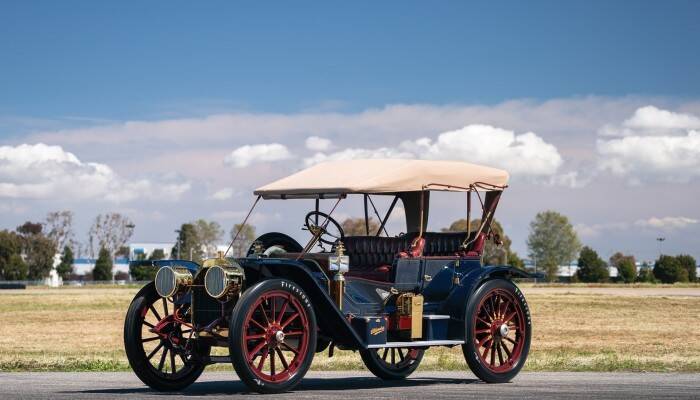
The Oldsmobile Model Z was the company's first top-level passenger car produced under the Oldsmobile brand before they became a division of General Motors in 1908. The Model Z was created and engineered after Mr. Olds left the company but before they became a division, the same year the car was introduced. It was the senior model to the mid-level Oldsmobile Model M, and the entry-level, Buick engineered Oldsmobile Model 20. It was upgraded to become the Oldsmobile Limited.
The Model Z was the first Oldsmobile to introduce a flathead engine with six cylinders, displacing 7423 cc developing 48 bhp. The engine was installed in the front, driving the rear wheels through a transmission shaft. The gearbox had three forward gears, with the gearshift lever positioned to the right of the driver.
For 1909 the engine displacement was increased to 8275 cc and a 2-door roadster was introduced.
limited

1910-1912


The Oldsmobile Limited was a top-level passenger car produced by GM's Oldsmobile Division in 1910, offered as an upgraded replacement to the Oldsmobile Model Z when it was discontinued in 1909. The Oldsmobile Limited was very large and expensive in comparison to vehicles offered by competitors, and was manufactured in Lansing, Michigan. It was the senior model to the mid-level Oldsmobile Autocrat of which it shared much of its technology while the Autocrat was smaller, and was replaced by the Oldsmobile Light Eight. It was also much larger than GM's lop level brand, the Cadillac Model Thirty which only had a four cylinder engine, and the Buick Model 10 which made the Limited the most expensive vehicle GM offered at the time.
The Series 23 was equipped with a large six-cylinder T-head engine that displaced 8275 cc developing 60 bhp. The engine was installed in the front, driving the rear wheels through a transmission shaft. The gearbox had four forward gears, with the gearshift lever and handbrake positioned externally and to the right of the driver, who sat on the right hand side of the vehicle.
six

1913-1915


1917-1921
The Oldsmobile Six, also known as the Model 53, 54 and 55 (1913-1915) then a brief cancellation until it reappeared as the Model 37, 37A and 37B (1917-1921) was a top level sedan along with the Oldsmobile Series 40 junior vehicle produced by GM's Oldsmobile Division and was manufactured at Lansing Car Assembly in Lansing, Michigan. It replaced the Series 28 also known as the "Oldsmobile Autocrat" and was replaced by the Oldsmobile Model 30 in 1927, and shared wheelbases with the Buick Six. It continued to use the T-head engine for two years. The various bodystyles were supplied by Fisher Body of Detroit, MI. It competed with the Chevrolet Series C Classic Six as Chevrolet was an independent company before becoming a division in 1917. Oldsmobile also shared technology with GMC for commercial and industrial products.
The Oldsmobile Six was reintroduced in 1917 with a new designation, called the Model 37 as a senior platform to the Oldsmobile Light Eight, and was positioned below Buick where it would remain. The engine displacement was reduced to a more efficient 2901 cc, and the overall size was reduced.
l-series

1932-1938


The Oldsmobile L-Series, or the Oldsmobile 8, was built from the 1932 through 1938. Oldsmobile had not offered a full-sized luxury flagship since the cancellation of the Oldsmobile Light Eight in 1923. The 1933 model introduced a completely new body style influenced by the "streamlined" appearance, and it was shared with all GM brands due to GM's Art and Color Studio headed by Harley Earl. The appearance showed influences of Chrysler and Lincoln-Zephyr vehicles.
The L-Series was equipped with a side-valve, 3933 cc straight eight-cylinder engine developing 87 bhp and was offered as a closed body sedan, coupe and convertible.
series 70

1939-1940

1941–1942/1946-1948

1949-1950
The Oldsmobile Series 70 is a full-size midrange automobile produced by Oldsmobile between the 1939 and 1950 model years. Oldsmobiles of this time period were in an upwardly-shaded "middle" position in GM's hierarchy of automobile brands. Chevrolet and Pontiac were the budget priced models, while Buick and Cadillac were the high-end brands. GM would discontinue the budget Oldsmobile Series 60 in 1949 and the Series 70 in 1950, while introducing the Oldsmobile 88 in 1949 to push Oldsmobile upmarket and leaving the lower priced market position to Chevrolet and Pontiac.
Production was delayed from 1942 until 1945 due to World War II. To celebrate the company's 44th anniversary, all limited production 1942 autos received a small "B-44" badge on their grille.
88
The Oldsmobile 88 (marketed from 1989 on as the Eighty Eight) is a full-size car that was produced by the Oldsmobile Division of GM from 1949 until 1999. From 1950 until 1974, the 88 was the division's most popular line, particularly the entry-level models such as the 88 and Dynamic 88. The 88 series was also an image leader for Oldsmobile, particularly in the model's early years (1949–51), when it was one of the best-performing automobiles, thanks to its relatively small size, light weight, and advanced overhead-valve high-compression V8 engine. This engine, originally designed for the larger and more luxurious C-bodied 98 series, also replaced the straight-8 on the smaller B-bodied 78. With the large, high-performance Oldsmobile Rocket V8, the early Oldsmobile 88 is considered by some to be the first muscle car.

first generation (1949–1953)
The new car used the same new A-body platform as the straight-6 engined 76 but paired it with the company’s new 5.0 L, 135 horsepower V8. This combination of a relatively small, light body and large, powerful engine was a sensation in performance circles, causing it to be viewed by some as the first muscle car.
V8 Oldsmobiles were automatic-only in 1949 as Oldsmobile lacked a manual gearbox that could handle the torque of the new engine.

second generation (1954–1956)
The 1954 Oldsmobiles were completely restyled, remaining on the GM B platform but receiving new longer and lower body shells, and new one piece wrap-around windshields and rear windows.
The standard Rocket V8 was enlarged to 170 horsepower, while Super 88s got a 185hp hors version.
Just one year after the all new 1954 models, the 1955s were heavily facelifted.

third generation (1957–1958)
Styling highlights were more evolutionary than radical, with a three-piece rear window design marketed as the “Twin-Strut Rear Window.”
Oldsmobile revived station wagons for the first time since 1950, offering the sporty hardtop Super 88 Fiesta.
Oldsmobile now surpassed its sister division Buick on the sales charts.

fourth generation (1959–1960)
All Oldsmobiles were completely restyled for 1959, with the 88 series given longer, lower and wider styling on a GM B-body chassis. The 88 shared its appearance with the top-model Oldsmobile 98.
A larger Rocket V8 rated at 315 hp was standard on the Super 88. The lower-priced Dynamic 88 retained the 265 hp '57–58 Rocket V8, with a 300 hp version optional.

fifth generation (1961–1964)
An all-new body and chassis with perimeter "Guard Beam" frame and all-coil suspension replacing the previous leaf springs highlighted the 1961 full-sized Oldsmobiles.
All full-sized Oldsmobiles had a Rocket V8 with the Dynamic 88 getting a 250 hp version that used regular gas, while the Super 88 was powered by a "Ultra High Compression" 394 Skyrocket V8 rated at 325 hp.

sixth generation (1965–1970)
The Delta name in 1965 was an upscale trim line of the Dynamic 88, the Dynamic 88 Delta, replacing the previous top-series B-body Olds, the Super 88.
A new option for all senior Oldsmobiles (88, Ninety-Eight and the new front-drive Toronado) was GM's automatic Comfortron Air Conditioning system first introduced by Cadillac in 1964.

seventh generation (1971–1976)
All GM B-body full-size cars were completely restyled and enlarged for 1971, but continued to ride on a 3150 mm wheelbase. It reached its maximum size in 1974 at 5763 mm in length. It was available as a pillared four-door Town Sedan, two-door and four-door Holiday hardtops and a convertible. Also new for 1971 was the Custom Cruiser station wagon, the first full-sized Oldsmobile wagon since 1964.

eighth generation (1977–1985)
The 1977 Delta 88s and other GM B-body cars were considerably downsized from their predecessors in length and wheelbase.
The standard engine was now a 3.8 L Buick V6 with a Turbo-Hydramatic 200 automatic transmission. An Oldsmobile 260 was the base V8, followed by either a Chevrolet 350 or Oldsmobile 350.

ninth generation (1986–1991)
In late 1985, for the 1986 model year, the Delta 88 Royale switched platforms from the GM B platform to the smaller front-wheel drive H platform. The Eighty Eight Royale was given a mild facelift in 1990, eliminating the former chromed grille for a body-colored fascia with four slots and the Oldsmobile Rocket logo.

tenth generation (1992–1999)
The Oldsmobile Eighty Eight was redesigned for 1992, following the redesign of the Ninety Eight the previous year. This was the last Eighty Eight or 88 model from Oldsmobile (along with its performance LSS and Regency models) before being discontinued in 1999 and being replaced in 2001 with the Aurora. The 3.8 L Buick V6 was still the only engine, but output increased to 170 hp. After the demise of the Ninety-Eight in 1996, Oldsmobile added the Regency to the 1997 and 1998 lineups, which used the same front fenders and chrome grille as the Ninety-Eight sedan but kept the standard Eighty-Eight body.
jetstar

1964-1965


1965
The Oldsmobile Jetstar I is a sporty, high-performance full-sized car produced by Oldsmobile for the 1964 and 1965 model years. Based on the upscale Starfire model, the Olds 88's B-bodied Jetstar I lacked many of the Starfire's standard luxuries but shared its powerful engine, roofline and seating arrangement. Positioned to compete with Pontiac's successful full-sized Grand Prix, it was only offered as a two-door hardtop. The Jetstar I was made in Lansing, Michigan, Kansas City, Kansas, and Linden, New Jersey.
The Jetstar I was initially designed as both a lower-priced companion to the more luxurious Starfire and a direct competitor to the successful Pontiac Grand Prix.
Standard equipment included the Starfire's 345 hp Rocket V8 engine, but lacked its automatic transmission, power steering, power brakes, leather interior, and distinctive brightwork trim. A three-speed column-shift manual transmission was standard, with a three-speed Roto Hydra-matic automatic with console-mounted T-handle shifter optional. A three-speed column-shift manual transmission was standard, with a three-speed Roto Hydra-matic automatic with console-mounted T-handle shifter optional.
The Jetstar I, like all other full-size Oldsmobiles, was completely restyled for 1965 with bodylines receiving a more rounded rendition.
vista cruiser
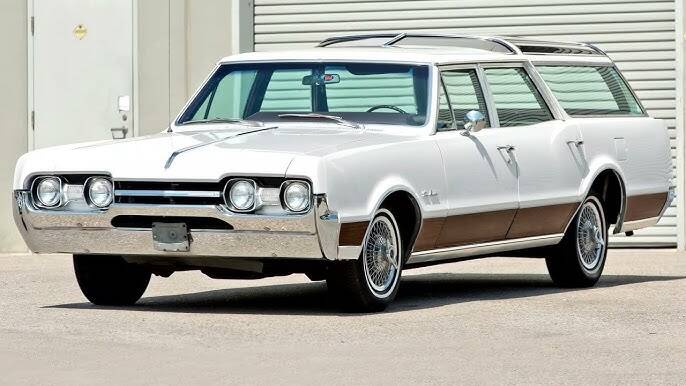
The Oldsmobile Vista Cruiser is a station wagon manufactured and marketed by Oldsmobile over three generations from 1964 to 1977.
The first and second generation Vista Cruisers are noted for their fixed-glass, roof-mounted skylights over the second-row seating with sun visors for the second row passengers, a raised roof behind the skylight and lateral glass panels over the rear cargo area along the raised roof, and access to the third row of forward-facing passenger seating was accomplished by a second row split bench seat that retracted forward.
first generation (1964–1967)
The first-generation Vista Cruiser pioneered a standard raised roof with split skylight that began over the second-row seating, with lateral glass panels over the rear cargo area that was earlier introduced in 1954 on the GMC Scenicruiser Bus. In 1964, the Vista Cruiser was one of three station wagons offered by Oldsmobile.
Engines in the Vista Cruiser paralleled other Olds intermediates, with a 5.4 L Rocket V8 producing from 210 to 320 horsepower.

second generation (1968–1972)
From 1968 to 1972, a 5.7 L V8 became standard, with a high-output 6.6 L V8 from the 442 muscle car optional in 1968-69, and a 7.5 L V8 available from 1970 to 1972.
For 1971, Oldsmobile brought back the full-sized Custom Cruiser wagon on a 3226 mm wheelbase 98 C-body chassis, featuring GM's disappearing clamshell tailgate, but the glass-roofed Vista Cruiser continued until 1972.

third generation (1973–1977)
While its Buick counterpart was replaced with the Buick Century Estate station wagon, the Vista Cruiser was the woodgrained version, and the new Cutlass Supreme Cruiser joined the station wagon list for 1974. Despite the shortened wheelbase, three-row seating returned, with the third row direction changed to facing rearward.
Standard equipment included a 5.7 L Rocket V8 and a three-speed Turbo Hydramatic transmission.
4-4-2
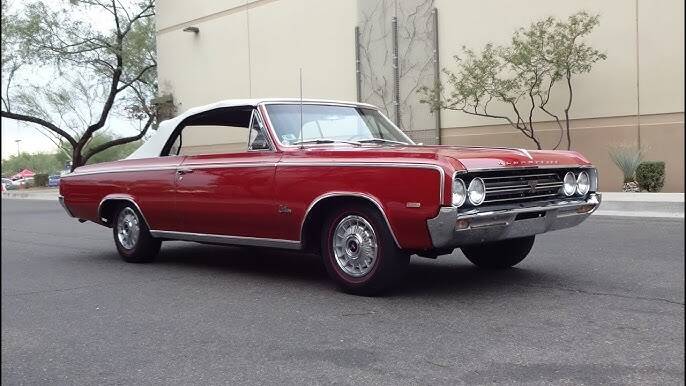
The Oldsmobile 4-4-2 is a muscle car produced by Oldsmobile between the 1964 and 1987 model years. Introduced as an option package for US-sold F-85 and Cutlass models, it became a model in its own right from 1968 to 1971, spawned the Hurst/Olds in 1968, then reverted to an option through the mid-1970s. The name was revived in the 1980s on the rear-wheel drive Cutlass Supreme and early 1990s as an option package for the new front-wheel drive Cutlass Calais.
The "4-4-2" name (pronounced "Four-four-two") derives from the original car's four-barrel carburetor, four-speed manual transmission, and dual exhausts. It was originally written "4-4-2".
first generation (1964-1967)
The 4-4-2 was born out of competition between Pontiac and Oldsmobile divisions of GM. The high performance GTO version of the Pontiac LeMans intermediate had proved an unexpected success midway through the 1964 model year. Oldsmobile's hasty response was to beef up their own popular Cutlass.
The standard transmission was a three-speed manual with column shift and the two-speed Jetaway automatic with switch-pitch torque converter was optional.
Car Life tested an L69 4-4-2 with a four-speed transmission and obtained a 0–100 km/h time of 6.4 seconds and 400m of 14.8 seconds at 156 km/h.
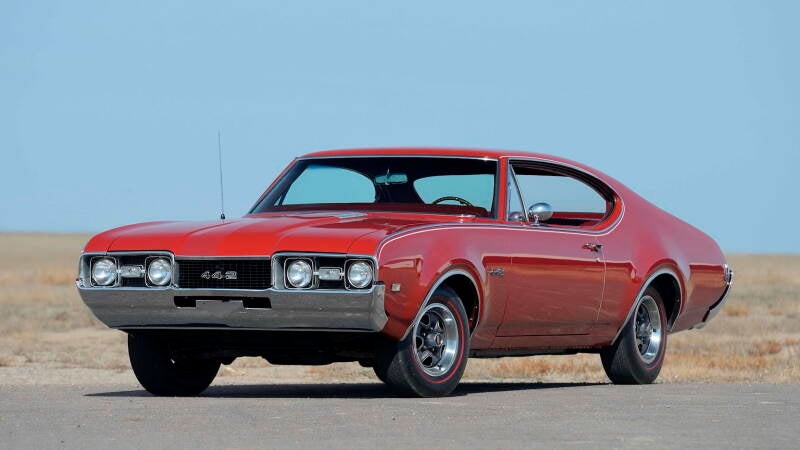
second generation (1968-1972)
The 4-4-2 became a separate model from 1968 through 1971. The wheelbase was 2845 mm, and over 33.000 were sold for 1968.
The base engine was still rated at 350 hp, but only with the standard three-speed and optional four-speed; automatics were rated at 325 hp. All standard 1968 4-4-2 engines are painted a bronze–copper color, as with the 1967s, topped with a fire-red air cleaner.
1970 was considered the pinnacle of performance from Oldsmobile.[15][16] In order to keep up in the horsepower arms-race, General Motors dropped the cap on engine size in 1970, and Oldsmobile responded by making the Olds 455 V8 the standard 4-4-2 engine. Output was 365 hp.

third generation (1973-1977)
Originally expected to debut for the 1972 model year, the new "Colonnade" body style was delayed until 1973 due to an auto workers strike in 1972. The body was redesigned to feature massive 1.5 m long doors and energy absorbing bumpers. The 1974 4-4-2 received the same facelift as other Cutlasses that year.
Engine offerings included the standard 180 hp Rocket 350 V8 or optional 230 hp Rocket 455. All engines were mated to catalytic converters, which required use of unleaded gasoline and spelled the end of true dual exhausts.
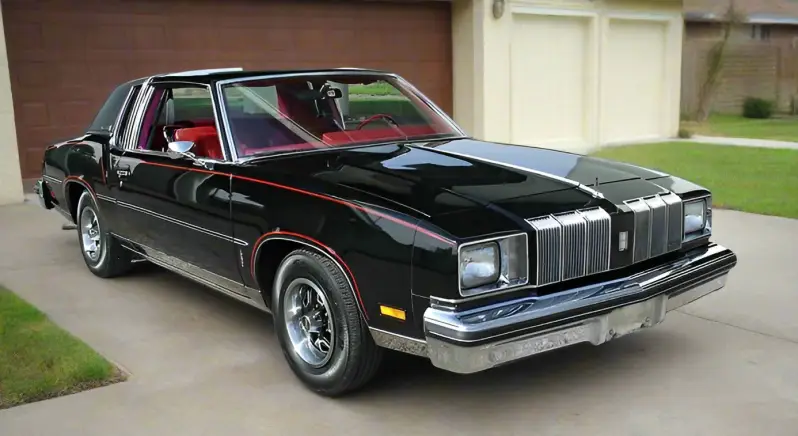
fourth generation (1978-1980)
The 4-4-2 model continued on the downsized A-body platform introduced for the 1978 model year. The 1978 version of the 4-4-2 was an option package on the semi-fastback "Aeroback" Cutlass Salon, which was now the entry-level trim of the best-selling Cutlass range. It was offered with all powertrains available on the standard Cutlass, including the 3.8 L Buick V6, 4.3 L Oldsmobile V8, and 5.0 L Chevrolet V8s.

fiith generation (1985-1987)
The 4-4-2 name was revived in 1985 on the rear-wheel drive G-body Oldsmobile Cutlass Supreme due to the demise of Oldsmobile and Hurst's official collaboration on the Hurst/Olds but Oldsmobile wanted to continue to offer a performance-oriented Cutlass model to the public. This W42 model replaced the 1983 and 1984 Hurst/Olds models and used the same 5.0 L LG8 V8. 3000 were produced in the first year, and all were sold quickly. 4273 were produced for 1986, and 4208 were made in 1987.

sixth generation (1990-1991)
The 442 option was revived on the Quad 442 front-wheel drive 1990–1991 Cutlass Calais. The engine was tuned with higher output camshafts which produced more top end power at the expense of idle quality. It used a single exhaust with a dual tipped muffler and produced 180 hp with a five-speed manual transmission. This 442 model lasted just two years. Only 3993 were produced.
toronado
The Oldsmobile Toronado is a personal luxury car manufactured and marketed by the Oldsmobile division of General Motors from 1966 to 1992 over four generations. The Toronado was noted for its transaxle version of GM's Turbo-Hydramatic transmission, making it the first U.S.-produced front-wheel drive automobile since the demise of the Cord 810/812 in 1937.
The Toronado used the GM E platform introduced by the rear-wheel drive Buick Riviera in 1963 and adopted for the front-wheel drive 1967 Cadillac Eldorado. The three models shared the E platform for most of the Toronado's 26-year history.


first generation (1966–1970)
second generation (1971–1978)
The 1966 model was widely recognized as a step forward in design, gaining publicity for the division by winning several leading automotive awards, such as Motor Trend's Car of the Year Award and Car Life's Award for Engineering Excellence. It was also the second American car to ever be awarded recognition in Europe, as the third-place finisher at the European Car of the Year competition in 1966.
The Toronado sold reasonably well at introduction, with 40.963 produced for 1966.
The first-generation Toronado persisted with the usual annual facelifts through 1970. Other than the brakes, the major changes were the replacement of the original 7 L V8 with the new 7.5 L in 1968, rated at 375 hp in standard form or 400 hp with the W-34 option. This option included a cold air induction system for the air cleaner, a special performance camshaft and a "GT" transmission calibrated for quick and firm up-shifts and better torque multiplication at 5 mph.
With heavily revised styling from the first generation, the Toronado transitioned from a "GT"-style car into a more traditional luxury car. It was now more similar to the Cadillac Eldorado than the Buick Riviera (which would be redesigned in 1974, then again in 1977), with styling taking several cues from the 1967–1970 Eldorado. Sales increased dramatically. All overall dimensions of the 1971 Toronado were larger than previous models.
The 7.46 L Rocket V8 was carried over from previous models as the standard Toronado engine. For 1977, the 7.46 L V8 was replaced by a smaller 6.60 L engine rated at 185 hp.
This generation was probably helped in the sales race by the radical and controversial "boat-tail" design of the contemporary Buick Riviera, since during this period the Toronado outsold its Buick cousin for the first time.


third generation (1979–1985)
The third generation Toronado was substantially downsized, losing nearly 450 kg and almost 410 mm in length. Reflecting its 5200 mm length and 2900 mm wheelbase, it came equipped with the smaller Oldsmobile 5.7 L V8. The engine was rated at 170 HP giving it a top speed of over 175 km/h and a 0–100 km/h acceleration time of 9.5 seconds. A 5.03 L V8 (140 HP) was introduced in 1980.
The three-speed Turbo Hydra-Matic automatic transmission was standard equipment from 1979 to 1981 and replaced by the four-speed Turbo Hydra-Matic 325-4L overdrive unit from 1982 to 1985.
This generation Toronado, along with its Riviera and Eldorado cousins, were the last body-on-frame, front wheel drive cars with longitudinally mounted V8 engines.
fourth generation (1986–1992)
With a nearly 16% price increase over the 1985 model, the final generation Toronado made its debut in 1985 for the 1986 model year. It was smaller overall, moved from body-on-frame to unibody construction, and was the first Toronado since 1969 to feature hidden headlights. The Toronado's previous longitudinally-mounted V8 engines were superseded by a single, transversely-mounted fuel-injected version of the Buick 3.8 L V6.
In mid-1987, Oldsmobile attempted to bolster declining Toronado sales by introducing a sportier model marketed as the Toronado Troféo.
The Toronado was ultimately replaced in the lineup in early 1994 by the Aurora sports sedan.
cutlass supreme
The Oldsmobile Cutlass Supreme is a mid-size car produced by Oldsmobile between 1966 and 1997. It was positioned as a premium offering at the top of the Cutlass range. It began as a trim package, developed its own roofline, and rose during the mid-1970s to become not only the most popular Oldsmobile but the highest selling model in its class.
It was produced as a rear-wheel drive two-door hardtop, sedan, and station wagon into the 1980s, and a convertible through 1972.
When production ended there was no direct replacement for the Cutlass Supreme, although the Intrigue introduced for 1998 was designed in size and price to replace all the Cutlass models.

first generation (1966–1967)
The Cutlass Supreme name first appeared for the 1966 model year, the first year of GM's new intermediate four-door hardtop sedan—also known as the Holiday Sedan. For the 1967 model year, the Cutlass Supreme line was expanded into a full series that also included a two-door hardtop coupe (Holiday Coupe), two-door pillared coupe (Sport Coupe), four-door pillared sedan (Town Sedan) and a convertible.
The standard Supreme engine for both years was Oldsmobile's 5.4 L "Ultra High Compression" Jetfire Rocket V8 rated at 320 hp. Oldsmobile also introduced a 5.7L V8 diesel engine option.

second generation (1968–1972)
The Cutlass and other GM intermediates were completely restyled for 1968 with wheelbases shortened for 2-door coupe models and lengthened for four-door sedans and station wagons (with the exception of the glass-roof Vista Cruiser station wagon, which rode on an even longer wheelbase).
The standard Rocket V8 was enlarged to310 hp.
1972 was also the final year for Olds to offer the Cutlass Supreme convertible, until 1990. In its final year, it was the best-selling convertible in the U.S.

third generation (1973–1977)
In 1973, the Cutlass Supreme, like other GM mid-size cars, was redesigned. Hardtop models were replaced by new "Colonnade" styling with fixed center pillars.
The Cutlass line soon became Oldsmobile's biggest seller, accounting for 43% of the division's total volume in 1974, with the Cutlass Supreme coupe being the single most popular model.
The 1973-74 energy crisis resulting from the Arab Oil Embargo led Oldsmobile to introduce two new smaller engines to the Cutlass line in 1975.


fourth generation (1978–1988)
The Cutlass Supreme was downsized for 1978, along with the rest of the Cutlass line. An upscale Cutlass Calais model was added, differing from the Cutlass Supreme only in minor trim details. The new notchback Cutlass Supreme proved to be far more popular than the controversial fastback Cutlass Salon coupe and sedan introduced at the same time. From 1978 through 1980, a high-performance 442 model was available, and for 1979 (Cutlass Calais), a special-edition performance model, the Hurst/Olds was offered.
fifth generation (1988–1997)
A front-wheel-drive Cutlass Supreme based on the GM10 platform (W-body) was introduced as a 2-door notchback coupe mid-year during the 1988 production run, while the final year of Cutlass Supreme RWD coupes were still being produced. This new FWD model shared its 2730 mm wheelbase with the Pontiac Grand Prix, Buick Regal, and later Chevrolet Lumina. Throughout its run, the convertible was especially popular and considered a separate trim level.
aurora
The Oldsmobile Aurora is a luxury sedan, manufactured and marketed by General Motors from 1994 until 2003 over two generations — sharing platforms with Buick Riviera and using the Cadillac-derived G platform. At the time of production, the Aurora was the flagship vehicle in the Oldsmobile lineup. It originated as the 1989 Oldsmobile tube car concept.
The Aurora replaced the Toronado coupe and eventually the Oldsmobile 98, LSS and Regency in the Oldsmobile range — using V8 and V6 engines. It was equipped with a four-speed automatic transmission.


first generation (1995–1999)
second generation (2001–2003)
The Aurora came standard with Oldsmobile's 4.0 L L47 V8 engine, a DOHC engine based on Cadillac's 4.6 L Northstar V8. The Northstar engine and 4T80-E had been exclusive to Cadillac prior to the Aurora. The L47 put out 250 hp.
The Aurora used a four-speed automatic transmission with driver selectable "normal" and "power" shift modes.
The Aurora was noted for its engine, build quality, ride, and structural integrity. During normal crush-to-failure tests to evaluate body torsional rigidity, the Aurora's unibody construction broke GM's testing machine.
Oldsmobile's original intention for the second generation was to move the Aurora further upmarket, retaining its V8-only drivetrain and sharing a platform with the new Buick Riviera, as with the first gen Aurora.
The second generation Aurora also offered a V6 engine, the LX5, a version of the DOHC Aurora V8 with six cylinders. The V6-powered Aurora was manufactured solely for model years 2001–2002, with production ending in mid-2002.
This Aurora did not sell as well as the original, overshadowed by GM's announcement in December 2000 that the Oldsmobile marque was to be phased out over the next several years.
alero

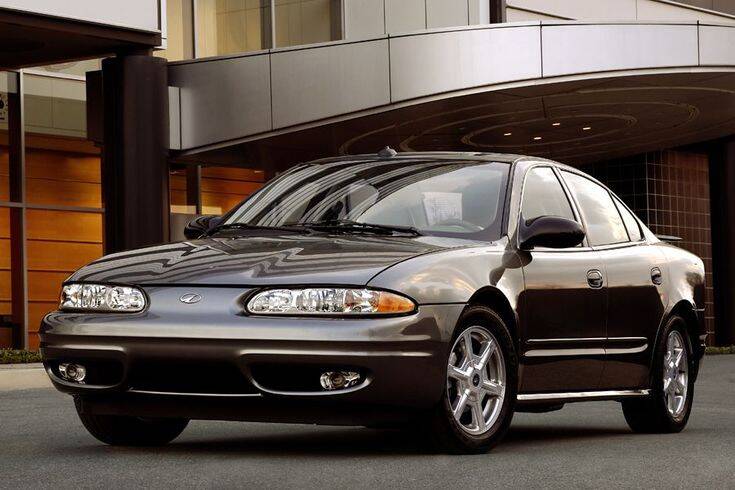

1999-2004
The Oldsmobile Alero is a compact car that was produced by General Motors for its Oldsmobile division. Introduced in 1998 as a 1999 model, the Alero was the replacement for both the Achieva and Cutlass. The Alero was Oldsmobile's last new model nameplate, and — on April 29, 2004 — was also the last Oldsmobile manufactured.
The Alero was sold either as a 4-door sedan or as a 2-door coupe. It shared its chassis and many parts, including engines, with the Pontiac Grand Am. The Alero experienced minimal changes during its 5-year run. Most of these changes were either in choice of engines or options.
The Alero's production ended with a special Final 500 Edition. These last 500 Aleros featured custom logos inspired by vintage Oldsmobile logos.
A second generation Alero was never built and the car was phased out with the Oldsmobile brand in 2004.
conceptcars
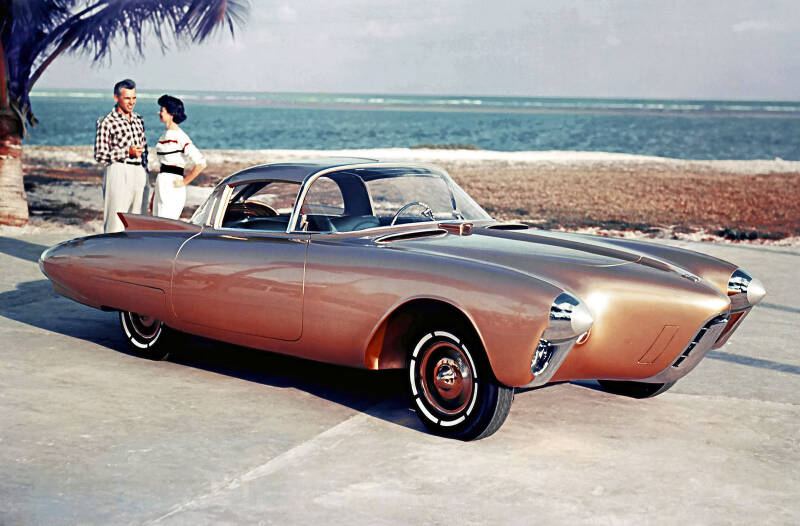
The Oldsmobile Golden Rocket was a two-seater show car built by Oldsmobile for the 1956 General Motors Motorama. The radically styled fiberglass concept, designed to resemble a rocket on wheels, was revised several times and displayed at various other auto shows, most notably at the 1957 Paris Motor Show where it generated much fanfare, 18 months after it was first revealed. The car was featured in the promotional short film Design for Dreaming along with the rest of the 1956 General Motors lineup.
The car was powered by an upgraded Rocket V8 engine tuned to produce 275 horsepower. According to interior photos, the Golden Rocket had an automatic transmission like all other Motorama show cars.
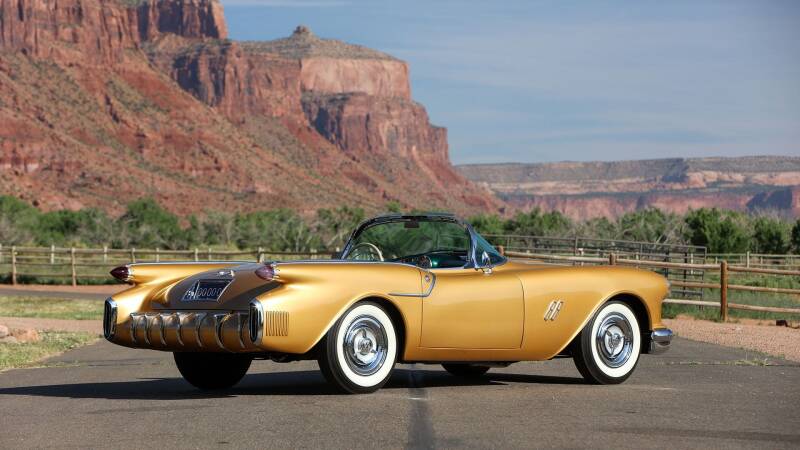
The Oldsmobile F-88 was a concept car created by Oldsmobile in 1954, with initial sketches made by Bill Lange. It used the chassis of the Chevrolet Corvette and shared its wheelbase. Like the Corvette, and the Pontiac Bonneville Special, the F-88's body was fiberglass.
The car used a 5.3 litre Super 88 V8 engine.
The F-88 was sold to John and Maureen Hendricks for over three million dollars. Today it is on display in its own showroom at the Gateway Colorado Automobile Museum.
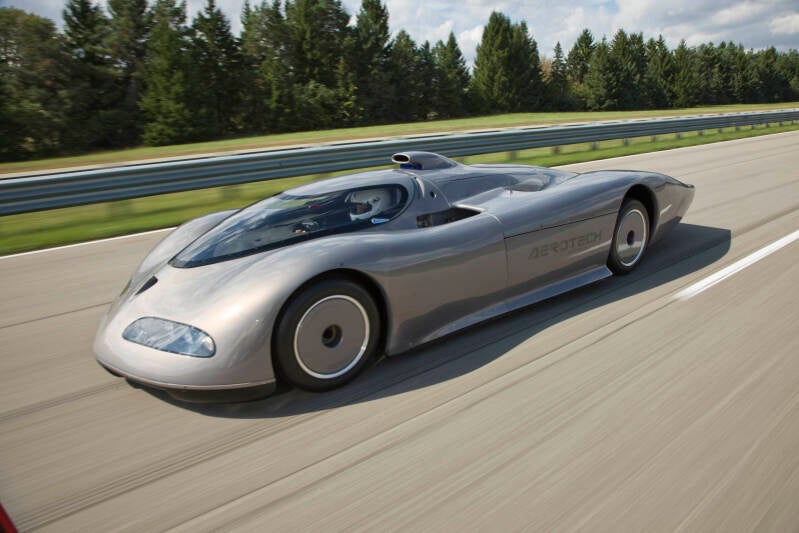
Oldsmobile Aerotech refers primarily to a series of three experimental high-speed vehicles built between 1987 and 1992, with the first two created to demonstrate the potential of Oldsmobile's new Quad 4 engine design. An Aerotech driven by four-time Indianapolis 500 winner A. J. Foyt set a world closed-course speed record on August 27, 1987. Oldsmobile used the Aerotech name on two unrelated concept cars in 1989.
The engine proved capable of generating a maximum power output in excess of 1000 hp.
The initial design sketches of the car were inspired by Le Mans winning race cars such as the Porsche 917. Completed in early 1985, the design was quickly approved by GM's top management, and the first mockup was finished shortly afterwards.
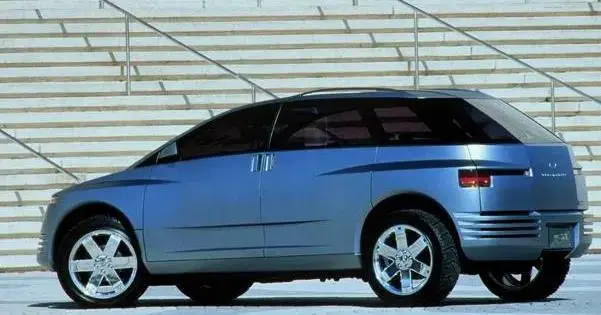
The Oldsmobile Recon was a 1999 concept car built by Oldsmobile. It was a compact crossover SUV that featured 5 doors, 5 seats, a dual panel panoramic sunroof and rear suicide doors.[2] Another unique feature was a reconfigurable instrument panel. The Recon was all-wheel-drive. It also featured a 3.0L V6 engine. The Recon never became a production model; the most likely reason is Oldsmobile's discontinuation in 2004. However, GM's first true compact SUV, the 2002 Saturn Vue does bear a slight resemblance to the Recon.
the end
Oldsmobile ended because of declining sales, brand identity confusion, and heavy internal competition within General Motors (GM).
By the 1980s, Oldsmobile's buyer base was aging rapidly. To attract younger buyers, GM launched the infamous marketing campaign: "This is not your father's Oldsmobile." The strategy backfired heavily. It alienated loyal older customers while failing to convince younger buyers, who still viewed the brand as outdated.
During Oldsmobile's identity crisis, Japanese and European imports (like Honda, Toyota, BMW, and later Acura and Lexus) surged in the US market. These competitors offered superior reliability, better fuel economy, and fresher styling in the exact mid-luxury segment Oldsmobile occupied.
By the late 1990s, Oldsmobile was losing billions of dollars. GM tried a final rebrand with highly modern cars like the Aurora sedan and the Intrigue, but the effort came too late.
In December 2000, GM officially announced it would phase out the brand. On April 29, 2004, the very last Oldsmobile—a cherry-red Alero GLS sedan signed by the assembly line workers—rolled off the line in Lansing, Michigan, ending 107 years of automotive history.


Create Your Own Website With JouwWeb