


Mitsubishi Motors Corporation ( lit. 'Three Diamonds Automotive Industry Company') is a Japanese multinational automobile manufacturer headquartered in Minato, Tokyo, Japan. In 2011, Mitsubishi Motors was the sixth-largest Japanese automaker and the 19th-largest worldwide by production. Since October 2016, Mitsubishi has been one-third (34%) owned by Nissan, and included in the Renault–Nissan–Mitsubishi Alliance.
Besides being part of the Renault–Nissan–Mitsubishi Alliance, it is also a part of Mitsubishi keiretsu, formerly the biggest industrial group in Japan. The company was originally formed in 1970 from the automotive division of Mitsubishi Heavy Industries.
Mitsubishi Fuso Truck and Bus Corporation, which builds commercial-grade trucks, buses, and heavy construction equipment, was formerly a part of Mitsubishi Motors, but is now owned by German automotive corporation Daimler Truck, with Mitsubishi continuing to own a small stake.

Mitsubishi's automotive origins date back to 1917, when the Mitsubishi Shipbuilding Co., Ltd., introduced the Mitsubishi Model A, Japan's first series-production automobile. An entirely hand-built seven-seater sedan based on the FIAT Tipo 3, it proved expensive compared to its American and European mass-produced rivals, and was discontinued in 1921 after only 22 had been built.
In 1934, Mitsubishi Shipbuilding was merged with the Mitsubishi Aircraft Co., a company established in 1920 to manufacture aircraft engines and other parts. The unified company was known as Mitsubishi Heavy Industries (MHI), and was the largest private company in Japan. MHI concentrated on manufacturing aircraft, ships, railroad cars and machinery, but in 1937 developed the PX33, a prototype sedan for military use. It was the first Japanese-built passenger car with full-time four-wheel drive, a technology the company would return to almost 50 years later in its quest for motorsport and sales success.
model A


1917-1921
Based on the Fiat Tipo 3, it was a four-door seven-seat sedan using a town car body style powered by a front-mounted 35 hp 2.8-litre straight-4 engine driving the rear wheels, and was capable of speeds up to 97 km/h. 22 were built at the company's Kobe shipyard, including prototypes, between 1917 and 1921.
Because it was expensive to produce—it was built entirely by hand, with the interior rear compartment furnished with lacquered white cypress—it could not compete with cheaper American and European competition, and Mitsubishi halted production after four years. Concentrating instead on its successful Fuso commercial vehicles, the Model A would be the company's last passenger car until the Mitsubishi 500 of 1960.
px33


1934-1937
The Mitsubishi PX33 is a prototype passenger car built by Mitsubishi Heavy Industries, the company which would eventually sire Mitsubishi Motors. Commissioned for military use by the Japanese government in 1934, it was the first Japanese-built sedan to have full-time four-wheel drive, a technology the company would return to fifty years later in pursuit of motorsport success.
Four working prototypes were built, and a version was in development using Mitsubishi's 6.7 litre, 70 PS 445AD powerplant, Japan's first direct injection diesel engine. However, the entire PX33 project was cancelled in 1937 after the government decided to prioritize Mitsubishi's manufacturing capabilities on commercial development of trucks and buses. In 1937, another Japanese company Tokyu Kurogane Kogyo began production of a smaller four-wheel drive car called the Kurogane Type 95.
500


1960-1962
The Mitsubishi 500 was the first passenger car produced after the Second World War by Shin Mitsubishi Heavy-Industries, Ltd, one of the companies which would become Mitsubishi Motors. It was built from 1960 until 1962 and formed the basis for Mitsubishi's next model, the Colt 600. It was exported in small numbers.
It was powered by a rear mounted, air-cooled 493 cc two-cylinder engine with a single downdraught carburettor producing 21 PS at 5000 rpm, driving the rear wheels through a three-speed manual transmission. The body was a monocoque, in order to be light and strong enough to reach the goal of seating four and reaching 100 km/h with such a small engine. Chassis code was A10, later A11.
Buoyed by its sales success, it was given an enlarged, 25 PS 594 cc engine (NE35A) in August 1961 for improved acceleration and durability. This model was known as the Mitsubishi 500 Super DeLuxe.
colt
The Mitsubishi Colt is a nameplate from Mitsubishi Motors that has been applied to a number of automobiles since 1962. It was first introduced with a series of subcompact cars in the 1960s, and then for the export version of the subcompact Mirage between 1978 and 2002. Chrysler, Mitsubishi's longtime partner, also used the name when applying its long-running practice of rebadging Mitsubishi vehicles as the Dodge and Plymouth Colt captive imports for the North American market between 1970 and 1994.
Colt was also used as a marque from 1974 to 1984 by the Colt Car Company to market Mitsubishi vehicles in the United Kingdom. In New Zealand, the Colt brand ceased in favour of the Mitsubishi name in 1970, upon the release of the "Dyna-wedge" Galant model.


Colt 600, 800, 1000, 1100, 1200, 1500 (1962–1971)
The Colt 600 is powered by a 594 cc NE35B OHV air-cooled straight-twin engine. At this time, Mitsubishi did not yet exist as an autonomous company, and vehicles were being produced by three regional subsidiaries of Mitsubishi Heavy Industries.
To complement the 600, a larger compact car was introduced in 1963, the Colt 1000. The larger Colt 1500 arrived in 1965, the Colt 1100 replaced the Colt 1000 in 1966, and the Colt 1200 took the 1100's place in 1968.
The third Colt line was the smaller, fastback Colt 800 and its derivatives the 1000F, 1100F, and 11-F. This series was built from 1965 until late 1971.


_(cropped).jpg)
Mitsubishi reintroduced the Colt nameplate as a front-wheel drive hatchback in 1978, with a sedan later released in 1982. Sold in Japan as the Mirage, the Colt name was restricted to markets such as Europe and Australia (where the Colt was built by Mitsubishi Motors Australia from 1982 to late 1989).
Five generations of Mirage-based Colts were sold between 1978 and 2002, with new generations released in 1983, 1987, 1991, and 1995. These Mirage derivatives were sold in various forms as the Mitsubishi Lancer in many markets, with the Colt nameplate in Europe typically restricted to the hatchback variants; coupes, sedans and station wagons were relegated to the Lancer name.


2002-2014
2008 facelift
2023-now
In November 2002, a new Colt was released by Mitsubishi in Japan with a design by Olivier Boulay and built on the same platform as the Smart Forfour.
Colt models included a 1.1, 1.3, and a 1.5-litre, fuel injected petrol engine with MIVEC as well as a turbocharged version of the 1.5. A three-door arrived in 2005 for Europe only.
Colts built in the Netherlands received a facelift in 2008. The Japanese-built Colt received their facelift in October 2009.
debonair
The Mitsubishi Debonair is a four-door executive sedan introduced by Mitsubishi Motors in 1964 to serve as their flagship passenger vehicle in the Japanese market. The word "debonair" means gentle, courteous, suave, lighthearted, or nonchalant. Three distinct generations were available during its 35-year production run until it was discontinued in 1999. The first and second generation models were built mainly for senior level executives of the Mitsubishi Group and affiliated companies, essentially a Mitsubishi senior executive company car made by the motor vehicle division of Mitsubishi.
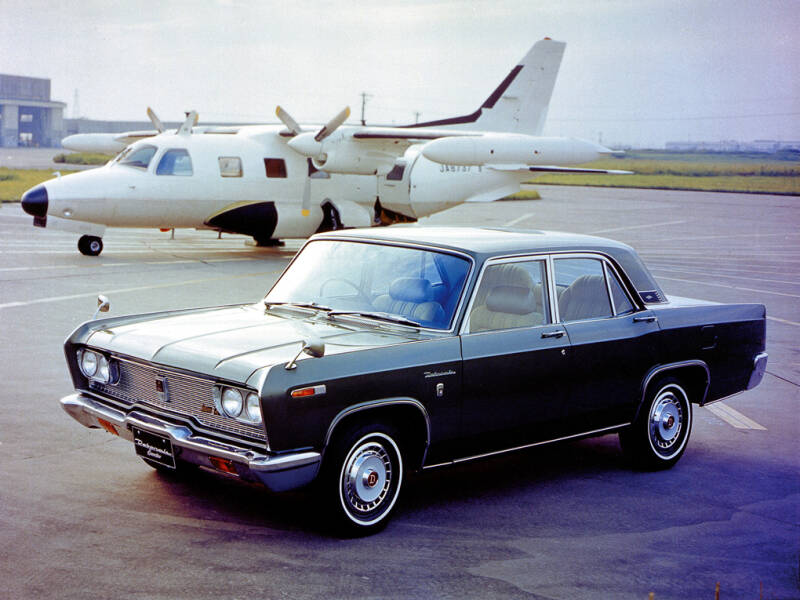
first generation A30/A31/A32/A33 1964-1986
The Debonair was Mitsubishi's competitor to the Nissan Cedric, Prince Gloria, Isuzu Bellel and Toyota Crown, and during the first generation's production, the appearance remained generally unchanged from 1964 until 1986, sharing a tradition with the Toyota Century.
Powered initially by the KE64 1,991 cc six-cylinder engine with twin carburetors and dual exhausts, the original A30 series developed 105 PS and had a maximum speed of 155 km/h.

second generation S11A/S12A 1986-1992
The second-generation Debonair adopted a front-wheel drive layout, a cost-effective way to increase interior space without investing money on engineering in an executive sedan, shared with the E11 Galant. It also came with Mitsubishi's first V6 engines, the 2.0-liter and the 3.0-liter under the "Cyclone" moniker, which were shared with the Galant model line later.
Even after the introduction of the more modern Diamante, the Debonair underwent one last facelift in 1991.

third generation S22A/S26A/S27A 1992-1999
The third-generation Debonair debuted in late 1992, which were longer and wider than its predecessors. The wider range of available engines was topped by a 260 PS 3.4 L V6 engine, and as Mitsubishi's domestic flagship incorporated much of the company's technology.
The Debonair was discontinued in November 1999 and directly replaced by the Proudia.
galant
The Mitsubishi Galant is an automobile which was produced by Japanese manufacturer Mitsubishi from 1969 until 2012. The model name was derived from the French word galant, meaning "chivalrous". There have been nine distinct generations with total cumulative sales exceeding five million units. It began as a compact sedan, but over the course of its life evolved into a mid-size car.
Initial production was based in Japan, with manufacturing later moved to other countries.
Spanning nine generations, total sales exceeded five million units. The sixth generation (1987–1992) was particularly notable for "Dynamic Four" technology, which included 4-wheel drive, 4-wheel steering, 4-wheel independent suspension, and 4-wheel ABS.
The model was officially discontinued in 2012 as Mitsubishi shifted its focus toward smaller cars and SUVs.

first generation A50 1969-1972

second generation A112, A114, A115 1973-1975

third generation A120/A130 1976-1979

fourth generation A160 1980-1982

fifth generation E10 1983-1986

sixth generation E30 1987-1991

seventh generation E50/60/70/80 1992-1995

eighth generation EA/EC 1996-2003

ninth generation DJ/DM 2004-2012
triton/L200
The Mitsubishi Triton or Mitsubishi L200 is a mid-size pickup truck produced by Mitsubishi Motors. In Japan, where it has only been sold intermittently and in small numbers, it was originally known as the Mitsubishi Forte and from 1991 as the Strada. In the United States, Mitsubishi marketed it as the Mitsubishi Mighty Max until 1996. Chrysler Corporation sold captive imports as the Dodge D50, Dodge Ram 50 and Plymouth Arrow truck in the U.S. and as the Chrysler D-50 in Australia.
For most export markets the name L200 is used.


first generation L200; 1978-1985
second generation K00/K10/K20/K30; 1986-1995
third generation K50/K60/K70; 1996-2004
fourth generation KA/KB; 2005-2013
fifth generation KJ/KK/KL; 2014-2023
pajero
The Mitsubishi Pajero is a full-size SUV (sport utility vehicle) manufactured and marketed globally by Mitsubishi over four generations—introduced in 1981 and discontinued in 2021.
The Pajero nameplate derives from Leopardus pajeros, the Pampas cat. Mitsubishi marketed the SUV as the Montero in North America, Spain, and Latin America (except for Brazil and Jamaica) due to the term "pajero" being derogatory (meaning "wanker") in Spanish. In the United Kingdom, it was known as the Shogun, named after the Japanese word for "General." The model was discontinued in North America in 2006.
The Pajero, Montero, and Shogun names were used on other, mechanically unrelated models, such as the Pajero Mini kei car, the Pajero Junior and Pajero iO/Pinin mini SUVs, and the Triton-based Pajero/Montero/Shogun Sport mid-size SUVs. The Pajero is one of four models by Mitsubishi (the others being the Triton, Pajero Sport and the Pajero iO) that share Mitsubishi's heavy-duty, off-road-oriented Super-Select four-wheel-drive system as opposed to their light-duty Mitsubishi S-AWC all-wheel-drive system.
The Pajero has generated more than 3.3 million sales in its 40-year run.

first generation L040-, L140- / NA, NB, NC, ND, NE, NF, NG 1982-1991
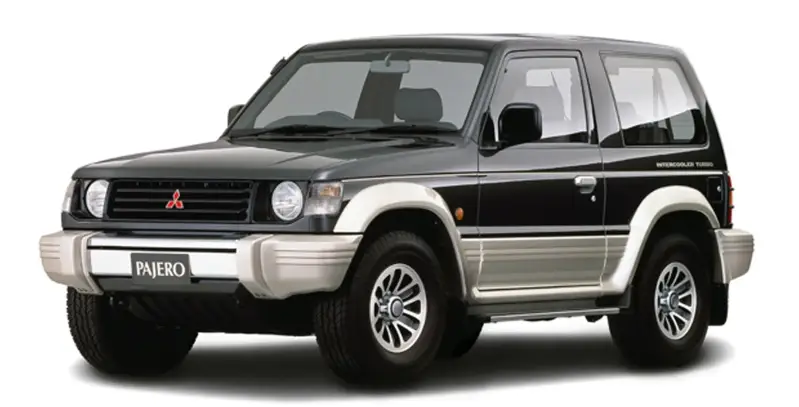
second generation V20-, V30-, V40- / NH, NJ, NK, NL 1991-1999

third generation V60-, V70- / NM, NP 1999-2006

fourth generation V80-, V90- / NS, NT, NW, NX 2006-2021

fifth generation LH 2026-now
starion


1982-1989
The Mitsubishi Starion is a sports car which was manufactured and marketed by Mitsubishi from 1982 until 1989 — with badge engineered variants marketed in North America as the Conquest, under the Chrysler, Dodge, and Plymouth brands. It is a two-door coupé with a fastback design and seating for four passengers. The Starion's straight-four engine is mounted in the front and drives the rear wheels, with some models being turbocharged.
The Starion was one of the first modern Japanese turbocharged performance automobiles with electronic fuel injection.
It was manufactured in two body configurations, a narrowbody and widebody; the narrower style complied with Japanese exterior dimension regulations taxing larger vehicles and engine displacement exceeding two liters.
Engine capacity differed between markets. American customers received the larger SOHC 2.6 L engine. Most markets received the SOHC 2.0 L engine. Horsepower for the turbocharged models ranged between 145 and 200 PS.
3000gt

1990–1993 (Series 1)

1994–1996 (Series 2)

1997–2000 (Series 3)
The Mitsubishi 3000GT is a front-engine, all-wheel/front-wheel drive grand touring/sports car manufactured and marketed by Mitsubishi from 1990 until 2000 over three different series. Manufactured in a three-door hatchback coupé body style in Nagoya, Japan, the 2+2 four-seaters were marketed in the Japanese domestic market as the GTO, and globally as 3000GT.
In North America, it was sold both as the Mitsubishi 3000GT (1991–1999) and the Dodge Stealth (1991–1996), a badge engineered, mechanically identical captive import. As a collaborative effort between Chrysler and Mitsubishi Motors, Chrysler was responsible for the Stealth's exterior styling.
The car was based on Mitsubishi's Sigma/Diamante and retained their transverse mounted 3-liter, 24-valve V6 engines and front-wheel-drive layout. The GTO's engines were naturally aspirated or with twin-turbochargers and were also available with active aerodynamics (automatically adjusting front and rear spoilers), four-wheel-steering, full-time all-wheel-drive and adaptive suspension.
Initially two different powertrains were offered on the 3000GT while the Stealth had three different options. The base 3-door hatchback Stealth came equipped with a 3.0-liter 12-valve SOHC V6 engine producing 164 hp. The base 3000GT and SL model and the Dodge Stealth ES and R/T model came equipped with a 3.0-liter DOHC V6 engine producing 222 hp. The VR-4 (Viscous Realtime 4WD) and R/T Turbo came equipped with a twin turbocharged 3.0-liter DOHC V6 engine producing 300 hp.
townbox
The Mitsubishi Town Box is a kei car (Town Box) and minivan (Town Box Wide) produced for the Japanese domestic market (JDM) by the Japanese automaker Mitsubishi Motors. It was initially available with the alloy-headed 657 cc inline-four engine, but switched to the 659 cc straight-three engine in 2002.
From June 1999 until August 2001, a slightly larger version of the same vehicle powered by a 1.1 L straight-four, the Mitsubishi Town Box Wide, was also available. The first generation Town Box was discontinued in November 2011, ending the twelve-year production run. The nameplate returned in February 2014 on a rebadged version of the Suzuki Every Wagon.
The first generation Town Box was also sold in Japan as the Nissan Clipper Rio, while the Town Box Wide was also produced under licence in Malaysia as the Proton Juara.
It was a mid-engined, rear-wheel drive (optional four-wheel drive was available) with a short bonnet. It was more passenger-oriented than the company's Bravo series. The rear seat used separate chairs rather than a bench and recessions in the floors provided additional leg space for the rear seat passengers.

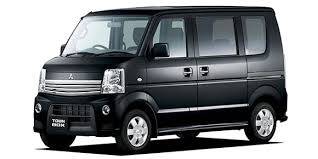

first generation U61W/62W/63W/64W 1999-2011
second and third generations 2014-now
townbox wide
dignity
The Mitsubishi Dignity is a full-size luxury car originally manufactured by Mitsubishi Motors from late 1999 to 2001 as the flagship of the company's domestic range, alongside the shorter Proudia, and was reintroduced 2012 to Japanese buyers as a rebadged fifth-generation Nissan Cima. The Dignity was discontinued for the second time in 2016. In Japan, it was sold at a specific retail chain called Galant Shop.
The name "Dignity" was used to describe the "peerless grandeur and majestic stateliness" of the model.
The Dignity/Proudia range was designed by Mitsubishi Motors and co-manufactured with Hyundai of South Korea, who marketed their own version as the Hyundai Equus (from 1999 to 2009). The Dignity was introduced as a competitor to the Nissan President, the Toyota Celsior, and the Toyota Century as the company's top level flagship.

first generation S43A 1999-2001
The first-generation Dignity was powered by Mitsubishi's 4498 cc, 90-degree, aluminum-block GDi V8 engine producing 280 PS. The Dignity and Proudia's combined volumes fell far shy of Mitsubishi's forecasted 300 sales per month, only 59 Dignitys were produced.
However, the Equus proved more commercially successful and would remain in production until replaced in 2008.
A first-generation Dignity is used by Fumihito, Prince Akishino, the second son of Emperor Emeritus Akihito.

second generation BHGY51 2012-2016
The Dignity nameplate was revived as a rebadged rear-wheel drive, fifth-generation Nissan Cima to Japanese customers only. The second-generation Dignity is slightly taller, but narrower and shorter, and is lighter by 200 kg .
The Dignity was only offered with one engine option, which is the Nissan's 3,498 cc V6 engine.
The Dignity/Proudia nameplates were discontinued for the second time in November 2016. Sales were extremely low - between July 2012 and February 2015, 98 examples were sold in Japan, the car's only market.


Create Your Own Website With JouwWeb