


Mercury was a brand of medium-priced automobiles that was produced by American manufacturer Ford Motor Company between the 1939 and 2011 motor years.
Created by Edsel Ford in 1938, Mercury was established to bridge the gap between the Ford and Lincoln model lines within Ford Motor Company. From 1945 until its closure, it formed half of the Lincoln-Mercury Division of the company.

In addition to serving as a combined sales network for Ford's two premium automotive brands, Lincoln-Mercury also represented the Continental (1956–1960), Edsel (1958–1960, formally designated Mercury-Edsel-Lincoln Division), Comet (1960–1961), Capri (1970–1978), De Tomaso (1972–1975), and Merkur (1985–1989, forming Lincoln-Mercury-Merkur). Through the use of platform sharing and manufacturing commonality, Mercury vehicles often shared components and engineering with Ford or Lincoln (or both concurrently), serving as counterparts for vehicles from both divisions.
Following an extended decline in sales and market share for Mercury, Ford announced the closure of the division at the end of 2010.
In 1937, Edsel Ford began work on Mercury as a completely new brand, personally selecting the Roman god's name from over 100 options – in spite of the name having been used just four years earlier for the Chevrolet Mercury and no fewer than seven separate failed automobile companies from 1903 to 1923.
In November 1938, Edsel Ford introduced four body styles of the Mercury Eight at the New York Auto Show. Along with a two-door sedan and a four-door sedan, the Mercury was also introduced as a two-door convertible and a two-door trunked sedan; the body design was overseen by E.T. 'Bob' Gregorie. While similar in concept to the modestly restyled De Luxe Ford, the V8-powered Mercury was an all-new car sized between the V8 Ford and the V12 Lincoln-Zephyr.
eight

first generation (1939–1940)

second generation (1941–1948)

third generation (1949–1951)
The Mercury Eight is an automobile that was produced by the American manufacturer Ford Motor Company under their now defunct division Mercury between 1939 and 1951. The debut model line of the Mercury division, Ford positioned the full-size Mercury Eight between the Ford Deluxe (later Custom) model lines and the Lincoln. In total, Ford assembled three generations of the Eight (before and after World War II).
During its production, the Eight offered a full range of body styles, including coupes, sedans, convertibles, and station wagons. For its first generation, the Eight was produced with its own body, adapting its own version of a Ford body for its second generation; for the third generation, the Eight shared its body with the Lincoln.


From 1946 to 1957, to attract buyers of medium-price vehicles, Ford of Canada marketed the Monarch brand in their dealership network. Using much of the body and trim of the Mercury, Monarch was a three-model line with the Richelieu, Lucerne and Sceptre matching the Mercury Monterey, Montclair, and Park Lane, respectively. It was sold at Ford dealerships, offering an upgraded car from the standard Ford line.
Ford of Canada replaced Monarch with the Edsel brand for 1958; a poor reception to Edsel in Canada led to the return of Monarch for 1959. The same year, the Ford Galaxie was introduced, shifting the Ford brand upward in price and content; fearing brand overlap with the Galaxie, Ford of Canada ended the Monarch brand after the 1961 model year.
In 1975, the Monarch nameplate would again become associated with Mercury (in both the United States and Canada), becoming the counterpart of the Ford Granada.
monterey

1952–1954

1955–1956

1957–1958

1959–1960

1961–1964

1965–1968

1969–1974
The Mercury Monterey is a series of full-size cars that were manufactured and marketed by the Mercury division of Ford from 1950 to 1974. Deriving its name from Monterey Bay, the initial Mercury Monterey served as the top-of-the-line two-door sedan model for 1950 and 1951 to compete with the hardtop models of Oldsmobile and Buick. It came with a vinyl roof covering, upgraded upholstery, and other features. The hardtop was introduced for 1952. During its production, the Monterey would be offered in multiple body styles, ranging from coupes, convertibles, sedans, hardtops, and station wagons.
Over its 22 years of production, the Monterey served variously as the flagship, mid-range, and entry-level offering of the full-size Mercury product range. The only Mercury nameplate to be in continuous production throughout the 1960s, the Monterey was positioned above the Medalist, Custom, and Meteor; later, it was positioned below the Turnpike Cruiser, Montclair, Park Lane, and finally the Marquis.
Following the 1974 model year, Mercury discontinued the Monterey, consolidating its full-size range down to the Marquis and Colony Park station wagon. For 2004, the Monterey nameplate was revived, becoming the counterpart of the Ford Freestar minivan; it was produced through the 2007 model year.
colony park

first generation (1957–1958)

second generation (1959–1960)

third generation (1961–1964)

fourth generation (1965–1968)

fifth generation (1969–1978)

sixth generation (1979–1991)
The Mercury Colony Park is an American luxury full-size station wagon that was marketed by the Mercury division of Ford Motor Company between 1957 and 1991. Distinguished by its simulated wood-grain paneling, the Colony Park was marketed as either the premium-trim or the sole full-size station wagon offering of the division. Following the 1960 demise of Edsel, full-size Mercury vehicles shared bodywork with Ford; the Colony Park served as the counterpart of the Ford Country Squire through 1991.
Serving as the flagship, and more exclusive, station wagon series of the Ford Motor Company — as the Lincoln division has not offered a factory-produced station wagon — the Colony Park was marketed against the similar Chrysler Town & Country prior to its 1979 downsizing, and GM's Buick Estate and Oldsmobile Custom Cruiser, each also offering external (simulated) woodgrain trim. During the mid-1950s and '60s, the Mercury Commuter was briefly offered as a lower-priced alternative to the Colony Park without the simulated woodgrain appearance, but lost sales to the very similar Ford Country Sedan and Ford Ranch Wagon and was cancelled in 1968, leaving the Colony Park as the only Mercury station wagon. In 1976, American Motors Corporation introduced the Jeep Grand Wagoneer, with similar passenger accommodation, luxury standard equipment and a simulated woodgrain appearance built on a dedicated chassis.
Through the late 1980s, demand for full-size station wagons declined as consumer interests shifted towards minivans and four-door SUVs. As the Ford Crown Victoria and Mercury Grand Marquis underwent a major redesign for the 1992 model year, the two model lines dropped the station wagon body from the lineup. Up to the 2010 closure of the Mercury brand, the Colony Park was not directly replaced.
park lane

first generation (1958–1960)

second generation (1964–1968)

park lane brougham 1967
The Mercury Park Lane is a full-sized automobile that was produced by the Mercury division of Ford Motor Company. While not officially introduced as the replacement of the Mercury Turnpike Cruiser, the Park Lane became the flagship of the Mercury model line upon its introduction. The second-generation Park Lane was positioned above the Mercury Montclair.
The Park Lane was powered by a Ford MEL V8. Initially rated at 360 hp for 1958, the Super Marauder engine option package allowed any Mercury with to increase its output to 400 hp (the first mass-production engine in an American automobile to be so rated). For 1959, the Super Marauder was discontinued, with the standard engine rated at 345 hp, retuned to 310 hp in 1960.
For 1967, to complement the Mercury Marquis, which was only available as a two-door hardtop, the Park Lane Brougham was introduced as an exclusive trim package of the already luxurious Park Lane on the sedan only.
As the division redesigned its full-sized line for 1969, the Marquis was expanded to a full model range, taking over the place of the Park Lane (the Brougham was largely replaced by the later Grand Marquis).
The Park Lane Brougham was the flagship Mercury model for 1967. Powerful and luxurious, it was offered as a four-door sedan, or four-door hardtop and was replaced by the Marquis as a two-door hardtop coupe only for 1968 followed by the sedan in later years.
marauder

first generation (1963–1965)

second generation (1969–1970)

third generation (2003–2004)
The Mercury Marauder is an automobile nameplate that was used for three distinct full-size cars produced by the Mercury division of Ford Motor Company. Deriving its name from the most powerful engines available to the Mercury line, the Marauder was marketed as the highest-performance version of the full-size product range.
Introduced as a 19631⁄2 model line for its first production run, the Mercury Marauder was distinguished by its sloped roofline (shared with the Ford Galaxie). The nameplate was a sub-model of the three Mercury model lines (Monterey, Monterey Custom, and S-55).
For the 1966 model year, the Marauder was replaced by the S-55 as a stand-alone model line, making it the Mercury counterpart of the Ford Galaxie 500 XL version.
The Marauder model name returned as a fastback-like version of the Mercury Marquis for the 1969 model year. It was positioned as a personal luxury car between the Mercury Cougar and Continental Mark III. Following the 1970 model year, the Marauder model was discontinued.
The Mercury Marauder nameplate was revived for the 2003 model year as a high-performance variant of the full-size Grand Marquis using the Ford Panther platform. After lower-than-expected sales, the Marauder was discontinued at the end of the 2004 model year. The Mercury Marauder became the last rear-wheel drive sedan introduced by Ford Motor Company in North America.
cyclone

first generation (1964–1965)

second generation (1966–1967)

third generation (1968–1969)

fourth generation (1970–1971)
The Mercury Cyclone is an automobile that was marketed by the Mercury division of Ford from 1964 to 1971. Introduced in 1964 as the Mercury Comet Cyclone, the Cyclone replaced the S-22 as the performance-oriented version of the Mercury Comet model line. The Cyclone became a distinct nameplate for the 1968 model year, as the Mercury Montego was phased in to replace the Comet.
Within Mercury, the Cyclone was positioned between the Cougar pony car and the Marquis/Marauder full-size two-doors. Though largely overshadowed by the Cougar, the Cyclone was positioned as a muscle car, representing the Mercury brand in racing as a clone of the Ford Fairlane Thunderbolt.
Four generations of the Cyclone were produced, with production ending after the 1971 model year. For the 1972 model year, the Cyclone returned as an option package for the Montego; only 30 examples were produced. Within the Mercury line, the Cyclone was not directly replaced. The Cougar XR7 was repackaged as a personal luxury version of the Montego for 1974.
marquis

first generation (1967–1968)

second generation (1969–1978)

third generation (1979–1982)

fourth generation (1983–1986)
The Mercury Marquis is a model line of automobiles marketed by Mercury from 1967 to 1986. Deriving its name from a title of French nobility, the Marquis was introduced as the divisional counterpart of the Ford LTD; four generations of the two model lines were paired through rebranding. Initially slotted as the flagship Mercury full-size range (above the Monterey), the Marquis would serve as the basis for the later Mercury Grand Marquis.
The first three generations of the Marquis were full-size sedans (alongside the Mercury Colony Park station wagon). For the fourth generation, the Marquis became the mid-size Mercury sedan, following the 1983 split of the Marquis and Grand Marquis into distinct product lines. As Ford Motor Company expanded its use of front-wheel drive, the Marquis ended production after the 1986 model year, replaced by the Mercury Sable (the Mercury counterpart of the Ford Taurus). As the Grand Marquis, the nameplate continued on until the closure of Mercury during the 2011 model year.
cougar

first generation (1967–1970)

second generation (1971–1973)

third generation (1974–1976)

fourth generation (1977–1979)

fifth generation (1980–1982)

sixth generation (1983–1988)

seventh generation (1989–1997)

eighth generation (1999–2002)
The Mercury Cougar is a series of automobiles that was sold by Mercury from 1967 to 2002. The model line is a diverse series of vehicles; though the Cougar nameplate is most commonly associated with two-door coupes, at various stages in its production, the model also was offered as a convertible and a hatchback. During its production as the mid-size Mercury line, the Cougar was also offered as a four-door sedan and five-door station wagon.
In production for 34 years across eight generations (skipping the 1998 model year), the Cougar is second only to the Grand Marquis (36 years) in the Mercury line for production longevity. 2.972.784 examples were produced, making it the highest-selling Mercury vehicle.
During the 1970s and 1980s, the marketing of the Mercury division was closely associated with the Cougar, with promotional materials advertising Mercury dealers as "The Sign of the Cat" with big cats atop Lincoln-Mercury dealer signs. Cat-related nameplates were adopted by other Mercury lines, including the Bobcat and Lynx.
For its first two generations, the Cougar was derived from the Ford Mustang. Initially serving as a pony car, the popularity of the Cougar led it to replace the Cyclone muscle car in the Mercury model line. The second generation moved its market position closer to the personal luxury car segment.
The eight generation served as the replacement for the Ford Probe, the first front-wheel drive Cougar shifted market segments from two-door personal luxury coupe to three-door sport compact, introducing the first Mercury sport hatchback coupe since the 1986 Mercury Capri.
bobcat


1974-1980
Lincoln-Mercury dealers marketed a rebadged variant of the Pinto as the Mercury Bobcat, beginning with the 1974 model year in Canada. It was produced in all of the same body styles and styled with a unique egg-crate grille and chrome headlamp bezels (which were later recycled for a styling update to the 1976 Pinto). The rear featured modified double-width tail lamps for the sedan and Runabout models.
For 1975, the Bobcat was added to the U.S. market and sold initially in upgraded levels of trim as the Runabout hatchback and Villager wagon. Lesser-trimmed versions were offered in subsequent model years. The Bobcat was never offered as a two-door sedan with an enclosed trunk for the U.S. market. The Bobcat was offered as a two-door sedan for a limited number of years in Canada. All Bobcats were restyled with a domed hood and a taller vertical bar grille styled to look like senior Mercury models. Throughout all the model years, Bobcats offered various appearance options that were similar to the Pinto's.
For 1979, the Bobcat received a major restyling shared with the Pinto featuring a slanted back front end with rectangular headlamps and inboard vertical parking lamps but distinguished with a large vertical bar grille. Except for the wagons, the tail lamps were revised. The base instrument cluster received a new rectangular design with a modified dash pad.
Production of the Bobcat ended in 1980 to make way for its replacement, the Mercury Lynx. In total, 224,026 Bobcats were produced from 1975 until 1980.
grand marquis

The Grand Marquis name made its first appearance in 1974 as part of an interior trim package for the Marquis Brougham.
For 1975, all full-size Mercury sedans adopted the Marquis nameplate, as the division retired the Monterey (in use since 1950). To expand the model range, the Grand Marquis became the highest-trim Marquis (slotted above the Brougham).
1975–1978 marquis

first generation (1979–1991)

second generation (1992–1997)

third generation (1998–2002)

fourth generation (2003–2011)
The Mercury Grand Marquis is an automobile that was produced by Mercury from the 1975 until 2011 model years. Introduced as the flagship sub-model of the Mercury Marquis in 1975, the Grand Marquis became a stand-alone model line in 1983, serving as the largest Mercury sedan. The model line served as the sedan counterpart of the Mercury Colony Park station wagon up to 1991. The fourth generation was the basis of the 2003 and 2004 Mercury Marauder.
From 1979 until 2011, the Grand Marquis shared the rear-wheel drive (RWD) Panther platform with the Ford LTD Crown Victoria (Ford Crown Victoria after 1992), and from 1980, the Lincoln Town Car. For over three decades, the Ford and Mercury sedans were functionally identical, with two of the three generations of the model line sharing the same roofline. The Grand Marquis was available as a four-door sedan for nearly its entire run; from 1988 to its final year in 2011, it was the only body style that was offered. A four-door hardtop was available from 1975 to 1978 and a two-door hardtop coupe from 1975 to 1987.
The Grand Marquis was the second-best-selling Mercury line (after the Cougar) with 2.7 million units produced; at 36 years of continuous production, the Grand Marquis was the longest-running Mercury nameplate (the Cougar, 34 years).


For the 1985 model year, Ford chose to revisit the success of the 1970s Mercury Capri, with participating Lincoln-Mercury dealers launching the Merkur brand. Drawing its name from the German word for Mercury, Merkur sold German-produced captive imports designed by Ford of Europe, competing against European executive cars sold in North America from Audi, BMW, Mercedes-Benz, Saab, and Volvo (along with the launch of Acura).
The initial Merkur product line included the Merkur XR4Ti sports coupe, a federalized version of the Ford Sierra XR4i (renamed by Ford in deference the GMC Sierra pickup truck). For the 1988 model year, the brand doubled its product range with the introduction of the Merkur Scorpio, sharing nearly its entire specification with the Ford Scorpio flagship sedan of Ford of Europe.
Following the 1989 model year, Ford discontinued the Merkur brand. In addition to the combined model line falling far under sales projections, the cancellation resulted from several additional factors. At the time, the German assembly of the vehicles led to unstable pricing of the vehicles (partially due to an unstable exchange rate between the US dollar and the West German mark at the time). As many examples of the Scorpio sold for over US$26.400 at the time (approximately $68.569 in current dollars), despite its close appearance to the Mercury Sable, the Scorpio bore a price closer to the Lincoln Town Car and the Mark VII of the time. In addition, for the 1990 model year, cars sold in the United States were required to meet updated passive safety regulations, requiring the fitment of airbags or motorized seatbelts; neither the XR4Ti nor the Scorpio were designed with such features nor were they due for a redesign by Ford of Europe). At only five years, Merkur remains one of the shortest-lived brands in the modern American automotive industry.
sable

first generation (1986–1991)

second generation (1992–1995)
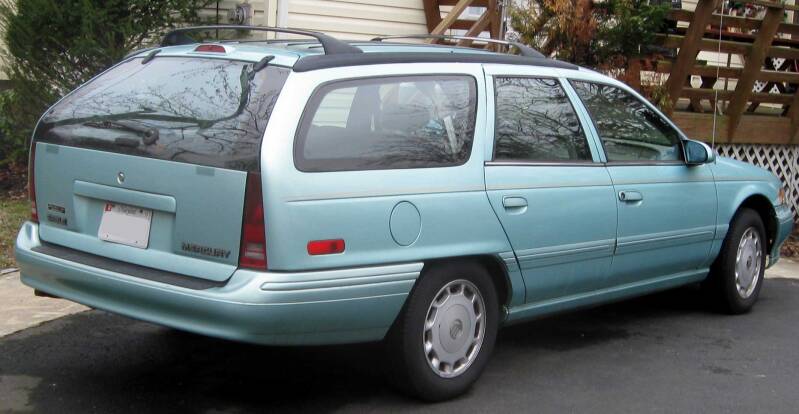

third generation (1996–1999)

fourth generation (2000–2005)

fifth generation (2008–2009)
The Mercury Sable is a range of automobiles manufactured and marketed by the Mercury brand of Ford Motor Company. Introduced on December 26, 1985, as the replacement for the Mercury Marquis, the Sable marked the transition of the mid-sized Mercury product range to front-wheel drive.
Over its production span, the Sable was Mercury's badge-engineered counterpart to the Ford Taurus, below the Grand Marquis in the Mercury range. From the 1986 to 2005 model years, it was produced as a mid-sized, four-door sedan and five-door station wagon. For 2006, the Sable was replaced by the full-sized Montego and mid-sized Milan. It was reintroduced for 2008 as a full-sized car, offered as a four-door sedan.
Because of declining sales, the Sable was discontinued after the 2009 model year, leaving no Mercury counterpart for the sixth-generation Taurus. The final Sable was produced on May 21, 2009; in total, 2.112.374 Sables were produced during its 1985 to 2005 production run.
For 1986, the Sable was offered was with two engines: a 90 hp HSC I4 (mated to a three-speed automatic) and a 140 hp Vulcan V6 (paired to a four-speed automatic). Following poor sales of the four-cylinder engine in the Sable, the engine was dropped from the line (along with the 3-speed automatic) for 1987.
mountaineer

first generation (1997–2001)

second generation (2002–2005)

third generation (2006–2010)
The Mercury Mountaineer is a mid-size luxury sport utility vehicle (SUV) that was sold by Mercury from 1996 until 2010. The first Mercury SUV, the Mountaineer was a divisional counterpart of the Ford Explorer, marketed above it and between the Lincoln Aviator (ultimately replacing the latter). Across its three generations, the Mountaineer was marketed exclusively as a 5-door wagon, with no counterpart to the 3-door Explorer Sport or the Explorer Sport Trac pickup truck.
For its entire production, the Mountaineer was assembled by Ford at its Louisville Assembly facility (Louisville, Kentucky); prior to 2007, additional production was sourced from St. Louis Assembly (Hazelwood, Missouri).
As with the Ford Explorer Limited, the Mercury Mountaineer was offered only as a five-door wagon.
For 2000, the Mountaineer was the third-best-selling Mercury (behind the Sable and Grand Marquis); ten years later, the model line had become the slowest-selling vehicle of the brand. Following the June 2010 announcement by Ford Motor Company to shelve the Mercury brand, the final Mountaineer was produced on October 1, 2010 at the Louisville, KY assembly plant.
the end
After 2000, Ford began to phase out its practice of releasing direct Mercury counterparts of its Ford car lines. Following the retirement of the Tracer and Mystique, no version of the Ford Focus was developed as a Mercury. Later on in the decade, Ford did not develop Mercury counterparts of the Ford models.
On June 2, 2010, Ford announced the closure of the Mercury line effective at the end of 2010; the company intended to concentrate its marketing and engineering efforts on the Ford and Lincoln model lines. In terms of overall sales in North America, the Mercury brand held a 1 percent share (compared to the 16 percent share of Ford). After selling under 93.000 vehicles for 2009, Mercury had sold fewer vehicles than either Oldsmobile or Plymouth prior to their discontinuation.


Create Your Own Website With JouwWeb