





the start
General Motors Company (GM) is an American multinational automotive manufacturing company headquartered in Detroit, Michigan, United States.
The company is most known for owning and manufacturing four automobile brands: Chevrolet, Buick, GMC, and Cadillac, each a separate division of GM. By total sales, it has continuously been the largest automaker in the United States, and was the largest in the world for 77 years before losing the top spot to Toyota in 2008.


est. 1911
est. 1903
est. 1911
est. 1902
General Motors operates manufacturing plants in eight countries. In addition to its four core brands, GM also holds interests in Chinese brands Baojun and Wuling via SAIC-GM-Wuling Automobile. GM further owns a namesake defense vehicles division which produces military vehicles for the United States government and military, the vehicle safety, security, and information services provider OnStar, the auto parts company ACDelco, and a namesake financial lending service.
The company originated as a holding company for Buick established on September 16, 1908, by William C. Durant, the largest seller of horse-drawn vehicles at the time. The first half of the 20th century saw the company grow into an automotive behemoth through acquisitions; going into the second half, the company pursued innovation and new offerings to consumers as well as collaborations with NASA to develop electric vehicles. The current entity was established in 2009 after the General Motors Chapter 11 reorganization.
As of 2024, General Motors ranks 25th by total revenue out of all American companies on the Fortune 500 and 50th on the Fortune Global 500. In 2023, the company was ranked 70th in the Forbes Global 2000. In 2021, GM announced its intent to end production of vehicles using internal combustion engines by 2035, as part of its plan to achieve carbon neutrality by 2040. These plans were mostly scaled back in 2025.
the purchases
GM's first acquisition was Buick, which Durant already owned, then Olds Motor Works on November 12, 1908. Under Durant, GM went on to acquire Cadillac, Elmore, Welch, Cartercar, Oakland (the predecessor of Pontiac), the Rapid Motor Vehicle Company of Pontiac, Michigan, and the Reliance Motor Car Company of Detroit, Michigan (predecessor of GMC) in 1909. In 1926, the company introduced the Pontiac brand.


Acadian (1962-1971)
Alphabetically the first of all GM brands, Acadian was the name for slightly altered Chevrolet Chevy IIs and Chevelles sold in Canada by Pontiac-Buick dealers.
Alpheon (2010-2015)
A Korea-only endeavor, the Alpheon brand was created shortly after GM went bankrupt, and launched with only one model, a rebadged second-generation Buick LaCrosse. The sedan was sold through Daewoo dealers, and at the time, the company needed a large sedan in its lineup, and couldn’t call it a Buick since the brand wasn’t established in the country, and didn’t want to badge it a Chevrolet either. The model and the brand were both canned in 2015.
Asüna (1992-1994)
Asüna was the equivalent of Geo, but for Pontiac-Buick-GMC dealers in Canada who also wanted a lineup of small and affordable vehicles. All of its cars were shipped in from factories in Asia.
Baojun (2010-present)
Baojun is owned by a joint venture established by GM and SAIC Motor of Shanghai, China. Several of its products are crossovers, but it also markets sedans, station wagons and an electric city car.
Beaumont (1966-1969)
Beaumont was originally a model name used by Acadian. It became a standalone brand for the Canadian market in 1966, producing its own version of the Chevrolet Chevelle.
Bedford (1931-1991)
Bedford was the commercial vehicle division of GM's U.K. brand Vauxhall for several decades. Early Bedfords were Chevrolets assembled locally from components originating in Canada.
Buick (1899-present)
Born in Arbroath, Scotland, David Dunbar Buick set up a car company under his own name in 1899. Although he left it seven years later, Buick remains the longest-lived of all GM brands.
Cadillac (1902-present)
The second oldest of the GM brands is Cadillac, which was founded under another name in 1901. It was reorganized (and named after French explorer and Detroit founder Antoine de la Mothe, Sieur de Cadillac) the following year.
Cartercar (1905-1915)
GM founder William Durant bought Cartercar from its creator Byron Carter in 1909, largely because of its friction-drive transmission. Criticized later for his decision, Durant said, "Well, how was anyone to know that Carter wasn't to be the thing?"
Chevrolet (1911-present)
William Durant and Swiss race car driver Louis Chevrolet created Chevy during Durant's period of exile from General Motors. The new business was so successful that Durant was able to buy his way back into GM after just five years.
Daewoo (1937-2005)
The South Korean company became a GM subsidiary in 2001 and was renamed GM Korea ten years later. From 2005, cars formerly sold in Europe as Daewoos were renamed Chevrolet.
Elmore (1893-1916)
Elmore was one of many companies added to the rapidly expanding list of GM brands during William Durant's buying spree. Production stopped in 1912, four years before the remains of the marque were sold off.
Envoy (1959-1970)
While Pontiac-Buick-GMC dealers in Canada were selling Vauxhall models imported from the U.K., Chevrolet-Oldsmobile dealerships also wanted small and affordable models to sell, so the Envoy brand was created. These rebadged Vauxhall sedans and wagons, as well as Bedford vans, had slightly different features and trim.
Epic (1964-1970)
Similar to the Envoy brand, a couple of Vauxhall models were imported into Canada for Pontiac-Buick-GMC dealers, while Chevrolet-Oldsmobile retailers received rebadged variants called the Epic HA and Epic HB. They were mostly identical to the Vauxhall Viva models, but with slightly different exterior styling elements to set them apart.
Ewing (1908-1911)
The Cleveland Auto Cab Company began building taxis named after its home town of Geneva, Ohio. They were renamed Ewing after an investor who took over the whole business. GM bought the brand in 1909 and, typically for the era, shut it down two years later.
Geo (1989-1997)
Geo was established as a brand selling rebadged Isuzus, Suzukis and Toyotas. It was shut down in 1997, but former Geos continued to be sold as Chevrolets until as late as 2004.
GM (1996-2003... but see note)
GM was used as the brand name for the all-electric EV1 which was produced long after the first electric car boom and shortly before the second. Nearly all its products were repossessed and destroyed.
(Note: GM Authority readers have helpfully pointed out that the GM nameplate also appeared on Yellow Coach buses built after that brand's retirement in 1943, and that it was one of many nameplates used for the 1970s Basic Utility Vehicle, or BTV, developed by Vauxhall on behalf of General Motors Overseas Operations and based on the Bedford HA van.)
GMC (1912-present)
GMC was formed by merging the Rapid and Reliance brands, both of which had been bought by GM before 1910. The GMC name was first used in 1912.
Holden (1856-2020)
Australian company Holden was founded as a saddlery in the mid-19th century and later moved into manufacturing car bodies. GM bought it in 1926, but stopped production in 2017 and discontinued the brand entirely in 2020.
Hummer (1992-2010)
The original Hummers were civilian vehicles built by AM General. GM bought the brand in 1998 and discontinued it in 2010. The upcoming Hummer EV pickup and SUV will be marketed by GMC.
LaSalle (1927-1940)
LaSalle was one of four companion makes allied to existing GM brands in an effort to exploit the auto market more fully. LaSalle was the companion to Cadillac, but built more affordable cars until it was abandoned in 1940.
Lotus (1948-1986)
GM bought a controlling interest in 1986, four years after the death of company founder Colin Chapman. In 1993, it was sold to Romano Artioli, who also owned Bugatti at that time. The Lotus Elise is named after Artioli's granddaughter, Elisa.
Marquette (1909-1912, 1929-1931)
Marquette was established to build Rainier cars in the first decade of the 20th century. The name reappeared in 1929 as a Buick's companion make, but was discontinued very soon afterwards.
McLaughlin (1907-1942)
Canadian automaker McLaughlin became part of the GM empire in 1918 and was merged with Chevrolet Canada to form General Motors Canada. McLaughlin cars continued to be sold until 1942.
Oakland (1907-1931)
Oakland was the only GM brand to be outlived by its companion make. A successful brand in its own right, placed slightly above Chevrolet in the GM hierarchy, it was joined by Pontiac in 1926. While Pontiac continued into the 21st century, Oakland did not survive beyond 1931.
Oldsmobile (1897-2004)
Founded by Ransom E. Olds, Oldsmobile was one of the longest-surviving of all GM brands. Its Curved Dash model of 1901 is credited with being the first car built on an assembly line. It was acquired by GM in 1908 and withdrawn from the market 96 years later.
Opel (1899-2017)
One of three European GM brands, Opel built its first car in 1899. GM took a majority shareholding in the German company in 1929 and bought it outright in 1931. For many years the centerpiece of GM Europe, it was sold to Groupe PSA in 2017 and is about to become one of the brands in the Stellantis conglomerate.
Passport (1988-1991)
Passport was a Canadian brand which sold cars built in Europe or Asia. It was replaced by Asüna, which was no more successful than Passport had been.
Pontiac (1926-2010)
As mentioned previously, Pontiac was the only companion make to outlast the brand it had been assigned to (in this case Oakland). By the time it was discontinued in 2010, Pontiac had also outlived all the other companion makes by 70 years.
Rainier (1905-1911)
A manufacturer of large, powerful cars, Rainier was one of several manufacturers brought into GM by the power of William Durant's checkbook. This happened in 1909, although two years later, with Durant in temporary exile, the brand was dropped.
Rapid (1902-1912)
Rapid began manufacturing commercial vehicles in 1902 and became part of GM seven years later. Its identity was submerged within GMC in 1912.
Ranger (1968-1978)
Perhaps uniquely in the auto industry, Rangers were built in South Africa, Belgium and Switzerland. The cars were locally produced versions of the Opel Rekord, but with the front grille and quad headlights from the Vauxhall Victor. African and European versions used Chevrolet and Opel engines respectively.
Reliance (1904-1912)
The Reliance story is almost identical to that of Rapid, except that Reliance was founded in 1904 and absorbed into GM in 1908.
Saab (1945-2012)
The brilliantly innovative automotive division of the Swedish Aeroplane Company (Svenska Aeroplan Aktiebolaget, or SAAB) was founded in 1945 and produced its first car, the astonishingly aerodynamic Saab 92, in 1949. GM bought a 50 percent stake in 1989 and the remainder in 2000. The brand eventually folded, under new ownership, in 2012.
Saturn (1985-2010)
Marketed as "a new kind of car company" from the launch of its first model in 1990, Saturn was an attempt to build inexpensive North American cars in opposition to Asian imports. The project was not GM's greatest success, though it did continue producing cars for two decades.
Scripps-Booth (1913-1922)
Engineer and artist James Scripps Booth created his own luxury automotive brand in 1913, adding a hyphen to his surname for the purpose. Scripps-Booth became a division of General Motors about halfway through its short life. Depending on which source you believe, it was discontinued in either 1922 or 1923.
Sheridan (1920-1921)
Sheridan was the first brand created (as opposed to bought) by General Motors, a few years before the companion makes program started. It was a pet project of William Durant, who was removed from GM for the second and final time shortly afterwards. He bought the Sheridan brand in 1921, but it was gone by the end of the year.
Vauxhall (1903-present)
Vauxhall's roots are in an engineering company founded in the mid-19th century, but it did not move into the auto business until 1903. It was purchased (and effectively saved) by GM in 1925. By the 1980s, Vauxhalls were essentially Opels rebadged for the U.K., though in many cases also built there. Along with Opel, the brand was sold to Groupe PSA in 2017.
Viking (1929-1930)
Of all the companion makes, Viking was the only one placed higher in the GM line-up than its partner, which in this case was Oldsmobile. Like Marquette, it was hardly on the market long enough for anyone to notice, selling cars only from 1929 to 1931.
Welch (1901-1911)
Welch began operations as Chelsea in 1901, but was renamed in honour of its founding brothers three years later. Notable for its technological innovation, Welch was taken over by General Motors and abandoned almost immediately afterwards.
Wuling (2007-present)
Wuling is a brand created by the joint venture between GM and Chinese company SAIC Motor. Its products include trucks and buses as well as private passenger vehicles. There is also a division devoted entirely to manufacturing engines.
Yellow Cab (1920-1943)
The Yellow Cab Manufacturing Company was founded in 1920 by John Hertz to build vehicles for the Yellow Cab company he had created in 1907. GM took a controlling interest in 1925 and bought the whole business in 1943, absorbing it immediately into GMC.
Yellow Coach (1923-1943)
Yellow Coach was the bus-building subisidiary of John Hertz's Yellow Cab brand. Its history from 1925 is identical to that of Yellow Cab. The final Yellow Coach design, the "old look" bus, was introduced in 1940. Though technically replaced by the "new look" model in 1959, it remained in production for a further ten years after that.
motorsports


GM participated in the World Touring Car Championship (WTCC) from 2004 to 2012, and has also participated in other motorsport championships, including 24 Hours of Le Mans, NASCAR, SCCA and Supercars Championship.
GM's engines were successful in the Indy Racing League (IRL) throughout the 1990s, winning many races in the small V8 class. GM has also done much work in the development of electronics for GM auto racing. An unmodified Aurora V8 in the Aerotech captured 47 world records, including the record for speed endurance in the Motorsports Hall of Fame of America. Recently, the Cadillac V-Series has entered motorsports racing.
GM has also designed cars specifically for use in NASCAR auto racing. The Chevrolet Camaro ZL1 is the only entry in the series. In the past, the Pontiac Grand Prix, Buick Regal, Oldsmobile Cutlass, Chevrolet Lumina, Chevrolet Malibu, Chevrolet Monte Carlo, Chevrolet Impala, and the Chevrolet SS were also used. GM has won many NASCAR Cup Series manufacturer's championships, including 40 with Chevrolet, the most of any make in NASCAR history, 3 with Oldsmobile, 2 with Buick, and 1 with Pontiac. In 2021, Chevrolet became the first brand to reach 800 wins.


Formula 1 will not only have a completely new set of regulations in 2026, but will also see the arrival of new teams and engine manufacturers. For the first time since 2016, the grid will expand to 11 teams, with Cadillac making its highly anticipated debut.
Cadillac’s entry is the culmination of several years of efforts to get a new American team into F1, with the project initially spearheaded by Michael Andretti and later evolving into a full-fledged partnership between General Motors and TWG Motorsports.
Its entry was finally approved in March of 2025, although work on the project had been ongoing for several years, the company expanding its facilities, hiring more staff and even testing a wind tunnel model of an F1 car.
Getting the final approval was a lengthy process as Andretti faced opposition from the current teams and Formula One Management, which questioned the value of the entry and worried about the dilution of the prize fund.
In its first years, Cadillac will use Ferrari-supplied engines and gearboxes, while GM is already laying the groundwork for a future in-house power unit, targeting a debut for its own engine as early as 2028.
Cadillac’s main headquarters will be near Silverstone in the UK, complemented by engineering and technical facilities in Indiana, North Carolina, and Michigan.
Its entry means F1 will have two American teams from next year as Cadillac joins Haas.
Ex-Marussia and Virgin Racing boss Graeme Lowdon will serve as team principal of the team.
Russ O’Blenes will be the CEO of TWG GM Performance Power Units LLC, the entity tasked with developing Cadillac’s future F1 engines. Additionally, Dan Towriss, CEO of TWG Motorsports, will play an executive role in the project, overseeing the partnership between TWG and General Motors.
Cadillac drivers will be Valtteri Bottas and Sergio Perez.
sales
General Motors was the largest global automaker by annual vehicle sales for 77 consecutive years, from 1931, when it overtook Ford Motor Company, until 2008 when it was overtaken by Toyota. This reign was longer than any other automaker, and GM is still among the world's largest automakers by vehicle unit sales.
In 2009, General Motors sold 6.5 million cars and trucks globally; in 2010, it sold 8.39 million. Sales in China rose 66.9% in 2009 to 1,830,000 vehicles and accounting for 13.4% of the market.

Global Volt/Ampera family sales totalled about 177,000 units from its inception in December 2010 through 2018. including over 10.000 Opel/Vauxhall Amperas sold in Europe up to December 2015. The Volt family of vehicles ranked as the world's all-time top-selling plug-in hybrid as of September 2018, and it is also the third best selling plug-in electric car in history after the Nissan Leaf (375.000) and the Tesla Model S (253,000), as of October 2018. The Chevrolet Volt is also the U.S. all-time top-selling plug-in electric car with 148.556 units delivered through October 2018.
parade of progress
The GM Parade of Progress was a famous mid-20th-century traveling science and technology fair by General Motors, featuring futuristic exhibits and the iconic, massive Futurliner buses, showcasing American innovation to millions across North America from 1936 to 1956, bringing science out of the lab and into local communities. Conceived by GM's research head Charles F. Kettering, it used these unique vehicles, with folding side panels and towering displays, to demonstrate advances in everything from home life to space exploration, boosting optimism and GM's image.
In essence, the GM Parade of Progress was a traveling billboard for the future, using stunning vehicles and free educational shows to connect industry, science, and everyday people.
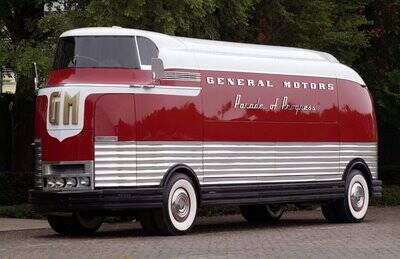


This “Parade of Progress” took to the road in 1936, with 8 Streamliners, specially built vans to house displays, along with 9 semi truck-trailers housing tents and support items for the show. Leading the impressive caravan into town was always a GM concept car, and in 1936 it was the World’s Fair Cadillac V-16 Fastback. The parade would typically play to audiences for up to five days at each destination and then it was off to the next town.

After touring over a million miles and displaying to over twelve million people in the U.S., GM executives decided it was time for a change-one that would make the “Parade of Progress” bigger and better. In 1939, GM introduced 12 Futurliners, hand built buses that could house each technological display in its main body. The estimated cost of each Futurliner in 1939 was said to be $100,000 each. They had a pilot type driver’s compartment with center mounted steering wheel, rubber bumpers, spectacular in appearance, and were easy to clean and operate. Now the caravan was even more impressive, including concept cars, 8 Streamliners, 9 Semi’s and now 12 Futurliners. It must have been quite a site to see heading to small cities across America, better than even the circus coming to town. But that image would have to wait; World War II halted all of GM’s plans, but only temporarily.


After the war ended The “Parade of Progress” was back on the road in 1953, bigger and better than before World War II. But this post war success would be very short lived. On July 4th, 1956 in Spokane, Washington the “Parade of Progress” and the Futurliners made their last showing. Over 70.000 people were in attendance for the finale.
There are only 10 Futurliners in existence today. Number Eleven sold at the Barrett-Jackson auction in 2006, for $4,000,000.00, while Number 10 is restored and in the National Automotive and Truck Museum of the U.S. in Grand Rapids, Michigan. And now Number Three will be at Kindig-It Designs to undergo a year and a half restoration. This is a very exciting piece of history to come to Utah. It will be a pleasure to report back each month on its progress and offer more historical tidbits as well.


Create Your Own Website With JouwWeb