


Alpina is a high-end luxury automobile brand by BMW. Alpina originally started as an automobile manufacturing company named Alpina Burkard Bovensiepen, based in Buchloe, in the Ostallgäu district of Bavaria, Germany that develops and sells high-performance versions of BMW cars.
The company was officially renamed BMW Alpina in 2025. Alpina works closely with BMW and their processes are integrated into BMW's production lines, and is recognized by the German Ministry of Transport as an automobile manufacturer, in contrast to other performance specialists, which are aftermarket tuners.
The Alpina B7 is produced at the same assembly line in Dingolfing, Germany (BMW Plant Dingolfing), as BMW's own 7 Series. The B7's twin-turbo 4.4-litre V8 is assembled by hand at Alpina's facility in Buchloe, Germany, before being shipped to BMW for installation, and the assembled vehicle is then sent back to Alpina for finishing touches.

Alpina Burkard Bovensiepen KG was established on 1 January 1965 in Kaufbeuren, Bavaria. The company had eight employees. Although Alpina started by producing typewriters, the original Alpina ceased to exist at the end of the 1960s in their attempt to move into the textile industry. In 1965, Burkard established a BMW tuning business, following his success with investments in the stock market. He started the tuning business in an outbuilding of the original Alpina typewriter factory. The company worked on carburetors and revised cylinder heads. By 1970, with seventy employees, the original facility changed locations from Kaufbeuren to Buchloe.
Since 1983, Alpina has been recognized by the German Federal Ministry of Transport as an automobile manufacturer, thus Alpina-built cars are branded and registered as Alpina instead of BMW, although an Alpina can be serviced at all BMW dealerships, and is fully covered if a warranty issue arises. Alpina automobiles are also sold at some BMW dealerships.
Distinctive features of Alpina vehicles are the fact that these models are literally "manu-factured", meaning "hand-made". The production process switches between fine tuning the engine, delivering it to the BMW plant, marrying engine and body there, and bringing it back to Alpina for interior upgrade with Alpina's specific components, again all in a hand-made process that allows only limited production numbers.
Besides engine and interior, Alpina also optimizes the transmission and installs steering wheel-mounted button shifters (called Switch-Tronic) on most cars, with paddle shifters used on the B4 S Edition 99. This has historic reasons, since Alpina was the first to mount shifting buttons on the steering wheel.
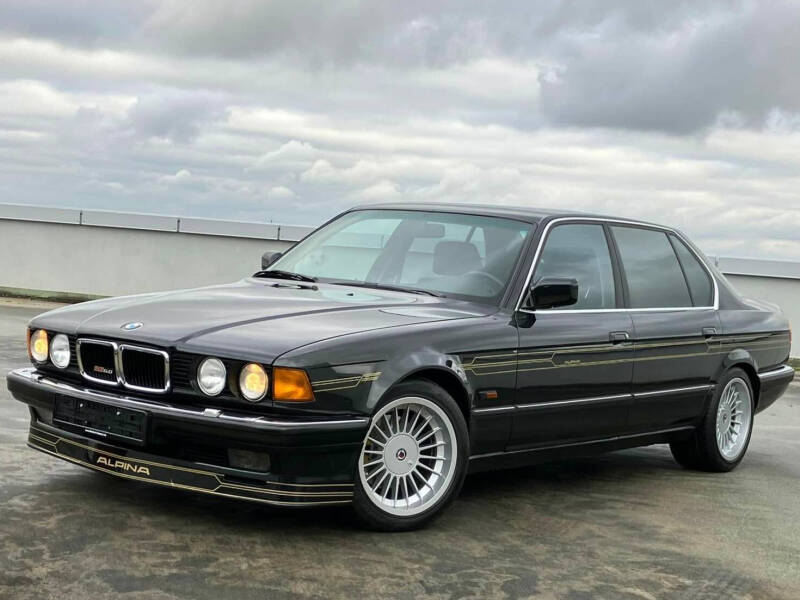
Distinguishing marks from the exterior are the 20-spoke alloy wheels with hidden valves under the center cap and the "Alpina Blue" or "Alpina Green" metallic exterior colours. Inside, "the finest materials are used to fabricate the exclusive feel". A typical blue and green pattern is often used on interior parts such as stitching on leather. A thin, pinstriped style outside body decor set in gold or silver is also a hallmark of older Alpina cars which is an option on new Alpina models. Another distinguishing mark is the Alpina wordmark at the bottom of the car's front, a design heralded from its racing cars. A metal plate inside also proves the heritage and the serial number of the car.

Compared to cars from BMW's in-house performance subsidiary, BMW M, Alpina's vehicles have more emphasis on Touring, higher torque, and have their own Alpina-style shiftable ZF automatic transmissions instead of manual or semi-automatic transmissions. For instance, regarding the high performance variants of the BMW E60 5 Series, the B5 offers a different take on performance and how to accomplish it. Unlike BMW M's own M5 which has a naturally aspirated, high-revving 5.0L V10, the Alpina B5 uses a supercharged 4.4L V8 which produces similar horsepower and greater torque at lower rpm.
3 series based alpinas
c1
The Alpina C1 was based on the E21 323i and was among their most popular early models, providing superior performance over the unmodified car. The C1 2.3 made 168 hp and 225 N⋅m of torque. 0–100 km/h is achieved in 7.8 seconds. Top speed was 213 km/h. The extra power is due to special Mahle pistons, and a special exhaust and ignition system. It also received dry-sump lubrication and a short-ratio five-speed gearbox. Only 35 C1 cars were built, making it one of the rarest Alpina models. As BMW released the 325i, Alpina responded with the C2 2.5, and later the 2.7 models, providing between 190–210 hp. The brakes and suspension were also upgraded.

c2
The first C2 combined the wider bore of the M20B25 with the slightly larger 76.8 mm crankshaft of an M20B23, to create a torquier engine of 2552 cc. This version put out 185 PS and 265 N⋅m, 74 units were built between 1985 and November 1986. After the C2 2.7 appeared in the spring of 1986, the 2.5 was slightly upgraded and gained 5 horsepower. However, to indicate its "little brother" position in the lineup, the name was changed to C1 2.5. When the September 1987 facelift model of the E30 was introduced, the 2.5 litre C1 was discontinued, although a few cars were finished into 1988.

b3 bi turbo
The F30 Alpina B3 Bi-Turbo was in production since March 2013. It is based on the BMW F30 335i with a bi-turbocharged 3.0 litre six cylinder. The 404 hp engine with 600 N⋅m of torque accelerates the B3 from 0–100 km/h in 4.0 seconds. The top speed is 305 km/h. The B3 Biturbo is available as a sedan or touring, both can be combined with xDrive four-wheel drive. In March 2017, Alpina revised the engine of the B3 to produce 434 hp.
A new model based on the G20 3 Series replaced the F30 model, it uses the S58 3.0 litre bi-turbo inline six engine producing 456 hp and 700 N⋅m of torque, which is 150 N⋅m more than the BMW M3, and 50 N⋅m more than the BMW M3 Competition.

5 series based alpinas
e12 b2
The Alpina B2 is based on the 1976 BMW 5 Series (E12) 528i. The car featured a bored-out 230 hp 3.0-liter straight-six fitted with three double barrel carburetors. Only eleven B2 were built before the introduction of the B7.

E12 B7 Turbo / B7 S Turbo
The Alpina B7 Turbo is based on the BMW 5 Series (E12) 528i like its predecessor the B2. From 1978 to 1982 it featured a B7 engine with 296 bhp at 6000 rpm and 462 N⋅m at 3000 rpm. In 1981, Alpina introduced the B7 S Turbo with 326 bhp at 5800 rpm and 500 N⋅m at 3000 rpm. Only sixty B7 S Turbos were produced.

e34 b10
The B10 3.5 was the first Alpina based on the BMW E34, With production beginning in April 1988 at launch it was the only available B10. The 3.5-liter BMW M30 inline-six cylinder engine of the BMW 535i was reworked with Mahle pistons, a modified cylinder-head, and a new camshaft increasing power from 208 hp to 254 PS. In 1992 production was stopped after 572 cars were made.

e39 b10
The B10 was built as a sedan and touring based on the BMW E39 from January 1997 to May 2004.
In February 2000, Alpina introduced the Alpina D10 Biturbo, the first six-cylinder diesel model produced by Alpina. The engine, a 3.0 litre twin turbocharged unit with 247 PS and 500 N⋅m of torque, was based on the engine of the BMW 530d. It was at the time the most powerful diesel saloon in the world. High-pressure common-rail injection technology (the famous Bosch CP3 high-pressure pump) has revolutionized the diesel industry.

g30 b5 bi turbo
The Alpina B5 was introduced at the 2017 Geneva Motor Show in all-wheel drive Saloon or Touring versions. The B5 features a 4.4-litre N63M30 V8 engine that generates a maximum power output of 599 hp and 800 N⋅m of torque. Based on the N63B44O2 V8, it has uprated pistons, new twin-scroll Garrett turbochargers and new spark plugs by NGK. The B5 can accelerate from 0–100 km/h in 3.5 seconds with a top speed of 330 km/h for the Saloon, and 325 km/h for the Touring, making it the fastest production estate car in production at that time.

7 series based alpinas
e32 b12
Based on the BMW 750i and 750iL, Alpina released the B12 5.7 in 1995 and the B12 6.0 in 1999. In contrast to the cars they are based on, these models are not electronically limited to a top speed of 250 km/h, but are able to reach top speeds of more than 280 km/h and 291 km/h, respectively. According to Alpina, the B12 5.7 was the world's first production vehicle with an electrically heated metal catalyst as standard. The B12 5.7 has a 5.7 litre V12 and the B12 6.0 has a 6.0 litre V12.
f1/f2 b7
The B7's twin-turbo 4.4-litre V8 is assembled by hand at Alpina's facility in Buchloe, Germany, before being shipped to BMW for installation, and the assembled vehicle is then sent back to Alpina for finishing touches. It is based upon BMW's N63 twin-turbo V8 but produces considerable more torque and horsepower, albeit with some turbo lag due to the larger turbos, yet more measured throttle mapping makes the B7 smoother than a stock BMW 750i. The 2011 Alpina B7, with its twin-turbo 4.4-litre V8 engine and 6-speed automatic transmission, is less expensive and yet faster than its F01 stablemate, the 2010 BMW 760Li powered by a twin-turbo 6.0-litre V12 mated to an 8-speed automatic transmission.

g12 b7
The Alpina B7 is one of the two Alpina cars offered in the US and Canada, the other one being the Alpina B6. The B7 is produced at the same assembly line in Dingolfing, Germany, along with BMW's own 7 Series. It can be equipped identically to a normal M760Li. However, an exclusive Alpina Green finish is available.
BMW permitted Alpina to produce a high-performance version of its flagship 7 Series, however they did not want it to be a high-revving, BMW M version (which would have been known as a "BMW M7" under the current nomenclature). It has also been suggested that there was no market for an M7, customers who desired a performance option in the 7 Series would go for the V12-engined BMW 760Li.

8 series based alpinas

.jpg)


The B12 5.7 was available from 1992 and is based on the 850CSi. It is powered by an increased displacement version of the BMW S70 V12 with a modified intake, crankshaft. camshafts and a stainless steel exhaust system as well as a six speed manual gearbox with an optional system called Shift-Tronic that automatically actuates the clutch when shifting and allows the vehicle to creep in traffic, 32 B12 5.7s were equipped with Shift-Tronic. it produced 410 hp. The carbon-fibre hood has cooling vents and a NACA duct.

Alpina G16 B8 Gran Coupé
The Alpina B8 Gran Coupé was available in 2021 and is based on the BMW M850i and M8 Gran Coupé's respectively. Powered by an Alpina tuned version of BMW's N63 4.4L V8 Bi-Turbo, the B8 produces 630 PS (463 kW; 621 hp) and 800 N⋅m (590 lbf⋅ft) of torque. Alpina tuned suspension and handling provided drivers with a Comfort+ and Sport+ mode for ideal ride comfort and performance. The exterior sports Alpina Classic 21 inch wheels featuring 20 spokes per wheel, Alpina designed front and rear bumpers, and a choice of Alpina blue or green metallic paint. The interior features Alpina trim appointments, custom Alpina leather upholstery, and or BMW Individual trims and upholstery
alpina roadster V8


2002-2003
With production of the BMW Z8 completed by November 2002, for 2003 the Z8 production was replaced by the Alpina Roadster V8. The Alpina was a departure from the hard-edged sporting focus of the original car, and elements of the new grand touring intent were evident throughout this final edition.
Instead of the original six-speed manual and 4.9 L (S62) engine featured in Z8's, the Alpina came only as an automatic, using a five-speed BMW Steptronic transmission mated to a 4.8 L Alpina-tuned V8 motor from the Alpina E39 B10 V8 S (Alpina F5). In order to complete the car's transition from sports car to Alpina, relaxed suspension tuning was used. The standard Z8's run-flat tires on 18 in (46 cm) wheels were discarded in favor of conventional tires with softer sidewalls, on 20 in (51 cm) wheels.
Only 555 of these Alpinas were built, 450 of which were exported to the U.S. market and only eight to the UK. In the United States, this special edition of the Z8 was sold directly through BMW dealerships, marking a first for Alpina, whose cars had never been sold through retail channels in the U.S.
xb7


The new appearance is characterised by a modern, horizontally separated headlight design and the new illuminated BMW “Iconic Glow” kidney grille. The ALPINA front and rear aprons take up the new design vocabulary of the exterior and underline the BMW ALPINA XB7’s powerful presence.
The V8 engine with bi-turbo charging generates 621 hp from 4.4 litres of displacement and delivers exceptional driving performance: the luxury 7-seater SAV accelerates from 0 to 100 km/h in just 4.2 seconds, hits the 200 km/h mark in 14.8 seconds and can reach a top speed of 290 km/h.
The latest transmission generation from ZF (8HP80) with integrated 48v mild hybrid technology offers both comfort and performance at the highest level. Depending on the chosen drive and transmission mode, the 8-Speed Sport Automatic Transmission offers unparalleled shift comfort and the capability to execute shifts in tenths of a second.
A characteristic feature is the high torque output of 800 Nm which is available from just 1800 rpm all the way to 5400 rpm. The engine’s high power reserves are effortlessly and readily available at all times, which is what the superior ALPINA driving experience is all about.

As of 2026, BMW has fully acquired Alpina and established it as a new, high-luxury standalone brand positioned above the 7 Series to rival Mercedes-Maybach. The brand emphasizes extreme comfort and effortless performance (Speed, not Sport). Future models, including an Alpina-ified 7 Series, are planned for late 2026 and 2027.
Key Changes and Future Strategy:
- Standalone Luxury Brand: Launched officially on Jan 1, 2026, BMW ALPINA offers highly bespoke, custom-material vehicles designed to sit between top-tier BMWs and Rolls-Royce.
- Production Move: Manufacturing is being integrated within BMW’s own factory network to reduce costs, although the original Buchloe headquarters will handle heritage services.
- Product Focus: The brand is shifting focus from smaller models (like the 3 or 4 series) toward upper-luxury, such as an anticipated "G72" 7 Series derivative and future X7 variants.
- The Vision Car: A "Vision BMW ALPINA" concept was revealed in 2026, featuring a V8, 20-spoke wheels, and specialized "Comfort+" settings designed for high-speed cruising rather than track performance.
- Electric Future: While launching with high-performance internal combustion engines (V8), the lineup is expected to eventually include electric vehicles (EVs).
- Brand Identity: The new brand uses a redesigned, modern emblem that reinterprets traditional throttle body and crankshaft elements.
vision alpina


The Vision BMW ALPINA, unveiled at Concorso d'Eleganza Villa d'Este, gives a first glimpse of the future of ALPINA as a fully integrated brand within the BMW Group. It's a long, elegant four-seater grand tourer with a V8 engine, classic ALPINA design references, a shark nose front end and a clear strategic goal: to fill the space between BMW's most expensive luxury models and Rolls-Royce.
BMW already owns Rolls-Royce, and there is a clear gap between a high-end BMW 7 Series and the entry-level of a Rolls-Royce Ghost. ALPINA is now becoming the brand that can be right there.
At around 5.20 metres long, it has classic GT proportions: a long bonnet, low roofline, wide stance and a cabin designed for four adults. This is not a track car, not an SUV and not a limousine that tries to seem sporty, this is a luxury performance coupe.
An electric ALPINA may one day make perfect sense. Instant torque, silence and refinement are no stranger to the brand. But for the first big concept under BMW ownership, a V8 feels right.
The first production BMW ALPINA under the new structure is expected in late 2027 and is said to be based on the BMW 7 Series platform. The 7 Series gives BMW ALPINA the right technical basis: size, refinement, powertrain flexibility, luxury architecture and global relevance.


Create Your Own Website With JouwWeb