


Abarth & C. S.p.A. is an Italian racing and road car maker and performance division founded by Italo-Austrian Carlo Abarth in 1949. Abarth & C. S.p.A. is owned by Stellantis through its FCA Italy S.p.A. division. Its logo is a shield with a stylized scorpion on a yellow and red background.

Carlo Abarth was sporting director of the Cisitalia factory racing team starting in 1947. 1948 saw the financial downfall of Cisitalia, spurred by the investments needed to put the 202 coupé into production. The following year the manufacturer folded, and founder Piero Dusio flew to Argentina. Carlo Abarth, funded by Armando Scagliarini, took over Cisitalia's assets and on 31 March 1949 Abarth & C. was founded in Bologna. From the Cisitalia liquidation Abarth obtained five 204 sports cars (two complete Spiders and three unfinished), a D46 single seater and various spares. The 204s were immediately rechristened Abarth 204 A. Abarth built and raced sports cars developed from the last Cisitalia cars.
On 9 April 1951 the company's headquarters were moved to Turin; Abarth began his well-known association with Fiat in 1952, when it built the Abarth 1500 Biposto on Fiat mechanicals.

1959
In 1957, Abarth entered a deal with Fiat whereby they were paid direct fees for successful competition finishes. Abarth accordingly went on to enter their cars in countless hillclimbing and sports-car racing events across the world, mainly in classes from 850 to 2000 cc, competing with Porsche 904 and Ferrari Dino in the higher echelons. Since they were paid based on the number of results, Abarth entered their cars in every conceivable class and in countries across the entire world. Hans Herrmann was a factory driver from 1962 until 1965, winning the 500 km Nürburgring in 1963 with Teddy Pilette.
204a


1948-1950
The Abarth Cisitalia 204A was the first product of the recently founded Abarth & C.. As part of a deal in which Abarth took over the liquidated Cisitalia assets, the erstwhile Cisitalia 204 was marketed under both the Abarth and Cisitalia brands. Abarth received two complete 204 Spiders and two or three unfinished chassis in various states of completion; in total six 204A were built.[1] Abarth went on to develop several more cars derived from the Fiat 1100-based Cisitalia 204, following up with the Abarth 205A Berlinetta, Abarth 207A Spyder, Abarth 208A Spyder, and the Abarth 209A Coupé.
Built on a very short, 2100 mm wheelbase, the chassis was very rigid and very light. At 510 kg, it was ten to twenty percent lighter than its competitors. The design retained the Fiat 1100's four-cylinder engine, fitted with double Weber 36 DR4SP carburettors producing a max power of 83 CV. The reported top speed is 190 km/h.
After the agreement with Cisitalia came to an end, the 204As were campaigned under the Abarth name alone, no longer using Cisitalia badging. In all, 19 victories are ascribed to the 204A.
205a


1950-1951
This is a Vignale-Michelotti masterpiece. This was the first street car built by Karl Abarth, after the Cisitalia-Abarth 204. This car followed the decision to build a gran turismo berlinetta for a wealthy clientele: a brand new chassis was built, along with an aluminium coach. The 205-101 had a heavily tuned dry sump Fiat 1100 B engine with a Cisitalia head, two Weber 32 DR SP carburetors and a Magneti Marelli MVE4 magneto. This engine was said to produce around 80 hp.
The three specimens made had chassis numbers 205-101/102/103. The first one was completed in march 1950, then joined the Coppa Intereuropa on 23 march 1950. The 205-101 arrived ended the race 1st in 1100 class, driven by Guido Scagliarini (co-owner of Abarth & C.).
Only three Abarth 205s were made and all have survived and are in the hands of caring owners.
1500 biposto


1952
The Abarth 1500 Biposto was an experimental coupe designed by Franco Scaglione, who worked for Bertone at the time. It was displayed at the 1952 Turin Motor Show. Following the Turin Show, it was purchased by Packard and brought to Detroit, where it was used for design inspiration.
The Biposto was given to motoring journalist Dick Smith in mid-1953 as his prize for suggesting a new Packard advertising slogan. Smith sparingly drove the car for two decades, before putting it into storage. It did not reappear until put up for auction in 2003 where it was acquired by historic racer, car collector and restorer Chris M Drake.
It features a futuristic design consisting of a central headlight, similar to the earlier Tucker Torpedo, and fins in the rear. The design is believed to have paved the way for the Alfa Romeo BAT series of concept cars. Under the hood was a Fiat 1.5-litre, 75-bhp engine which got the new Abarth model to a top speed of 180 km/h.
1100 ghia


1953
This Abarth 205A 1100 Sport was shown at the 1953 Turin Salon. It appeared on the Ghia stand alongside the similar Dodge Firearrow that Ghia had previously built for Chrysler. The body design is thought to be the work of Giovanni Michelotti with heavy influences from Virgil Exner and Giovanni Savonuzzi. It was built on the last of four Abarth 205 competition chassis and used mechanical components from the new Fiat 1100 that was also previewed at the Turin Salon. After the show the Abarth was sold to William 'Bill' Vaughn of New York. Vaughn built a variety of Specials in the 1950s and he showed the Abarth at the New York Auto Show in 1954 under the name of the Vaughn SS Wildcat. The 2015 Pebble Beach Concours was the first time the Abarth was seen in public since that show.
215a coupe and 216a spyder


1956
The Abarth works are equipped mainly for batch fabrication processes; the factory employs 110 people plus 12 administrative staff. Initial development work on a new induction system is undertaken on a test bed, but thereafter-and particularly so with the exhaust system most of the experimental work is carried out in carefully controlled road performance tests along the autostrade. This would seem to be expensive, but the final results appear to justify the methods. Following up this specialist bodywork as well as obtaining increased performance from his modification to the Fiat 600 power unit, Abarth has produced two most attractive bodies for the 600 chassis in conjunction with Bertone. The first, a coupe (Type 215A) was introduced at Geneva and attracted much attention. At Turin an open two-seater Spyder version was exhibited, designed Type 216A.
abarth record bertone


1956
In 1956 Bertone created extremely streamlined designs for two record-breaking Abarths, which took their inspiration from the aerodynamics of similar German pre-war cars, with highly interesting results from a technical and aesthetic point of view. The two prototypes set an impressive ten world records for the H class on the high speed track at Monza: the most important being 4000 km at an average speed of 156.36 km/h, and 10,125.56 km covered in 72 hours. The car was fitted with a four-cylinder 743 cc. engine derived from the Fiat 600.
allemano 2200 coupe


1959
When Abarth chose to develop his own interpretation of the Fiat 2100 saloon, he turned to Turin-based Carrozzeria Allemano. Allemano was established in 1928 and worked with the likes of Ferrari, Alfa Romeo, Lancia, and Cisitalia. It is thought that just 28 examples of the Abarth 2200 (so named due to the increased displacement of the Fiat 2100) were produced, with a small number also bodied by Carrozzeria Ellena.
The 2162 cc inline six-cylinder engine with three Weber 38DCOE carburettors produces 135 bhp. The 2200 has a four-speed manual transmission, front transverse leaf-spring suspension, rear coil springs, and four-wheel hydraulic disc brakes.
2000 sport spider


1968-1969
Abarth 2000 Sport is an iconic Italian racing car which won its class at the 1000 km of Monza in 1971 and finished 11th overall. It was homologated for FIA Group 4 on 1 April 1969 with homologation number 252, and participated in a number of car races from 1969 to 1973. At least 50 cars were constructed. The small and sultry ‘2000 Sport Spider’ is without doubt one of the prettiest sports-racing cars ever designed. It was driven by an extraordinary roll call of racing legends, including Peter Schetty, Arturo Merzario, and Toine Hezemans, all of whom helped cement its place in the history books.
1600 gt coupé


1969
The Abarth 1600 Coupé stands as a significant milestone in the legacy of Abarth, marking its final proposal before succumbing to the embrace of FIAT. Designed by Italdesign on the chassis of the 1600, this coupe was envisioned as a sleek 2+2 configuration, aimed at a limited series production. However, despite its promise, it ultimately remained a prototype, never to grace the roads in significant numbers. While the Abarth 1600 Coupé may not have exuded the same futuristic aura as some of its counterparts, it boasted a contemporary design that captured attention. Unlike many Italdesign prototypes of its time, which favored a sober grey metal finish to accentuate the car’s form, the 1600 Coupé dared to deviate from this trend. In a departure from convention, it flaunted a color palette that defied Giugiaro’s preference, showcasing an alternative aesthetic approach. Although the prototype status of the Abarth 1600 Coupé relegated it to the realm of automotive history, its design language and styling cues would leave a lasting impression. It stood as a testament to the creative spirit and engineering prowess of Abarth, showcasing their dedication to pushing boundaries and exploring new frontiers in automotive design. Notably, the Abarth 1600 Coupé was part of a select group of Italdesign creations that dared to challenge the dominance of grey metal as the preferred canvas for automotive experimentation. Apart from exceptions like the Maserati Coupé 2+2 in 1974 and the New York Taxi, most prototypes until the turn of the millennium adhered to this standardized color scheme. Though its production may have been limited to the confines of imagination, its impact on automotive design transcends the boundaries of time and space.
2000 scorpione concept


1969
Created in the early days of the wedge era, the concept started off with a chassis borrowed from Abarth 2000 Sport Spider SE and then Pininfarina worked its magic to turn it into a piece of art. Notice the wraparound windshield and the absence of A-pillars creating a 180-degree cockpit view. There’s also a central pop-up headlight bar with six separate lights, while the rear end seems unfinished and hosts a glass canopy providing a spectacular view of the engine. It only has a small 2.0-liter four-cylinder Fiat engine upgraded by Abarth to deliver a healthy 220 hp. With a dry weight of just 670 kg it doesn’t need to be extremely powerful in order to be seriously fast.
Carlo sold Abarth to Fiat on 31 July 1971. The acquisition was not made public until 15 October. As Fiat was not interested in the Reparto Corse racing operations, these were taken over by Enzo Osella. Osella obtained cars, spares, technicians and drivers (amongst them Arturo Merzario), and continued the racing activity founding the Osella racing team. Thus ended for Abarth the days of sport prototype and hill climb racing. Under Fiat ownership, Abarth became the Fiat Group's racing department, managed by engine designer Aurelio Lampredi. Abarth prepared Fiat's rally cars, including the Fiat 124 Abarth Rally and 131 Abarth.
In 2000s, Fiat used the Abarth brand to designate a trim/model level, as in the Fiat Stilo Abarth. On 1 February 2007 Abarth was re-established as an independent unit with the launch of the current company, Abarth & C. S.p.a., controlled 100% by Fiat Group Automobiles.

1974 124 abarth rally
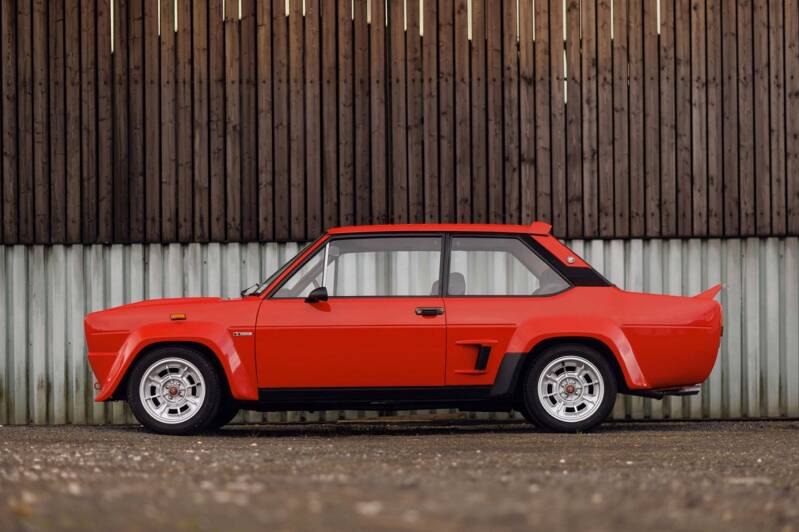
1976 131 abarth rally

2014 500 abarth 695 biposto
On 1 October 1981, Abarth & C. ceased to exist, and was replaced by Fiat Auto Gestione Sportiva, a division of the parent company specialised in the management of racing programmes that would remain in operation through to the end of 1999, when it changed to Fiat Auto Corse S.p.A.
On 1 February 2007, Abarth was re-established as an independent unit with the launch of the current company, Abarth & C. S.p.A., controlled 100% by Fiat Group Automobiles S.p.A., the subsidiary of Fiat S.p.A. dealing with the production and selling of passenger cars and light commercial vehicles.
The first models launched were the Abarth Grande Punto and the Abarth Grande Punto S2000. The brand is based in the Officine 83, part of the old Mirafiori engineering plant.
abarth grande punto


2007-2010
The Abarth Grande Punto is a car from the Italian car brand Abarth, based on the Fiat Grande Punto. The car was presented to the public at the Geneva Motor Show in 2007.
The four-cylinder engine has a capacity of 1368 cm³. The power is 155 hp at 5500 rpm. The maximum torque of 206 Nm is delivered at 5000 rpm, with the sport button pressed down 230 Nm of torque is temporarily delivered. The car has a six-speed manual gearbox and front-wheel drive. The top speed is 208 km/h.
The Grande Punto SuperSport is an extra sporty variant. The same engine delivers 180 hp at 5750 rpm and 272 Nm of torque. The price is therefore about € 5.000 higher.


Create Your Own Website With JouwWeb