The Tyrrell Racing Organisation was an auto racing team and Formula One constructor founded by Ken Tyrrell (1924–2001) which started racing in 1958 and started building its own cars in 1970.

The team experienced its greatest success in the early 1970s, when it won three Drivers' Championships and one Constructors' Championship with Jackie Stewart. The team never reached such heights again, although it continued to win races through the 1970s and into the early 1980s, taking the final win for the Ford Cosworth DFV engine at the 1983 Detroit Grand Prix.

The team was bought by British American Tobacco in 1997 and completed its final season as Tyrrell in the 1998 Formula One season. Tyrrell's legacy continues in Formula One as the Mercedes-AMG F1 team, who is Tyrrell's descendant through various sales and rebrandings via BARHonda, and Brawn GP.

The Tyrrell P34 was considered as one of the most unique and innovative race cars ever made due to its six wheel configuration. Several other teams attempted to use this wheel configuration including March and Williams.


Headquarters;  Ockham, Surrey, United Kingdom, 1970-1998

007

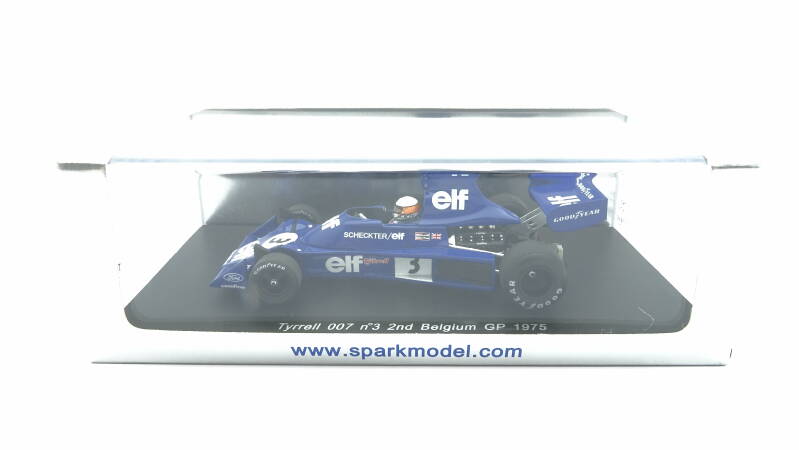
The Tyrrell 007 is a Formula One racing car, designed by Tyrrell's Chief Designer, Derek Gardner. It was used in the 197419751976 and 1977 Formula One seasons.

Ken Tyrrell, owner of Tyrrell Racing needed two new drivers for 1974 because Jackie Stewart retired from driving at the end of 1973 and François Cevert was killed at the 1973 season finale in the United States. The team had originally planned to have Cevert and Jody Scheckter as their driver line up for 1974. Following Cevert's death, Tyrrell signed Patrick Depailler as replacement. In the first three races of 1974, (Argentina, Brazil and South Africa), Tyrrell used the earlier 005 and 006 chassis.

1974

The Tyrrell 007 made its debut at the Spanish Grand Prix. Scheckter drove the 007 and finished fifth, Depailler raced the 006 and the 005 was no longer used. 

Two 007s raced at Belgium. At the start of the race, Clay Regazzoni's Ferrari took the lead ahead of Scheckter and Emerson Fittipaldi's McLaren. At the end of the first lap Fittipaldi passed Scheckter to take second place. At the Swedish Grand Prix, Scheckter won the race and Depailler finished second. At the Dutch Grand Prix Scheckter finished fifth and Depailler sixth. At the French Grand Prix, Scheckter took fourth and Depailler finished eighth in the 006. 

In the British Grand Prix Scheckter took the lead and won the race, engine failure took Depailler out of the race. In Germany, Depailler through an accident caused by broken suspension. At the Austrian Grand Prix Depailler retired after an accident. Peterson crossed the line less than a second ahead of Fittipaldi after 12 laps of battling in Italy. Scheckter finished third and Depailler finished eleventh.

The Tyrrell team scored 52 World Championship points; four points were scored by the 005 and the 007 scored 48 points, earning them third place in the Constructors' Championship standings.

1975

The Tyrrell team scored twenty five World Championship points, earning them fifth place in the Constructors' Championship standings.

1976

The Tyrrell team scored 71 World Championship points, 13 points were scored by the 007 and the Tyrrell P34 scored 58 points, earning them third place in the Constructors' Championship standings.

jody scheckter

1975

ford-cosworth dfv 2.993 cc  90° V8, naturally aspirated

circuit zolder

Tyrrell 007 1975 (youtube.com)

p34

The Tyrrell P34 (Project 34), commonly known as the "six-wheeler", was a Formula One (F1) race car designed by Derek Gardner, Tyrrell's chief designer. 

The car used four specially manufactured 254 mm wheels and tyres at the front, with two ordinary-sized wheels at the back. Along with the Brabham BT46B "fancar" developed in 1978, the six-wheeled Tyrrell was one of the most radical entries ever to succeed in F1 competition and has been called the most recognisable design in the history of world motorsports.

The P34 was introduced in September 1975 and began racing in the 1976 season. It proved successful and led other teams to begin design of six-wheeled platforms of their own.

Changes to the design made for the 1977 season made it uncompetitive, and the concept was abandoned for Tyrrell's 1978 season. The other six-wheeled designs ended development, and F1 rules later stipulated that cars must have four wheels in total. The cars later had some success in various "classics" race events, but today are museum pieces.

The car first took to the track at Silverstone on 8 October 1975, and, after more tests, Tyrrell decided to build two more examples with a slightly longer wheelbase to race in the 1976 season.

The stretched versions first ran in the Spanish GP in 1976 and proved to be very competitive. Both Jody Scheckter and Patrick Depailler produced good results with the car, but while Depailler praised the car continually, Scheckter was unimpressed. 

The P34's golden moment came in the Swedish Grand Prix. Scheckter and Depailler finished first and second, and to date Scheckter is the only driver ever to win a race in a six-wheeled car.

The P34B was introduced for the 1977 season and was wider and heavier than before, and, although Peterson was able to string some promising results from the P34B, as was Depailler, it was clear the car was not as good as before. In November 1977 Tyrrell introduced his car for the 1978 season with a conventional layout.

patrick depailler

1976

ford-cosworth dfv, 2993 cc, V8, na, mid-engine, longitudinally mounted

 fuji speedway

008

The Tyrrell 008 was a Formula One car manufactured and raced by the Tyrrell Racing Organisation team during the 1978 season. Driven by Didier Pironi and Patrick Depailler, it achieved several podium finishes including a win at the 1978 Monaco Grand Prix.

The Tyrrell 008 was designed by Maurice Philippe to replace the six-wheeler Tyrrell P34 used the previous two seasons. It used an aluminum monocoque in front of a V8 Cosworth DFV.

The 008 was originally conceived as a fan car, similar to the Brabham BT46. The idea was to position the radiators in the underside of the car, in turn tidying up the aerodynamics, and use the fan to extract heat from them. A small rear mounted fan had been developed to cool the oil and water radiators with the added bonus of aerodynamic downforce, but unlike Gordon Murray's effort, the team could not get the technology to work effectively. The car regularly overheated during testing and the fan was quietly dropped. Murray's assistant, David Cox, had however observed the 008 in testing and gave his boss all of the details that he could.

The team finished in fourth place in the Constructor's Championship with a total of 38 points. Depailler was fifth in the Driver's Championship with 34 points while Pironi was 15th with seven points.


didier peroni

1978

cosworth DFV V8 naturally aspired

hockenheim

Tyrrell 008 1978

1968-1998

1979-1980

Create Your Own Website With JouwWeb