


Toleman Motorsport was a Formula One constructor based in the UK. It participated in Formula One between 1981 and 1985, competing in 70 Grands Prix. Today, it is best known for giving Ayrton Senna his Formula One debut.

The team was generally uncompetitive during its short lifetime, prompting Senna to leave after just one year. However, several of its engineers, including Rory Byrne and Pat Symonds, stayed with the team after its sale to the Benetton Group and eventually built the organisation into the title-winning Benetton Formula. As such, Toleman is the progenitor of the racing lineage informally known as "Team Enstone".

In 1926, Edward Toleman established a company to deliver Ford cars from the Ford factory to dealers across the country. Edward's son Albert took over the company in the 1950s, and Albert's sons Ted and Bob succeeded him in 1966. The Toleman brothers recruited Alex Hawkridge to expand their transportation business into Europe.
The Toleman family were enthusiastic gentleman drivers. Albert Toleman won several club-level rally championships. Ted Toleman participated in Formula Two, the Dakar Rally, and the 1976 24 Hours of Le Mans. Unfortunately, Bob Toleman died in a racing accident in 1976.
Hawkridge encouraged the company to enter auto racing by sponsoring competitors. In 1976, Toleman began sponsoring Rad Dougall in the British Formula Ford Championship, although Dougall broke his legs in a crash the same day Toleman agreed to fund him. Toleman continued sponsoring Dougall for 1977, and he won the Formula Ford 2000 title that year. Impressed with the results, Ted Toleman agreed to start his own Formula Two team.
From 1978 to 1980, Toleman spent three seasons in the European Formula Two Championship under the leadership of Alex Hawkridge and Roger Silman.
Toleman entered Formula One for the 1981 season. Although Hawkridge admitted that the team was not ready to compete that year, he explained that the team had a short window of opportunity to enter the top level.
1981–1982: difficult early years
Toleman sought to distinguish itself from other small teams by commissioning its successful F2 engine supplier, Hart, to produce turbocharger engines for the team. By that time, Formula One was beginning to be dominated by turbo-powered cars, which outpaced the naturally aspirated engines previously dominant in the sport.
Toleman suffered greatly in the short run, due to growing pains associated with the innovative turbo technology and other issues. During this period, Toleman's cars were mocked in the racing press as "The Pig" (for their poor handling) and "The Belgrano" (for their oil leaks).
tg181


1981-1982
The Toleman TG181 is a Formula One car that was first used in the 1981 Formula One season. It was also the first car used by Toleman in F1.
Being heavy and with a relatively underpowered and unreliable engine, a 4-cylinder 1.5 litre turbo by Brian Hart, it was a generally poor performing car, with its drivers, Derek Warwick and Brian Henton, only getting through qualifying once each, with Henton's tenth place at Monza the only finish for the car. Due to its bulk, the team ended up nicknaming it the "General Belgrano". after the Argentine battleship sunk during the 1982 Falklands War, and the "Flying Pig".
In 1981, they were one of the only two teams on the grid bold enough to use a turbocharged engine (alongside Renault). Unfortunately, the combination of an innovative engine, an experimental Pirelli tyre partnership, and a heavy chassis made the car nearly impossible to qualify.
Drivers Brian Henton and Derek Warwick frequently struggled with extreme turbo lag—often waiting several seconds for power to kick in. The TG181 struggled immensely, qualifying for only two races all year: Henton made the grid at the Italian Grand Prix, and Warwick qualified for the season finale in Las Vegas.
Evolutions of the car, the Toleman TG181B and Toleman TG181C, were used the following year, to slightly better effect.

Derek Warwick
Brian Henton
Teo Fabi
1983: emergence as a serious team
In 1983, the TG183B showed improved form thanks to a major update. Derek Warwick was retained, while Teo Fabi was replaced by Bruno Giacomelli. The budget increased as Candy's sponsorship was joined by Iveco brand Magirus and BP.
The Hart turbos finally began showing true pace, with Warwick qualifying fifth and sixth in the first two races. The team peaked at the end of the season: Warwick scored the team's first points with a fourth-place finish at the Dutch Grand Prix, kicking off a run of four consecutive scoring finishes to close out the year. Toleman finished 9th in the Constructors' Championship with ten points, putting itself a cut above the other backmarkers like Arrows, Theodore, Ligier, Spirit, ATS, Osella, and RAM, none of which scored more than four points.
tg183


1982-1984
The Toleman TG183 was a Formula One racing car designed by Rory Byrne and built and raced by Toleman Motorsport.
The TG183 was distinctive in that it had twin rear wings and front wing mounted radiators. Unfortunately the front wing configuration caused the front of the car to move about at high speed and was eventually replaced by a more conventional front wing set up.
The car first raced in the last two races of the 1982 Formula One season driven by Derek Warwick. In the 1983 Formula One season an updated version of the car, designated TG183B, was introduced. The car also raced in the first four races of the 1984 Formula One season when Ayrton Senna made his debut in the Formula 1 championship alongside former FIM 350cc and Formula 750 motorcycle World Champion Johnny Cecotto from Venezuela.
The TG183B was replaced after four races of 1984 by the Toleman TG184.

Derek Warwick
Bruno Giacomelli
Ayrton Senna
Johnny Cecotto
1984: peaking with ayrton senna
Toleman got off to a poor start, as the team was still using the 1983 cars for the first four races of 1984. Senna made his F1 debut at the Brazilian Grand Prix, at Jacarepaguá. The team's performance fell off in mid-season, with Senna finishing only one out of six races at one point due to mechanical failures. Towards the end of the season, Senna announced his departure, having triggered his release clause to sign with Team Lotus.
Although not much was expected from the team who started the year with only their upgraded 1983 car and also with two untried rookie drivers, plus the underpowered Hart turbo engine, Toleman finished a career-best 7th in the Constructors' Championship, scoring 16 points (13 courtesy of Senna, the other 3 from Johansson's 4th place in Italy). Senna also recorded the only three podiums in the team's history.
tg184
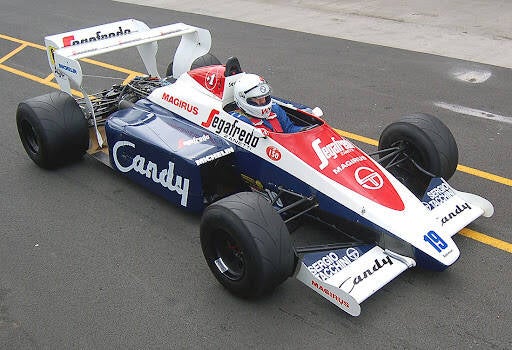
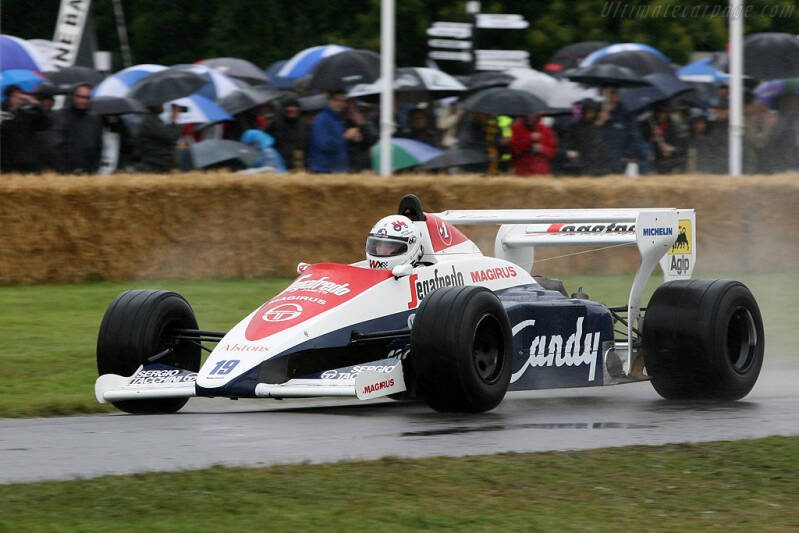
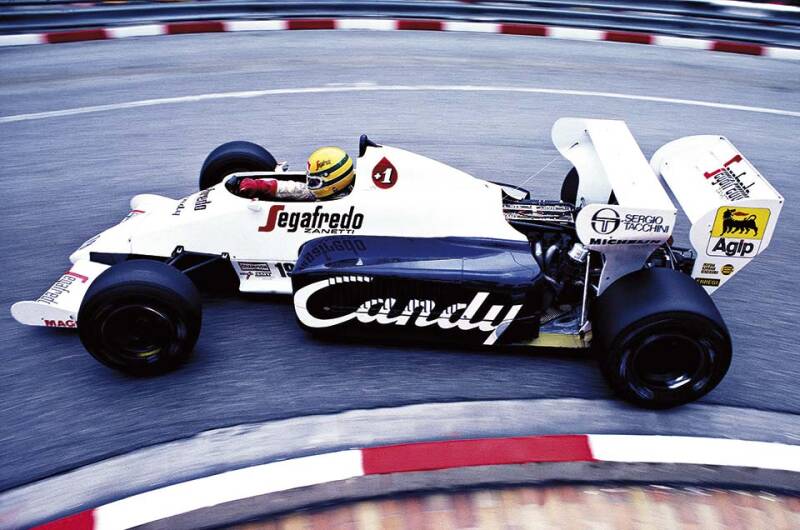
1984
The Toleman TG184 is a Formula One racing car designed by Rory Byrne and Pat Symonds and was used by Toleman Motorsport during the majority of the 1984 Formula One season.
Like its predecessor, the TG183B, the TG184 was powered by the 4 cylinder turbocharged Hart 415T engine which produced approximately 600 bhp in 1984.
The car's potential was evident early on with a second place in only its second grand prix scored by then rookie driver Ayrton Senna in the rain affected Monaco Grand Prix. Underlying his future as a World Champion, more podiums came for Senna during the 1984 season.
Unfortunately for Cecotto, the TG184 was his last F1 drive after he badly broke both of his ankles in practice for the British Grand Prix at Brands Hatch. He recovered from his injuries but never again raced in Formula One, instead going on to a successful career as a touring car driver.
The TG184 was replaced in 1985 by the TG185.

Ayrton Senna
Johnny Cecotto
Stefan Johansson
Pierluigi Martini
1985: near-collapse and sale to benetton
Following Senna's departure, the Toleman team sought to maintain its momentum by retaining Johansson and signing John Watson for the 1985 season.[36] In addition, that year's TG185 was the first carbon monocoque to be fabricated in-house at the Witney factory.
However, the team nearly collapsed. Michelin withdrew from F1 at the end of 1984, forcing the team to confront the fact that it had alienated every remaining tyre supplier in Formula One. Toleman was forced to sit out the first three races of the 1985 season.
Toleman returned in round 4 at Monaco, after Italian fashion label United Colors of Benetton bought the team in mid-season and acquired a Pirelli supply contract from the defunct Spirit team. Benetton kept the Toleman name until season's-end.
tg185


1985
The Toleman TG185 was a Formula One racing car designed by Rory Byrne for use by the Toleman team in the 1985 Formula One World Championship.
After a successful 1984 season, Toleman entered 1985 with Swede Stefan Johansson and John Watson signed as drivers.
The car was largely similar to the previous year's TG184, apart from a revised suspension to deal with running a different tyre compound and revised rear bodywork. The car was powered by the 800 bhp Hart 415T straight-4 turbocharged engine.
The TG185 made its debut at the Monaco Grand Prix.
At first, a single car was entered for Italian Teo Fabi, who had previously driven for the team in 1982. From the Austrian Grand Prix onwards, a second car was entered for another Italian driver, Piercarlo Ghinzani, who joined the team from Osella.
Fabi gave Toleman its first and only pole position at the German Grand Prix, held at the new Nürburgring. This was to be the team's only highlight of 1985, as the TG185 was otherwise unreliable and saw the finish line just twice all year, when Fabi finished 14th in France and 12th in Italy.

Teo Fabi
Piercarlo Ghinzani
legacy
The TG185 was the last Toleman car.
When Ted Toleman sold the team to Benetton, the Italians promised to keep the staff together. Rory Byrne and Pat Symonds, in particular, remained with the newly rebranded Benetton Formula, which proceeded to hire a new crop of talent, including Flavio Briatore and Ross Brawn.
Led by Michael Schumacher, the Benetton team won two Drivers' Championships and one Constructors' Championship in the 1990s. Schumacher took Byrne and Brawn with him to Ferrari, and the two helped lead the turn-of-the-century Ferrari dynasty. Symonds and Briatore stayed with Benetton, which was later renamed to Renault (colloquially, "Team Enstone" after Benetton opened a new factory in Enstone, Oxfordshire). With new star Fernando Alonso, Renault won two Drivers' Championships and two Constructors' Championships in the 2000s.
The original Toleman leadership (Toleman and Hawkridge) did not compete in Formula One again. Ted Toleman left England in 1993, but intermittently remained involved in motor racing, managing the Australian Mini Challenge one make series. Alex Hawkridge eventually chaired a company that used racing simulators to coach aspiring drivers.


Create Your Own Website With JouwWeb