


Osella is an Italian racing car manufacturer and former Formula One team. They participated in 132 Grands Prix between 1980 and 1990. They achieved two points finishes and scored five world championship points.


1972 Abarth-Osella 2000 Sport SE-021 Sports-Racing Spider
Osella was founded in Volpiano in 1965 by former rally driver Enzo Osella. The team began life by racing Abarth sports cars among local and national races in Italy since 1965. In 1974, Osella took over the factory Abarth sports car program and expanded into single-seater racing.
In 1975, the team entered the European Formula Two Championship with Giorgio Francia and Duilio Truffo, achieving some success with its own car, the BMW-powered Osella FA2.
Osella continued in Formula Two the following season, but financial problems meant that the team was not competitive and withdrew from the championship before the end of the season. In the following years, the FA2s were occasionally entered by privateers, one of them being the Swiss touring car driver Charly Kiser. The experience prompted Osella to try to become a manufacturer for other teams.
Osella returned to the European Formula Two Championship in 1979, with American driver Eddie Cheever racing the well-used FA2, again powered by a BMW engine. The car was good enough to win three races. Enzo Osella decided to upgrade his activities to Formula One.
fa1


1980
Osella's first F1 car, the 1980 FA1, used Ferrari-style 'Aero' construction and was bulky, overweight, and unreliable. Eddie Cheever moved up with the team from F2, and achieved some promising grid positions. It was powered by the Cosworth DFV 3.0 V8.
Osella had been a surprise success in Formula 2 in 1979, with 21-year-old lead driver Eddie Cheever winning the team's first race at Silverstone in March. The new F1 car was designed by Giorgio Stirano, the team's technical director who had also designed the 1979 F2 car, and would carry sponsorship from Denim After Shave and Monopolio Tabacchi, the state-owned tobacco company. Team Manager was Franco Palazzoli, who used to race as "Pal Joe".
A lack of testing plus overheating issues left Eddie Cheever at the bottom of the time sheets and failing to qualify for the two South American GPs at the start of 1980, slower even than the Shadow DN11s. The car was 100 kg overweight.
A narrower version, the FA1B, was produced for the Italian GP, and the older FA1s were retired at the end of the year.

Eddie Cheever
fa1b


1980-1981
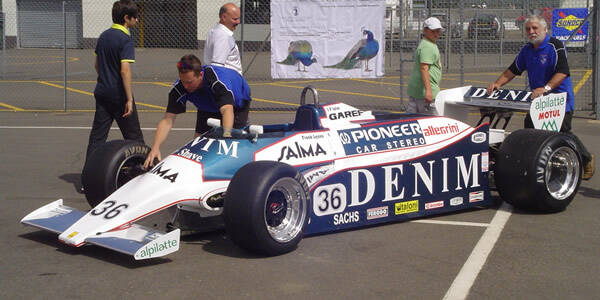
The Osella FA1B holds a critical place in the story of Osella Squadra Corse. It was the car that achieved the team's first-ever race finish in Formula 1, operating during the 1980 and 1981 seasons.
Unlike the later turbo-powered models, the FA1B was built around the classic, naturally aspirated British kit-car blueprint before the team forged its partnership with Alfa Romeo.
The FA1B was an "interim" evolution designed to rescue Osella from a disastrous 1980 debut with the bulky FA1A (which never managed to finish a single Grand Prix). Designed by Giorgio Stirano, the FA1B featured a radically narrowed hull and wider sidepods to better exploit the "ground effect" aerodynamics dominating F1 at the time.
The legendary 3.0-litre Ford-Cosworth DFV V8. It was reliable and easy to maintain, producing roughly 480 horsepower.
The FA1B was rushed to the grid for the final three races of the 1980 F1 season, driven by a young American star, Eddie Cheever.
At its debut during the 1980 Italian Grand Prix at Imola, Cheever qualified an impressive 17th.

Eddie Cheever
Beppe Gabbiani
Miguel Á. Guerra
Jean-Pierre Jarier
fa1c


1981-1982
The Osella FA1C represents a crucial evolutionary leap for Osella Squadra Corse. Competing across the 1981 and 1982 Formula 1 seasons, it was the team’s very first car to utilize a modern aluminum monocoque design rather than an outdated steel spaceframe.
While it brought a significant boost in chassis stiffness and aerodynamic efficiency, its legacy is deeply intertwined with flashes of brilliant driving and utter heartbreak.
Up until 1981, Osella's cars were heavy, bulky, and structurally flexible adaptations of Formula 2 blueprints. To modernize the team, Enzo Osella hired designer Giorgio Valentini, who styled the FA1C using the prevailing "English style" of contemporary F1 engineering.
It featured a genuine full monocoque built from skins of honeycomb aluminum riveted over structural bulkheads. This made the FA1C significantly lighter, stiffer, and narrower than the hefty FA1B it replaced.
The car was heavily influenced by the dominant Brabham BT49 at the rear and was the very first Osella chassis to undergo extensive development inside a wind tunnel (the Orbassano facility in Turin). It was powered by the highly reliable 3.0-litre Ford-Cosworth DFV V8 producing roughly 480 horsepower.

Riccardo Paletti
Jean-Pierre Jarier
fa1d


1983
Tony Southgate joined Osella for 1983, and his first job was to construct interim cars based on the remains of the crashed FA1Cs. These interim FA1D/83s were raced by Corrado Fabi and Piercarlo Ghinzani until the new FA1Es were ready.
Skincare company Kelémata arrived as main sponsor, and Corrado Fabi, the 21-year-old younger brother of Teo Fabi, and Piercarlo Ghinzani were employed as drivers. Tony Southgate, an independent design consultant since his Shadow and Chevron designs had flopped in 1979, was employed to produce a new car which would be powered by Alfa Romeo's normally aspirated V12 engine. All the FA1Cs had been crashed during 1982, but the surviving monocoques were used as the basis of interim cars to start the season. Southgate stiffened the monocoques, redrew the suspension, changed the rear uprights, and designed new sidepods, but this had little effect, and the FA1Ds were regularly at the very bottom of the time sheets.

Corrado Fabi
Piercarlo Ghinzani
fa1e


1983
The name FA1E was applied to two entirely different Osella designs in 1983: one interim car built from half a 1982 Osella and half a 1982 Alfa Romeo, and one designed by Tony Southgate and fabricated in England. Both used Alfa Romeo's V12 engine.
Osella had struck a deal with Autodelta to used Alfa Romeo's normally aspirated V12 engine for 1983, and at Autodelta's insistence, an interim car was built which consisted of the front end of an Osella FA1C/D grafted to the rear end of an Alfa Romeo 182. Everything behind the driver was exactly as it had been on the Alfa Romeo, even the rear suspension, but the car had slanted lateral radiators and no sidepods. This car was just a learning exercise for Osella, and Piercarlo Ghinzani was not close to qualifying it at its first three races.
Former Niki Lauda mechanic Ermanno Cuoghi joined the team at the Austrian GP, and Osella finally got both cars into the race and to the finish: 10th and 11th. From there it was downhill again, with Southgate disappearing and the cars remaining slow and unreliable. It would prove to be Southgate's last F1 design, but he would move to Tom Walkinshaw Racing where he would design the team's highly successful Group C Jaguars. Osella's attention turned to the 1984 FA1F, which would be powered by the turbocharged Alfa Romeo engine. The FA1E was seen once more, when Jo Gartner ran it as a second entry at San Marino in 1984, and in the paddock at the French GP where it was Ghinzani's spare.

Corrado Fabi
Piercarlo Ghinzani
fa1f


1984
The Osella FA1F is one of the most significant and hard-fought cars in the history of the small, underfunded Italian Formula 1 team Osella Squadra Corse. Operating during the brutal "Turbo Era" of the 1980s, the FA1F competed in various forms from 1984 through 1986. It delivered the team its absolute finest hour, despite chronic reliability struggles.
In 1983, Osella secured a supply of turbo engines from Alfa Romeo. For the 1984 season, this technical partnership went a step further. When the works Alfa Romeo team retired their Alfa Romeo 183T chassis from the 1983 season, they handed the blueprints and existing components over to Enzo Osella's team.
As a result, the Osella FA1F was not an entirely new car; it was a heavily modified clone of the 1983 factory Alfa Romeo.
The engine was a 1.5-litre Alfa Romeo Tipo 890T V8 Turbo. It possessed immense raw power but was notorious for extreme fuel consumption and exploding turbochargers. Its weight was roughly 575 kg (significantly heavier than the front-running cars of the era).
Because the team lacked the budget for continuous engine management updates, the V8 turbos frequently suffered from catastrophic failures. To finish races, drivers often had to manually dial down the turbo boost so low that the car became slower than naturally aspirated competitors.

Jo Gartner
Piercarlo Ghinzani
fa1g


1985-1987
The Osella FA1G was a direct technical evolution of the FA1F. Designed by Giuseppe Petrotta, it was built by Osella Squadra Corse to compete primarily across the 1985 and 1986 Formula 1 seasons, with a few final appearances as a spare car in 1987.
Because the team was operating on an extremely tight budget, only two FA1G chassis were ever built. In fact, the very first FA1G was actually a winter rebuild of the youngest FA1F chassis.
While the FA1G retained the core carbon-fiber/aluminum monocoque layout and the troubled Alfa Romeo Tipo 890T 1.5-liter V8 Turbo engine, several critical changes were introduced to improve upon the FA1F's flaws: The sidepods were lengthened and straightened to capture more airflow, feeding redesigned radiators. It also introduced a tight "bottleneck" rear diffuser to improve downforce.
The car weighed roughly 575 kg. While 10 kg lighter than the FA1F, it was still roughly 35 kg heavier than the top-tier cars on the grid.

Piercarlo Ghinzani
Huub Rothengatter
Christian Danner
fa1h


1986
The Osella FA1H is widely regarded as one of the shortest-lived and most ill-fated cars in Formula 1 history. Built by Osella Squadra Corse to compete during the 1986 season, the car was meant to be a brand-new technological savior for the team.
Instead, it was plagued by manufacturing delays, raced just a handful of times, and was permanently destroyed in a massive crash after only a few months on the grid.
The FA1H was designed by Giuseppe Petrotta as a genuine attempt to modernize Osella's aerodynamics and mechanical packaging beyond the recycled 1983 Alfa Romeo concepts they had been utilizing. The biggest technical leap from the FA1G was a completely revised suspension geometry, switching to a modern pushrod system in the front and a pullrod system in the rear to drastically improve tire contact and mechanical grip. The FA1H featured significantly slimmer, tighter bodywork compared to its bulky predecessors to improve straight-line speed.
Osella had initially intended to fit the FA1H with a new engine from Motori Moderni. When that deal fell through due to financial constraints, the team was forced to squeeze the bulky, notoriously thirsty 1.5-liter Alfa Romeo Tipo 890T V8 Turbo back into the tight engine bay.

Piercarlo Ghinzani
Allen Berg
Christian Danner
fa1i


1987
The Osella FA1I was a Formula 1 racing car built by the Italian underdog team Osella Squadra Corse. It competed during the 1987 season and made one final, brief appearance at the start of the 1988 season.
Designed by Ignazio Lunetta, the FA1I represents one of the darkest and most difficult periods in Osella's history. Heavily burdened by outdated technical designs and severe budget constraints, the car never successfully finished a single Grand Prix.
By 1987, the technical partnership between Osella and Alfa Romeo was crumbling. Alfa Romeo was preparing to withdraw from F1 entirely, meaning Osella was left with zero development support. The FA1I was not a brand-new car. It was built by heavily modifying the uncompetitive 1986 FA1H and FA1G chassis.
The "Osella" V8 Engine: Under the hood was the 1.5-litre Alfa Romeo Tipo 890T V8 Turbo. However, because Alfa Romeo wanted to distance its brand from Osella's poor performance, the engines were re-branded simply as "Osella V8".
While top teams were utilizing advanced electronic fuel injection systems, Osella was still forced to rely on an old, analogue Spica mechanical fuel injection layout, severely hurting both horsepower and fuel efficiency.

Alex Caffi
fa1l


1988
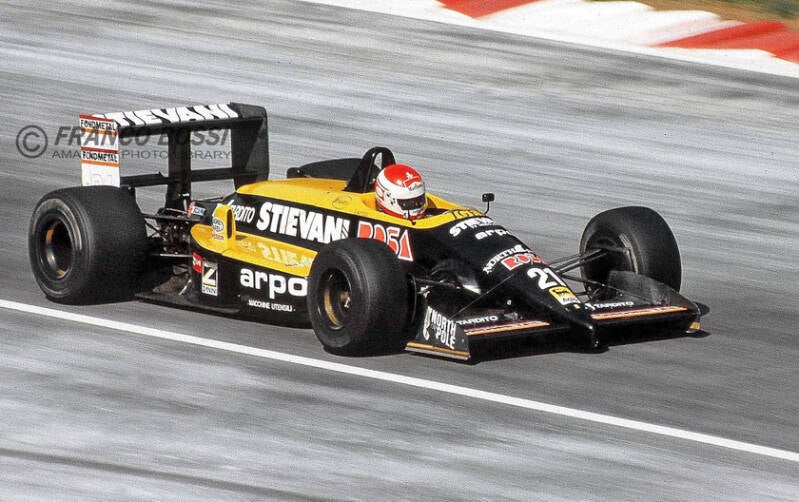
The Osella FA1L is one of the most infamous and extreme creations in Formula 1 history. Competing during the 1988 season, it holds a legendary reputation among F1 enthusiasts—not for its success, but for its bizarre name, its terrifying lack of safety, and the sheer political drama it caused within the paddock.
It was the very last car Osella built during the original "Turbo Era," and it was a mechanical nightmare from start to finish.
To English-speaking fans, the car's designation is an accidental comedy masterpiece. When written out, the FA1L looks exactly like the word "FAIL." Tragically for the team, the car lived up to its name in almost every conceivable way, becoming a regular fixture at the back of the grid and failing to qualify for more than half the races it entered.
Osella had no budget to design a truly new car to fit the new rules. Designer Antonio Tomaini was forced to take the old, obsolete 1984 FA1F chassis and alter it.
Alfa Romeo had officially walked away from F1 and forbidden Osella from using their name. The team re-badged the old, uncompetitive 1.5-litre Alfa Romeo Tipo 890T V8 Turbo as an "Osella 890T". It lacked power, guzzled fuel, and overheated constantly.

Nicola Larini
fa1m


1989-1990
The Osella FA1M (and its 1990 evolution, the FA1M-E) marks a massive turning point for Osella Squadra Corse. Competing in the 1989 and 1990 Formula 1 seasons, it was the car that finally broke the team's reliance on fragile Alfa Romeo turbo engines.
Financed by a fresh cash injection from Gabriele Rumi (owner of wheel manufacturer Fondmetal), the FA1M was an entirely new car built from the ground up by designer Antonio Tomaini. It was shockingly fast in qualifying but tragically fragile in races.
The FA1M was designed to comply with F1's brand-new 1989 regulations, which banned turbochargers entirely in favor of 3.5-liter naturally aspirated engines. It used the Ford Cosworth DFR 3.5-liter V8. This was a massive upgrade in driveability and base reliability compared to the old Alfa V8 turbo. Pirelli. This partnership was crucial, as Pirelli supplied special, ultra-sticky qualifying tires that played perfectly into the car's characteristics.
Despite the raw pace, the car was a mechanical nightmare on Sundays. Out of 32 total entries in 1989, the FA1M never officially finished a single race due to crashes, disqualifications, or non-qualifications.

Piercarlo Ghinzani
Nicola Larini
fa1m-e


1990
For 1990, the car was updated and renamed the FA1M-E. Frustrated by the lack of results, Enzo Osella scaled back to a single entry driven by Frenchman Olivier Grouillard.
Grouillard managed to qualify for most races, even securing a remarkable 8th on the grid at the season-opening United States Grand Prix. However, race results remained elusive, with a best finish of just 13th at the Monaco Grand Prix.
Exhausted by the soaring costs of running a top-tier racing operation, Enzo Osella sold his remaining shares in the team to Gabriele Rumi at the end of 1990. Rumi officially renamed the outfit Fondmetal for 1991, meaning the FA1M-E was the final car to ever race under the historic Osella name.

Olivier Grouillard

In 1990, Enzo Osella sold shares in his team to metalwork magnate Gabriele Rumi, as part of a sponsorship deal with Rumi's Fondmetal company. During 1990, the team entered a single car for French driver Olivier Grouillard. At the end of 1990, Rumi took over the remainder of the team and renamed it Fondmetal. The involvement of Rumi meant the end of Osella's activities in Formula One.
In the 1990s, Osella moved to Atella in the south of Italy where he built a new ultra-modern facility to produce some very competitive sports cars.
At the end of 2022, Osella Motorsports LTD merged with Osella Engineering. Under the leadership of Enzo Osella and Giuseppe Angiulli, the company, now known as Osella corse, produced cars such as the PA21 JrB from the E2B class, that can be equipped with motorcycling propellers from 1000 to 1600 cc., with a set-up both for hill climbing and track. This new collaboration, according to Enzo Osella, "breathed life into Osella and also into the spirit that has been driving the team".


Create Your Own Website With JouwWeb