


Vel's Parnelli Jones Racing, commonly referred to simply as Parnelli or VPJ, was a motor racing constructor and team from the United States. The team was formed in 1969 by former USAC racer Parnelli Jones and his business partner Velko "Vel" Miletich.
Parnelli was initially solely concerned with USAC racing, where success came quickly; their driver Al Unser won the Indianapolis 500 race in 1970, driving a VPJ Colt, after leading 190 of the 200 racing laps. Unser went on to win the USAC championship. Unser repeated the Indy 500 win in 1971 with a new Colt built without the left side chassis offset that had been made illegal by 1971 rules, ending the season in fourth place in the USAC drivers points while teammate Joe Leonard won the championship.
Parnelli secured the services of ex-Team Lotus designer Maurice Philippe and driver Mario Andretti for USAC racing in the early 1970s, and in 1974 decided to move into Formula One racing, with financial support from tire manufacturer Firestone.
After a brief foray into Formula One at the end of the 1974 season, Vel's Parnelli Jones mounted a full campaign in 1975. Their Parnelli VPJ4 car owed much to Philippe's Lotus 72 design. It appeared for the North American races at the end of the 1974 season and was gradually developed through 1975. However, Firestone's decision to quit racing at the beginning of 1975 meant that a major partner was lost. Jones was unable to find a replacement title sponsor and despite improvements made to the car the team folded only three races into the 1976 season. Andretti only learned of the Formula One team's future from journalist Chris Economaki, as he sat in the car on the grid for the Long Beach Grand Prix. This led to some bad feeling between Andretti and Jones, and Andretti returned to Lotus for the remainder of the season. In total, Vel's Parnelli Jones participated in 16 Grands Prix and scored 6 championship points.

Concurrent with the Formula One venture, VPJ was developing a turbocharged version of Cosworth's legendary DFV V8 Formula One engine, building on their experience from the previous two years. It was developed at their facility in Torrance, California, under the direction of engine builder Larry Slutter and dyno engineer Takeo "Chickie" Hirashima. The car debuted at the Speedway in 1975 in a modified Indy version of the Formula One Parnelli chassis, although it was not run regularly until late in 1976. This private project was quickly adopted by Cosworth itself, and the Parnelli engine evolved into the equally legendary Cosworth DFX, an engine which would go on to win every Indianapolis 500 race and USAC/CART Championship between 1978 and 1987.
vpj4


1974-1975
The Parnelli VPJ4 was a Formula One racing car designed by Maurice Philippe, and used by Vel's Parnelli Jones Racing during the 1974, 1975 and 1976 Formula One seasons. . Driven exclusively by racing legend Mario Andretti, it is remembered as one of the great "what could have been" stories of its era—a car with immense, untapped potential that fell victim to bad timing and funding issues.
The car was equipped with the dominant 3.0-liter Ford Cosworth DFV V8 engine (producing around 450–480 horsepower) paired with a 5-speed Hewland manual gearbox.
The VPJ4 made its debut at the 1974 Canadian Grand Prix with Andretti and finished seventh. At the United States, the American's car developed an ignition fault on the parade lap. The Parnelli team scored no World Championship points during the year.
Andretti briefly led the 1975 Spanish Grand Prix before a suspension failure. The Parnelli team scored five World Championship points in 1975, earning them tenth place in the Constructors' Championship.
Only three VPJ4 chassis were ever built.

Mario Andretti
vpj4b

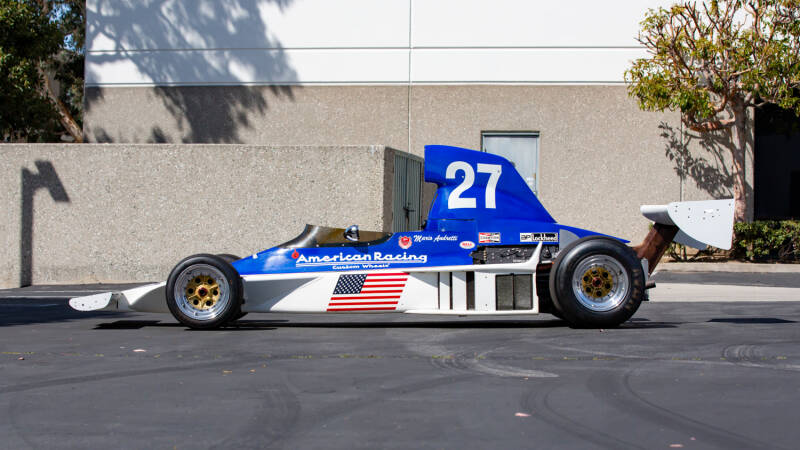
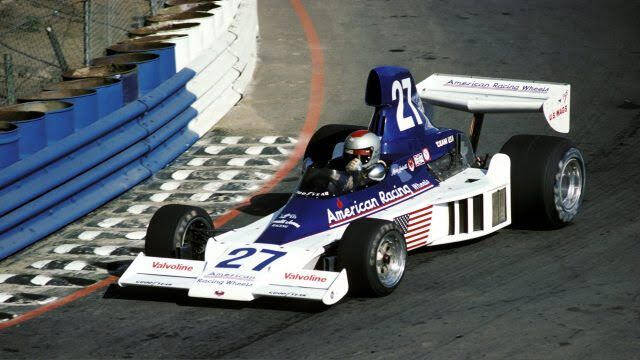
1976
The Parnelli VPJ4B was the final iteration of Parnelli’s Formula 1 car, introduced for the 1976 season. Modified by legendary designer John Barnard, it featured significant aerodynamic and mechanical changes but only competed in two races before the team's abrupt exit from F1.
The original, troublesome front torsion bar suspension was completely replaced with a standard coil-spring setup to improve handling on Goodyear tires. John Barnard completely reworked the car’s bodywork, introducing a sleeker profile and a redesigned airbox.
The VPJ4B's operational lifespan spanned just one single month in 1976.
The Parnelli team had scored one World Championship point, earning them thirteenth place in the Constructors' Championship.
The car is famously linked to one of the most awkward moments in F1 history. While Mario Andretti was sitting in the cockpit of the VPJ4B on the grid at Long Beach, legendary journalist Chris Economaki walked up to interview him. Economaki asked Andretti how he felt about Parnelli pulling out of Formula 1.
Team owner Parnelli Jones had chosen to fold the expensive F1 program to focus back on U.S. racing, but had neglected to tell his driver. Stunned by the news on live grid television, an infuriated Andretti finished the weekend and immediately signed a contract to return to Team Lotus, where he would win the world title two years later.

Mario Andretti
the end
The Parnelli F1 story ended abruptly on March 28, 1976, due to a lack of corporate sponsorship and escalating costs. This forced team owners Vel Miletich and Parnelli Jones to pull the plug.
Vel's Parnelli Jones Racing abandoned Formula 1 entirely but pivoted back to domestic racing with massive success. They adapted the VPJ4’s design concepts into the Parnelli VPJ6 Indy car, which won 15 races and captured the USAC Championship with A.J. Foyt.
Only three VPJ4 chassis were ever built during the F1 program:
- Chassis 4/001: Kept by the Parnelli Jones family for decades, this chassis was later put on display at the Indianapolis Motor Speedway Museum.
- Chassis 4/002: Thoroughly restored to its original racing specifications by the Phil Reilly Company, this car was sold to a private collector at a Mecum auction.
- Chassis 4/003 (The VPJ4B): The final updated chassis stayed with the team long-term before being sold into private hands. It is regularly maintained and still makes appearances today in historic Grand Prix racing events.



Create Your Own Website With JouwWeb