


Virgin Racing (subsequently Marussia Virgin Racing) was a Formula One racing team which was under management of Manor Motorsport, Wirth Research and Richard Branson's Virgin Group and competed in 2010 with a British licence and in 2011 with a Russian licence. It scored no points and finished last in the Constructor's Championship for the two years the team competed.

The team was one of the four granted an entry for the 2010 season, and was originally known as Manor Grand Prix, before being renamed Virgin Racing when Virgin bought a shareholding and naming rights at the end of 2009. The team's original car, the Virgin VR-01, was the first in Formula One to be developed using only computational fluid dynamics, and was driven by Timo Glock and Lucas di Grassi.

At the end of the season, Marussia Motors bought a stake in the team and became the main sponsor, with the team known as Marussia Virgin Racing. The partnership with Wirth ended midway through 2011, and a new technical structure bringing car development in-house was set up for 2012.
Marussia Virgin Racing was renamed to Marussia F1 Team at the end of 2011. The company retained its base in Dinnington, South Yorkshire as well as setting up the technical base in Banbury, Oxfordshire for the construction of the racing cars.
Virgin Racing were based on a three-way partnership between Manor Motorsport, which ran the cars, Wirth Research, which designed them and Virgin which handled commercial operations. Car preparation and racing operations were run from its headquarters in Dinnington, South Yorkshire, while Wirth Research designed, developed and built the Virgin VR-01 from its base in Bicester, Oxfordshire before announcing a relocation to new, larger premises in Banbury, Oxfordshire in July 2010.
vr 01


2010
The Virgin VR-01 was a Formula One motor racing car designed by Nick Wirth for Virgin Racing in the 2010 season. It was driven by former Toyota driver Timo Glock and Brazilian ex-GP2 driver Lucas di Grassi. The car was the first Formula One racing car designed entirely with computational fluid dynamics. The car was due to be launched online through the official team website on 3 February 2010, but technical issues prevented the live internet broadcast from taking place.
Technical director Nick Wirth took the decision to use only the computer simulation tool CFD to develop the aerodynamics, with no reference to a wind tunnel.
The car was launched on 3 February in a somewhat failed online event. It made its track debut 2 days later at Silverstone. At its first official tests, the car suffered from reliability problems, including a broken front wing and several hydraulic issues that hampered the team's progress towards the start of the 2010 season. Because of these delays, Virgin decided to only introduce its new aerodynamic package at the first GP of the season, rather than testing it beforehand.
The Virgin had a Cosworth CA2010 2.4L V8 engine.

Timo Glock
Lucas di Grassi
mvr 02
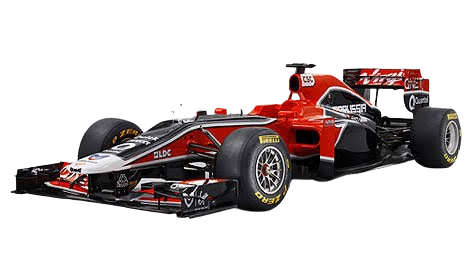


2011
The Virgin MVR-02 is a Formula One racing car designed by Wirth Research for Marussia Virgin Racing, and used by them during the 2011 Formula One season. Like its predecessor, the Virgin VR-01, the MVR-02 was designed entirely with computational fluid dynamics, with Nick Wirth's design studio doubling their CFD capacity ahead of the 2011 season. The addition of the "M" in the car's chassis designation reflected the team's new owner, Russian sports car manufacturer Marussia Motors. The car was unveiled in London on 7 February 2011, and was driven during the racing season by returning driver Timo Glock and debutant Jérôme d'Ambrosio.
The MVR-02 followed the VR-01's design principle of exclusively using computational fluid dynamics instead of the more traditional windtunnel approach. The car did not use KERS; chief designer Nick Wirth commented that the gains offered by the system did not justify the expense of developing it.
In June 2011 Marussia Virgin Racing announced that they had ended their relationship with technical partner Nick Wirth and his company, Wirth Research, who designed their 2010 and 2011 cars. The reason cited was a disappointing start to their 2011 season.
Following the arrival of Russian sports car company Maurssia as an investor the team are now registered under a Russian licence. The air intake on the front of the MVR-02 is designed to resemble the one on Marussia’s B2 road car.

Timo Glock
Jérôme d'Ambrosio

Following a disappointing start to the 2011 season, the team parted company with Wirth Research and entered a partnership with McLaren Applied Technologies ahead of the 2012 season. With this came a relocation from the original base in Dinnington, to the old Wirth premises in Banbury in Great Britain. Meanwhile, the team again finished the year bottom of the Constructors' Championship. In November 2011, it applied to the Formula One commission to formally change their constructor name for the 2012 season from Virgin to Marussia, to reflect their new ownership. Permission was granted before being formally ratified at a meeting of the FIA World Motor Sport Council.
On 5 March 2012, Marussia revealed the MR01 at Silverstone. The car design was led by technical consultant Pat Symonds and the team became the penultimate team to reveal its car for the 2012 season.

Virgin was one of the first teams to enter Formula E; its entry was officially confirmed in December 2013. Virgin partnered with Peugeot but rebadged as DS Automobiles from the 2015–16 season to the 2017–18 season, competing as DS Virgin Racing during that time. With DS moving its support to rival team Techeetah from the 2018–19 season onwards, Virgin chose to establish a long-term customer car deal with Audi Sport.

Following the 2020–21 season Virgin left the team as a partner and the team re-branded as Envision Racing, and introduced a new green livery for its entry. Cassidy and Frijns were retained as drivers, while Alice Powell became the Simulator and Development Driver for the team.


Create Your Own Website With JouwWeb