


Nash Motors Company was an American automobile manufacturer based in Kenosha, Wisconsin from 1916 until 1937.
From 1937 through 1954, Nash Motors was the automotive division of Nash-Kelvinator. As sales of smaller firms declined after 1950 in the wake of the domestic Big Three automakers’ (General Motors, Ford, and Chrysler) advantages in production, distribution, and revenue, Nash merged with Hudson Motors to form American Motors Corporation (AMC). Nash automobile production continued from 1954 through 1957 under AMC.

Nash Motors was founded in 1916 by former General Motors president Charles W. Nash, who acquired the Thomas B. Jeffery Company. Jeffery's best-known automobile was the Rambler whose mass production from a plant in Kenosha began in 1902.
The 1917 Nash Model 671 was the first vehicle produced to bear the name of the new company's founder. Sales for 1918 were 10.283 units. More models were added in 1919, and sales rose to 27.081.


The four-wheel drive Jeffery Quad truck became an important product for Nash. Approximately 11,500 Quads were built between 1913 and 1919. They served to move material during World War I under severe conditions. It featured four-wheel steering. The Quad achieved the reputation of being the best four-wheel drive truck produced in the country. The newly formed Nash Motors became the largest producer of four-wheel drives. By 1918, capacity constraints at Nash meant the Paige-Detroit Motor Car Company began to assemble the Nash Quad under license and Nash patents. Nash became the leading producer of military trucks by the end of World War I. After the War ended, surplus Quads were used as heavy work trucks in fields such as construction and logging.
1924: Nash was the principal stockholder in LaFayette Motors, a company started in Indianapolis, Indiana in 1920. Nash absorbed LaFayette and converted its plant to produce Ajax automobiles.
1925: Nash bought the Mitchell Motor Car Company plant in Racine, Wisconsin. Mitchell was the manufacturer of Mitchell-brand automobiles between 1903 and 1923.
1937: Nash merged with Kelvinator to form Nash-Kelvinator in 1937. Kelvinator was an appliance company.
1954: Nash merged with Hudson Motors to form American Motors Corporation (AMC).
ambassador

1927-1930

1932-1934

1935–1942

1946–1948
The Nash Ambassador is a full-size automobile produced by Nash Motors from 1927 until 1957. It was a top trim level for the first five years, then became a standalone luxury model from 1932 onwards. These Ambassadors included high levels of design, equipment, and construction, earning them the nickname "the Kenosha Duesenberg".
Between 1929 and 1934, Nash also produced a line of seven-passenger sedans and limousines. The Ambassador series was the Nash's "flagship" car. This positioning remained following the merger of Nash with Hudson Motor Car Company in 1954 that formed the American Motors Corporation (AMC).
The ongoing use of the Ambassador model name by Nash, and then its successor AMC versions built through the 1974 model year, made it "one of the longest-lived automobile nameplates in automotive history" as of the late 1970s.
Nash Motors' first use of the name Ambassador was for the 1927 model year, when a specially trimmed four-door, five-passenger club sedan version of the "Nash Advanced Six" (designated model 267) was introduced.
After the production of under 3600 big Nash cars, the final Nash Ambassador rolled off the Kenosha, Wisconsin production line in 1957.

1949–1951

1952–1957

1955

1956-1957
600

1945-1949


The Nash 600 is an automobile manufactured by the Nash-Kelvinator Corporation of Kenosha, Wisconsin, from 1941 through 1949 model years, after which the car was renamed the Nash Statesman.
The Nash 600 was the first mass-produced unibody-constructed car in the United States and the era's most advanced domestic car design and construction. The "600" name comes from the car's advertised ability to go 600 miles (970 km) on one tank of gasoline.
The Nash 600 was positioned in the low-priced market segment. It was the replacement for Nash's LaFayette line, which was discontinued after 1940.
Four body versions were available. A four-door Slipstream (fastback) Sedan with a smooth, flowing roofline that integrated into the rear, with no protruding lights, running boards, or exposed door hinges. A four-door Sedan with a built-in trunk (notchback) with a more conventional rear design. A two-door Coupe Brougham included a full-width front and rear seating for six adults. A two-door Business Coupe for utility with a bench seat in the front and a lined cargo compartment in the rear of the cabin.
The engine was 2.8 L L-head I6, was known for its fuel economy, produced 75 hp at 3600 rpm. A three-speed manual gearbox had an electric-controlled overdrive unit. Coil springs on all four wheels contributed to a comfortable ride while a 10.1 m turning circle made it agile for its size.
statesman

1950-1951


1952-1956

The Nash Statesman is a full-sized automobile that was built by Nash Motors for the 1950 through 1956 model years in two generations. The Statesman series was positioned below the top-line Nash Ambassador and above the Nash Rambler.
Nash developed its post–World War II automobiles using an advanced unit-body construction with fastback aerodynamic styling under the Airflyte name, reflecting a popular styling trend in the 1950s. The cars were available as a two- or four-door sedan.
Statesman engine designs were based on the L-head Nash Light Six engine that was designed in the 1920s and continued into the 1940s in the Nash LaFayette and Nash 600.
A new design was introduced for the 1952 model year featuring a large "envelope-bodied" sedan with enclosed wheels that were characteristic for Nash. The all-new notchback Statesman design coincided with Nash's 50th anniversary and included styling by Pininfarina, the Italian designer.
The 1954 models included the outside mounted "continental" spare tire increasing trunk space and making emergency tire changes easier.
rambler
nash motors 1950–1954


american motors corporation 1954–1955
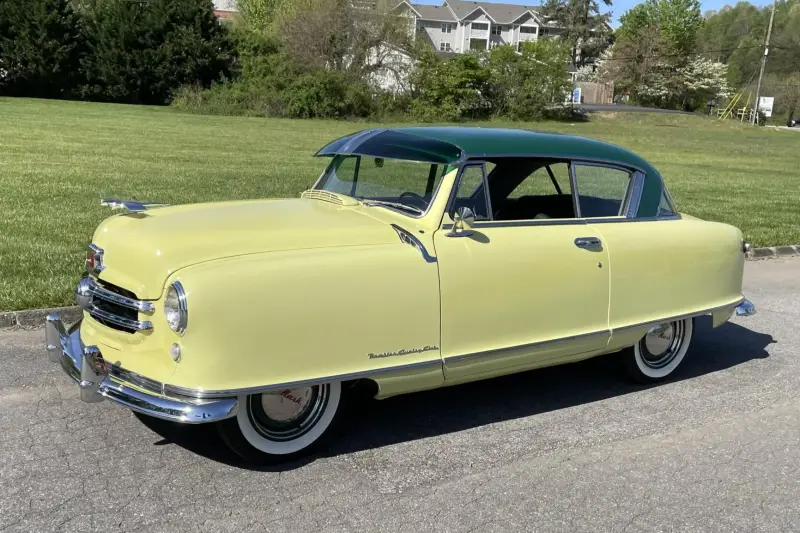
The Nash Rambler is a compact car manufactured and marketed by the Nash Motors division of Nash-Kelvinator Corporation for model years 1950-1954. It has a front-engine, rear-wheel-drive layout with sedan, station wagon, and fixed-profile convertible body styles.
In a marketing breakthrough, Nash successfully established the compact market segment by using the Rambler's size and an upscale complement of features and equipment as its unique selling proposition: small and economical, but also luxurious.
When Nash-Kelvinator merged with the Hudson Motor Car Company in 1954, the Rambler became a product of the resulting American Motors Corporation (AMC), which in a rare feat, subsequently reintroduced the Rambler for model years 1958-1960. The Rambler was manufactured in Kenosha, Wisconsin over its two separate production runs.
Power came from Nash's proven 2.8 L L-head (flathead) straight-6 cylinder engine that produced 82 hp. A car tested by the British magazine The Motor in 1951 had a top speed of 130 km/h and could accelerate from 0–100 km/h in 21.5 seconds.
nash-healey


1951-1954
The Nash-Healey is a three-seat luxury sports car or grand tourer produced from 1951 to 1954. It was marketed by the Nash-Kelvinator conglomerate in North America as a halo car to promote sales of its Nash Motors division.
The car resulted from a joint venture between Nash-Kelvinator and British automaker, the Donald Healey Motor Company. Nash supplied the drivetrain from their range-topping Ambassador model, and Healey provided the chassis and early bodies. One year after its introduction, the car was restyled by Pininfarina, and the final assembly was transferred to Italy. Some describe the Nash-Healey as the first sports car introduced in the U.S. by a major automaker after the Great Depression.
Various Nash-Healeys, some modified road cars, and some purpose-built racers competed in several endurance racing events, most notably posting a third-place finish at the 1952 24 Hours of Le Mans.
Nash supplied Healey's company with the powertrain components: the Ambassador's inline six-cylinder OHV 3.85 L engine and three-speed manual transmission with Borg-Warner overdrive. Healey fitted a lighter, higher-compression aluminum cylinder head. This increased power from the stock 112 hp version to 125 hp.
metropolitan

1953-1954 series I

1955 series II

1955-1958 series III

1959-1961 series IV
The Nash Metropolitan was an American automobile marketed from 1953 until 1962, manufactured in England. While designed and marketed in the USA by Nash and its successor companies, it was built entirely in BMC factories using many existing BMC parts.
It conforms to two classes of vehicle: economy car and subcompact car. The Metropolitan is considered a "subcompact", but this category was not yet in use when the car was made. At that time, it was categorized as a "small automobile" as well as an "economy car".
The Metropolitan was also marketed as a Hudson model when Nash and Hudson merged in 1954 to form the American Motors Corporation (AMC). The Nash and Hudson lines were phased out in favor of the Rambler line, and in 1957, the Metropolitan became a standalone brand and was badged with a stylized 'M' on hubcaps and grille. The cars were also sold in the United Kingdom and other markets.
The Metropolitan was the first postwar American car that was marketed specifically to women.
The two models, a convertible and a hardtop, were powered by the OHV 1200 cc straight-4 Austin 'A40' series engine (as used in the Austin A40 Devon/Dorset) driving the rear wheels through a three-speed manual transmission.
Approximately 95.000 Metropolitans were sold in the United States and Canada, making it one of the top-selling cars to be imported into those countries at the time, and its sales in 1959 helped to spur the introduction of the Big Three (General Motors, Ford, and Chrysler) new compact models.

In January 1954, Nash announced the acquisition of the Hudson Motor Car Company as a friendly merger, creating American Motors Corporation (AMC). To improve the financial performance of the combined companies, all production, beginning with the 1955 Nash and Hudson models, would happen at Nash's Kenosha plant. Nash would focus most of its marketing resources on its smaller Rambler models, and Hudson would focus its marketing efforts on its full-sized cars.
Even with the merger forming AMC, they were held to a total of about four percent of the market and thus were under pressure to lower expenses and tooling costs for new models, perhaps by innovation.


Create Your Own Website With JouwWeb