


Morgan Motor Company Limited is a British motor car manufacturer majority-owned by European investment group InvestIndustrial. Morgan was founded in 1910 by Henry Frederick Stanley Morgan. The company is based in Malvern Link, an area of Malvern, and employs approximately 220 people. As of September 2025, the company manufactures 630 cars per year. Morgan cars are unusual in that wood (from the ash tree) has been used in their construction for a century, and is still used in the 21st century for framing the body shell


H.F.S. Morgan quit the Great Western Railway in 1904 and co-founded a motor sales and servicing garage in Malvern Link. In 1909 he designed and built a car for his own use. Previously he developed the first independent front suspension in the engineering shop of Malvern College. He began production a year later and the company prospered. Production of three-wheelers approached 1000 by World War I and quickly resumed with both racing and touring models. Morgan's first four-wheeler came in 1935 with three-wheelers phased out in 1952. Morgan continued to run it until he died at age 77 in 1959.
For most of its history, the company was owned by the Morgan family. A press release dated 5 March 2019 announced the acquisition of a majority stake in Morgan Motor Company Ltd by the Italian investment group InvestIndustrial. Though it was announced that as a part of InvestIndustrial's investment, management and staff were rewarded with shares in the company, this appears nowhere in the information registered at Companies House. And though it was also announced that the Morgan family retained a minority shareholding and would continue to be involved in the company this does not appear on any statement filed with Companies House.
The early cars were two-seat or four-seat three-wheelers, and are therefore considered to be cyclecars. Three-wheeled vehicles avoided the British tax on cars by being classified as motorcycles. Competition from small cars like the Austin 7 and the original Morris Minor, with comparable economy and price and better comfort, made cyclecars less attractive.
f-series

1932-1952


The Morgan F-Series 3-Wheeler is a model of 3-wheeled car. It was produced between the mid- 1930s and 1952. The car was powered by Ford 8hp and 10hp sidevalve engines (as used in the Ford Model Y), instead of the V-twin motorcycle engines that had been used in previous Morgans (typically from JAP, Anzani, or Blackburne), and the F-Series had a new pressed-steel chassis.
The four-seater Morgan F-4 was introduced in 1933 at the Olympia Motor Cycle Show. The two-seat F-2 was introduced in 1935, and the F Super, which had a more sporting performance and image with its cycle-type wings and louvred bonnet tops, in 1937. During the models' lifetime, Morgan's production of 4-wheeled cars was ramping up and 3-wheeler production reducing until 1952 when the last 3-wheeler, a Ford-engined "F"-Super, was built. The company then focused exclusively on 4-wheeled designs until 2012, when the Morgan 3 Wheeler was introduced.
4/4
The Morgan 4/4 is a British motor car which was produced by the Morgan Motor Company from 1936 to 2018. It was Morgan's first car with four wheels, the name indicating that the model has four wheels and four cylinders (earlier Morgans had been three-wheelers, typically with V-twin engines). Early publicity and advertising material variously referred to the model as "4/4", "4-4", "Four Four", and similar names, but from the outset the factory designation was always "4/4".
Apart from a break during World War II (and the period March 1951 to September 1955), the 4/4 was in continuous production from its debut in 1936 until 2018. This span of 73 years was one of the longest production periods of any car in history. Engine capacity has increased from the 1,122 cc Coventry Climax engine in 1936 to a 1.8-litre Ford engine in 2004. From 2009 until the model was discontinued in 2018 a 1.6-litre Ford Sigma engine was fitted. Power has ranged from 34 to 125 bhp over the decades.

4/4 two-seater 1936-1950
The original open two-seater 4/4 was introduced in 1936 and became the most popular of the three body options available. 663 were built by 1939 and 249 more from 1946 to 1950, representing 53% of the overall production.
For the first years, the car had a 1,122cc Coventry Climax engine with 34 bhp (25 kW), superseded from 1939 by a Standard Special 1,267cc overhead valve engine with 38.8 bhp (29 kW). A four-speed Meadows gearbox was used until 1938, then a Moss gearbox.

4/4 series II 1955-1960
The Series II was introduced in 1955 with 386 built by October 1960. Although very similar in appearance to the model it replaced, it was virtually a new car with a chassis based on the one used in the Morgan Plus 4. The traditional independent front suspension using sliding pillars and coil springs was fitted with a rigid axle and semi-elliptic leaf springs at the rear. Disc wheels were fitted as standard items.
A side-valve 1172 cc Ford 100E engine was used with a Ford three-speed gearbox. The engine produced 36 bhp.

4/4 series III 1960-1961
The short-lived Series III was introduced in October 1960 and 58 were built by November 1961 when the Series IV arrived. The chassis was essentially the same as that used on the Series II but the track was increased by 2 inches (50mm). Hydraulic shock absorbers replaced the old Hartford friction type.
A 39 bhp overhead valve 997cc Ford Anglia 105E engine and Ford four-speed gearbox were used.

4/4 series IV 1961-1963
The Series IV introduced October 1961 with 114 built by March 1963 had a 62 bhp, 1340 cc, Ford Classic 109E engine and Ford four-speed gearbox. Front 279 mm disc brakes were now fitted.
The Motor magazine tested a Series IV in 1962 and found it had a top speed of 129.2 km/h, acceleration from 0-100 km/h) in 18.8 seconds

4/4 series V 1963-1968
The Series V was introduced in February 1963 with 639 built by March 1968.
A 65 bhp, 1498cc, Ford Cortina 116E engine and Ford four-speed gearbox were used.
During it's life span, 639 examples were produced.

4/4 1600 1968-1993
The car was further updated in 1968 to become the 1600 with two- and four-seat open bodies available. The 4/4 1600 also benefitted from minor improvements to the body, including door handles from the Land Rover.
The Morgan 4/4 1600 TC was introduced in November 1981. Offered as a more powerful alternative to the Ford-engined variants, this was fitted with a 97 bhp, 1584 cc Fiat twin-cam engine and five-speed Fiat gearbox.
From November 1991, a 100 bhp Ford 1597 cc CVH engine with electronic fuel injection was used.

4/4 1800 1993-2009
Starting in April 1993, the Morgan 4/4 used a 114 bhp Ford 1,796cc 16-valve Zetec R engine.
In January 2006, a "70th Anniversary Special edition" was presented, celebrating 70 years having passed since the introduction of the 4/4. In spite of seventy years of production, the accumulated figure had not yet reached 10.000 in 2006.

4/4 1.6 litre 2009–2018
From 2009 to 2018, the Ford Sigma engine was used. This model displaces 1595 cc and produces 110 bhp, enough for a 185 km/h top speed. The engine drives the rear wheels via a five-speed manual gearbox. Initially, a Ford gearbox was used, then from 2012 a Mazda unit was fitted.
plus 4 plus

1964-1967


The Morgan Plus 4 Plus or +4+ was an attempt by the Morgan Motor Company to modernize the bodywork. Announced at the 1963 Earls Court Motor Show, only 26 were built, due to poor sales, in spite of its performance.
The equipment may have varied between cars, but were typically mechanically similar to a Morgan +4 of the same year. It had the straight-four, pushrod engine of a Triumph TR4A, giving 110 hp (82 kW). The transmission was a four-speed with synchromesh on the top three gears. It also shared the suspension with the +4.
The closed envelope two seat body was thin streamlined fibreglass with fixed top and all glass windows, wind-ups on the sides, giving it a weight of 816 kg and a top speed of around 185 km/h.
plus 8

1968-2004


2012-2018

The Morgan Plus 8 is a sports car built by British car maker Morgan from 1968 to 2004 and again in revised form between 2012 and 2018. Its instant and enduring popularity has been credited with saving the company and keeping the company famous during the 36 years of its manufacture. Among Morgan enthusiasts, it is deeply associated with Peter Morgan, the owner-chairman behind its design.
The Plus 8 prototype was based on a modified chassis from the Plus 4, altered to accept the Rover alloy block 3.5 L V8, purchased from GM-Buick in 1967. Plus 4's Moss gearbox was carried over. The chassis was developed in stages to accommodate gearbox changes in 1973 and 1976, 1995 the body widened in 1976 to accommodate the widened chassis and the wings widened to accommodate larger tyres to handle the increasing power and trend for lower profile and wider tyres.
Following the discontinuation of the Rover V8, production of Plus 8 ended in 2004.
On the 2012 Geneva Motor Show, Morgan introduced a new edition of the Plus 8 roadster, powered by a 4.8-litre BMW V8 engine.
aero 8
The Morgan Aero 8 is a sports car built by Morgan Motor Company at its factory in Malvern Link, England from 2000 until 2018.
Announced in 2000, the Aero 8 is notable for several reasons, primarily because it is the first new Morgan design since 1964's +4+. It was touted as Morgan's first supercar and undertook a comprehensive development programme including endurance testing at BMW's huge proving grounds L'Autodrome de Miramas. It does not use anti-roll bars, an oddity in a modern sporting car. It is also the first Morgan vehicle with an aluminium chassis and frame as opposed to traditional Morgan vehicles ("trads") that have an aluminium skinned wooden body tub on a steel chassis.
The engine first powering the Aero 8 was a 4.4 L BMW M62 V8 mated to a 6-speed Getrag transmission. In 2007, the Series 4 Aero 8 was released which had an upgraded 4.8 L BMW N62 V8 with an optional ZF automatic transmission. All Aero 8s are assembled at Morgan's Malvern Link factory, where they are able to produce up to 14 cars a week (Aeros and trads).

aero 8 series 1 2000–2004
Morgan's first supercar, the first run of Aero models was unveiled at the Geneva Motor Show in 2000 by Charles Morgan.
The bonded aluminium chassis has elements of an ash frame to provide a link to the more traditional cars. It was designed by Chris Lawrence who had a long-standing relationship with Morgan and included many features of racing cars of the time.
Complete with a bespoke aluminium chassis, all independent suspension and powered by a 4.4 litre BMW V8 engine producing 286 bhp at 5500 rpm and 430 N·m at 3750 rpm this was a radical departure from the traditionally built Morgans. Performance was 0-100 in 4.8 seconds with a top speed of 257 km/h.

aero 8 series 2 2004–2005
This limited edition run-out model of the Series 1 was a nod to the successful Aero GT/Le Man racing cars and included the 4.6L Alpina BMW engine used on Alpina B10 and on BMW X5 4.6iS – 4619cc, 330 bhp, with a 0-100 time of 4.3 seconds and a top speed of 266 km/h. This version had slightly different and stiffened suspension plus semi-slick AO48's fitted as standard to black OZ centre lock magnesium wheels, a carbon fibre roof, carbon fibre interior and numerous other enhancements.
Just eleven were produced, all of them in a two-tone color scheme of BMW blue/silver.

aero 8 GTN 2004
Series 2 of the Aero 8 was launched at the 2004 Los Angeles Motor Show. This was the first Aero that was made for sale in North America. It was called the Aero Series 2 or Aero America as a result.
The back of the car was changed in a number of ways. The petrol tank was repositioned to comply with US rear impact regulations.
It now used the BMW N62B44 4.4L V8 engine using a DIVA inlet manifold (the world's first continuously variable length inlet manifold) and producing 333 bhp.
Somewhere in the region of 60 cars (both LHD and RHD) were produced.

aero 8 series 3 2005–2007
The third iteration of the Aero was largely around adding the new style Mini headlamps with changes to the wings and front panels resolving the famous squint of the earlier cars. It retained the interior and mechanical platform of the Series 2. This new front design went on to be used on the new AeroMax and subsequent Aero models.
Approximately 200 Series 3 models were produced.

aero GT3 2009
2009 was the centenary year of Morgan and the company took part in FIA GT3 using the Aero Supersports which was claimed to be more aerodynamic. The Aero Supersports had been released at the prestigious 2009 Villa d’Este event.
The car was among Audi R8, Aston Martin, Ferrari and other supercars which made the styling contrast all the more remarkable. With a custom gearbox and slight enlargement of the engine the car was instantly competitive.
One of the cars in racing colours remains with the factory and can be seen on the factory tour.

aero 8 series 4 2007–2010
Version 4 of the Morgan Aero 8 has seen the 3rd new engine in the life of the vehicle; the BMW 4.4 V8 has been replaced with the BMW 4.8 V8 (N62B48) with 362 bhp (270 kW) and 370 lb/ft of torque. This 13% power increase over the previous Aero gives the new Series 4 Aero 8 a power to weight ratio of 315 bhp per tonne. While heavier BMW saloons were unable to meet emissions regulations with the 4.8l V8 the lighter Aero did meet the Euro 6 emissions standard. BMW produced a short run of engines on a prototype line for Morgan.

aeromax 2005, 2008–2009
Initially presented at the 2005 Geneva Motor Show as a bespoke car built for a well respected Morgan customer Prince Eric Sturdza of Banque Baring Sturdza in Geneva, the AeroMax was the next development of the Aero chassis. The car is named after Charles Morgan's son Max.
Due to the level of interest at the show and with the agreement of Prince Sturdza a limited production run of 100 in celebration of Morgan's centenary was agreed, with final numbers ending slightly over this due to replacement of crashed cars. Production was initiated in 2008 and completed in 2009.

aero supersports 2009–2016
The Morgan Aero SuperSports is a targa-roofed development of the AeroMax platform.
Presented in 2009 at Villa d’Este Elegance Concours to celebrate the 100 years of Morgan, the Supersports shares the same chassis, engine and transmission of the Aero 8 Series 4. The Aero Supersports presented at Villa d'Este was based on AeroMax.
The rear of the car retained the Lancia Thesis rear lights and wing shape but had a boat tail style with a comparatively large practical boot.

aero coupe 2012–2016
The Coupe was introduced a short time after the Supersports and remained in production alongside it. The cars are largely identical with the Coupe having a fixed roof in the same design as the targa panels on the Supersports.

aero 8 series 5 2016–2018
At the Geneva Motor Show in March 2015 Morgan announced that the Morgan Aero 8 would be revived with a Series 5 model.
The Series 5 reintroduced a soft top to the Aero range but still using the same BMW 4.8L V8 engine and manual or automatic gearbox (with a paddle option for the auto). This was completed by the new design lead Jonathan Wells with the intention of bringing a fresh theme to the model with more modern materials. New interior finishes with a change to the dashboard and infotainment continue to update the experience.

plus 8 GTR 2021
The Plus 8 GTR is a special project for the 2021 year using nine chassis sourced from the sale of Bristol's assets in 2020.
Just nine Morgan Plus 8 GTRs were built, with production beginning in summer 2021.
As part of the special projects programme, customers were invited to commission their bespoke Plus 8 GTR alongside Morgan’s design team."
Each of the nine Plus 8 GTR chassis and BMW 4.8L V8 engines were reworked and recommissioned, tuned to 375 bhp. Customers were given the limited availability options of 6-speed manual or automatic transmission. A removable hardtop is included in this setup.
eva gt

The Morgan Eva GT was a proposed 2+2 grand tourer to be developed by Morgan Motor Company of Malvern, Worcestershire, United Kingdom.
Launched at the 2010 Pebble Beach Concours d'Elegance show in California with a display of a clay mockup, it was to share the chassis of the Aeromax SuperSports, but with an elongated body. The car also was to have a 302 bhp twin-turbo straight six, making the car Euro 6-emissions compliant.


However, in 2012, the Company announced that its deliveries would be delayed to 2014 to allow for the use of magnesium alloy technology. The company reported that they had spent £1.4 million in such development.
In early 2013, dealers confirmed that the model had been cancelled. Customer's £5000 deposits would be returned when requested or could be used for the purchase of a different model.
3-wheeler


2012-2021
The Morgan 3 Wheeler is a three-wheeled roadster produced by British manufacturer Morgan Motor Company from 2012 to 2021.
Initially said to have a Harley-Davidson Screaming Eagle V-twin engine, production three-wheelers turned out to have S&S engines. The acceleration from 0 to 100 km/h was estimated by Morgan as 4.5 seconds, with an (estimated) top speed of 185 km/h.
The current generation model of the Morgan 3 Wheeler ended production in summer 2021 with a run-out version called the P101. It was replaced by the Morgan Super 3 in 2022.
v6 roadster


2004-2019
The Morgan Roadster is a model produced by the Morgan Motor Company. It was introduced in 2004, replacing the Morgan Plus 8. The car is identical to its predecessor except for new, modern Ford V6 mechanicals. The new engine develops similar power, though less torque, and is slightly lighter than the Rover V8 which results in increased performance and better fuel economy. Air conditioning is now standard on U.S. models. Like its predecessor, the chassis consists of a standard ladder frame design and is built from galvanised steel with five tubular or box section cross members. The body is built of steel and aluminum around an ash frame. The suspension is a traditional Morgan slider type up front and solid axle/leaf spring at the rear.
Unlike its predecessor, the Roadster was available as a 2-seater or a 4-seater.
The standard colour range is Royal Ivory, Corsa Red, Indigo Blue, Connaught Green, and Black, but any single colour or two-tone combination from the ICI Autocolour range is available as an option.
plus four


2020-now
The Morgan Plus Four is a roadster produced by the British car manufacturer Morgan from 2020. The Plus Four replaces the Morgan +4, which was produced intermittently between 1950 and 2020.
The Plus Four is the second model, after the Plus Six, to be developed on Morgan's new bonded aluminium "CX-Generation" platform but, like its predecessor, it is assembled with an ash timber frame.
It is powered by an original 2.0 L BMW TwinPower petrol engine producing 259 PS and 350 N⋅m of torque when combined with the 6-speed manual transmission and 400 N⋅m of torque with the 8-speed automatic transmission. Only the automatic transmission will be available for US buyers, as the manual will require a different calibration to meet California Air Resources Board emission standards.
super 3


2022-now
The Morgan Super 3 is a three-wheeled roadster produced by the British car manufacturer Morgan. After production of the previous 3-Wheeler model was discontinued at the end of 2021, Morgan presented the Super 3 on 24 February 2022.
Only two small windscreens serve as wind protection for the passengers. A soft top is not available. All assemblies in the cockpit are dustproof and are protected against water to IP64 standards. The seats are not adjustable; The pedals and the steering column can be adjusted according to the driver's requirements.
A naturally aspirated three-cylinder petrol engine with a displacement of 1432 cc and an output of 117 hp powers the roadster, which weighs 635 kg when dry. The engine is installed longitudinally and hidden under a bonnet in front of the passenger compartment. The drive is transmitted through a Mazda-sourced, 5-speed manual transmission to the single rear wheel. The Super 3 takes seven seconds to reach 0 to 100 and the top speed is given as 209 km/h.
midsummer

2024-now
2026 coupé
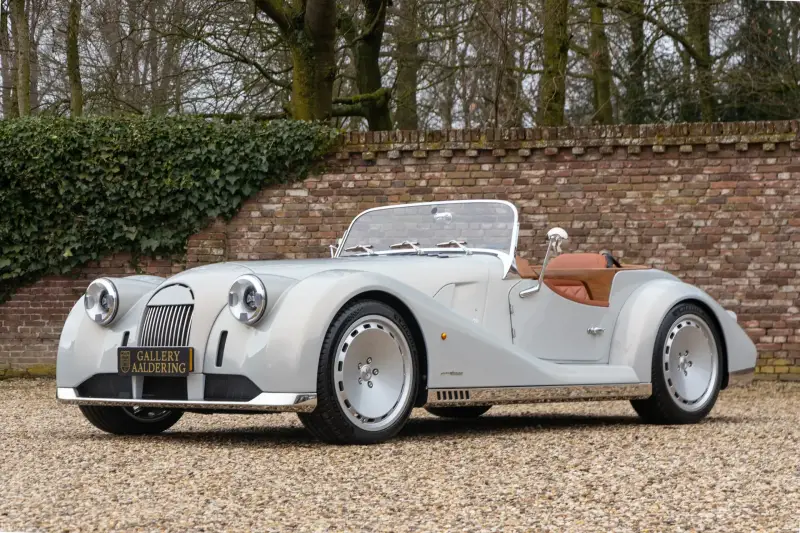
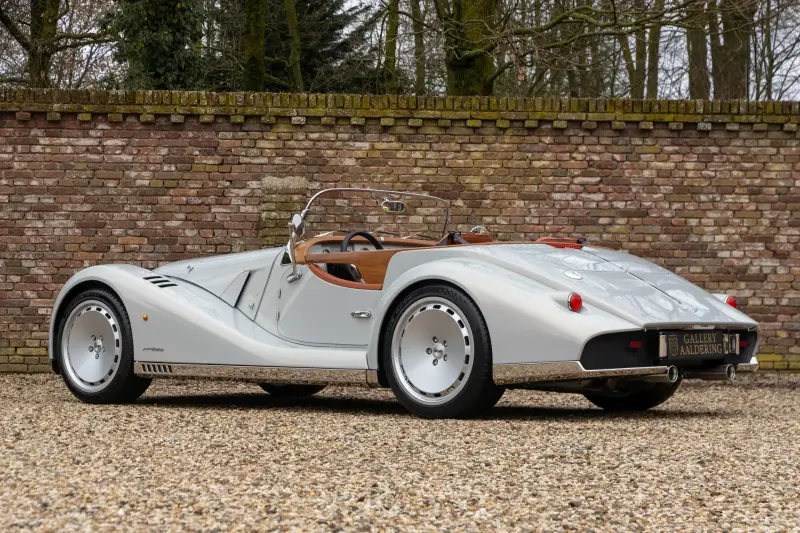
The Morgan Midsummer is a limited-production roadster manufactured by the Morgan Motor Company in collaboration with Italian design firm Pininfarina. Production began in 2024, with a total of only fifty units planned. All vehicles were sold prior to the announcement of the pricing. In October 2024, Morgan announced the completion of the first two production models.
In June 2026, Morgan announced a coupé variant of the Midsummer, limited to just 9 cars. The coupé is technically identical to the roadster, it features different bodywork and dimensions.
The Morgan Midsummer represents the absolute pinnacle of ultra-luxury automotive coachbuilding. Born out of a casual 2022 meeting at a British pub between the design teams of Morgan and Pininfarina, the project is a deep dive into artisanal car construction.
The hand-beaten aluminum bodywork takes over 250 hours per vehicle to complete. Pininfarina applied several signature cues to enhance aerodynamic beauty and vehicle stability. The car rides on unique 19-inch forged aluminum wheels that weigh just 10 kilograms each—shaving 3 kilograms off standard Morgan flagship wheels to dramatically reduce unsprung weight. Instead of a windshield, the open-top barchetta relies on two tiny flyscreens to keep the air moving over the cabin.
Under the long cowl is a 3.0-liter turbocharged BMW straight-six engine delivering 340 hp to 402 hp (depending on the exact spec/variant). Because it is so light, the roadster rocket launches from 0 to 100 km/h in just 4.0 seconds.
supersport


2025-now
The Morgan Supersport is a sports car produced by the Morgan Motor Company. It is a two-door roadster with a front-engine, rear-wheel-drive layout.
The design of the Supersport is a further development of the Midsummer special model based on the Plus Six, introduced in summer 2024. Technically, the Supersport is based on a further developed platform (CXV) of the predecessor model. The body is handcrafted from aluminum. The roof is available as either a carbon fiber composite hardtop or a mohair folding roof. The Supersport has removable side windows and a trunk.
Compared to the Plus Six, the car is longer, wider and taller, but the wheelbase is the same. The manufacturer states the kerb weight as 1170 kg.
The Supersport is powered by the BMW B58 six-cylinder inline petrol engine familiar from the predecessor model. It achieves a maximum output of 340 hp and a maximum torque of 500 Nm.


Create Your Own Website With JouwWeb