


March Engineering was a Formula One constructor and manufacturer of customer racing cars from the United Kingdom. Although only moderately successful in Grand Prix competition, March racing cars enjoyed much better success in other categories of competition, including Formula Two, Formula Three, IndyCar and IMSA GTP sportscar racing.


March Engineering began operations in 1969. Its four founders were Max Mosley, Alan Rees, Graham Coaker and Robin Herd. The company name is an acronym of their initials. They each had a specific area of expertise: Mosley looked after the commercial side, Rees managed the racing team, Coaker oversaw production at the factory in Bicester, Oxfordshire, and Herd was the designer.
The history of March is dominated by the conflict between the need for constant development and testing to remain at the peak of competitiveness in F1 and the need to build simple, reliable cars for customers in order to make a profit. Herd's original F1 plan was to build a single-car team around Jochen Rindt, but Rindt became dismayed at the size of the March programme and elected to continue at Team Lotus.
Andrea de Adamich driving a March-Alfa Romeo 711 at the 1971 German Grand PrixDe Adamich going to practice in a March 711
March's launch was unprecedented in its breadth and impact. After building a single Formula Three car in 1969, March announced that they would be introducing customer cars for F1, F2, F3, Formula Ford and Can-Am in 1970, as well as running works F1, F2 and F3 teams.
The Formula One effort initially looked promising, with March supplying its 701 chassis to Tyrrell for Jackie Stewart. These cars were merely a stopgap for Tyrrell, who no longer had the use of Matra chassis and were in the process of constructing their own car; March was the only option available given clashing fuel contracts.
701


1970-1971
The March 701 is a Formula One racing car model, designed by Robin Herd with Peter Wright, and built by March Engineering. The 701 was March's first Formula One design – following their one-off March 693P Formula Three prototype of 1969 – and was designed and built in only three months.
The March 701 made its race debut a month after its public unveiling, at the 1970 South African Grand Prix. In total, eleven 701s were constructed, with March supplying many privateer entrants as well as their own works team.
The 701's career started well, March drivers taking three wins and three pole positions from the car's first four race entries, but lack of development through the 1970 Formula One season resulted in increasingly poor results as the year wore on. The 701 was superseded by the March 711 in 1971, and made its last World Championship race appearance at the 1971 Italian Grand Prix.
The 701s Ford-Cosworth DFV engine was mated to a Hewland DG300 five-speed gearbox. The DFV was a 2993 cc 90° V8 engine, and in its original form developed around 430 bhp.

Jackie Stewart
François Cevert
Chris Amon
Jo Siffert
Mario Andretti
Ronnie Peterson
711


1971-1972
The March 711 was a Formula One racing car, designed by Robin Herd and Geoff Ferris, for the 1971 season, and saw continued use throughout the 1972 season. It had a distinctive appearance with a front 'tea-tray' spoiler. Despite winning no races, works driver Ronnie Peterson finished runner-up in the 1971 Drivers' World Championship.
With it’s revolutionary aerodynamic body and highly developed chassis, the MARCH 711 was one of the more influential Formula 1 cars of its era. The most eccentric feature of the bodywork was a front airfoil mounted on top of the nose that resembled the wing of a Spitfire fighter plane, a downforce-inducing component that was soon nicknamed the Spitfire (or the Tea Tray).
This important March enjoyed one more notable superlative during 1971 at the Austrian Grand Prix at Zeltweg on 15 August. A promising young driver who was fairly new to the March-STP team was given his first chance at a Formula 1 event... That driver, the legendary NIKI LAUDA, would go on to forge an impeccable racing career, winning the Drivers’ Championship three times. Notably, chassis 711-2 is the first car that he ever drove in a Formula 1 race.
The car used a 2,993 cc Ford-Cosworth DFV V-8 engine with dual overhead camshafts and Lucas mechanical fuel injection, good for around 450 hp. A five-speed manual Hewland FG400 transaxle was used, front and rear independent suspension with coil springs and telescopic shock absorbers, and four-wheel ventilated disc brakes.
After the 1971 season, three of the four works 711s were not seen again, which fed a belief that they had been used to build the early-1972 721s. However, no evidence has been found to support this theory.

Ronnie Peterson
Andrea de Adamich
Alex Soler-Roig
Henri Pescarolo
Nanni Galli
Skip Barber
Mike Beuttler
Niki Lauda
Carlos Pace
Ray Allen
721

1972
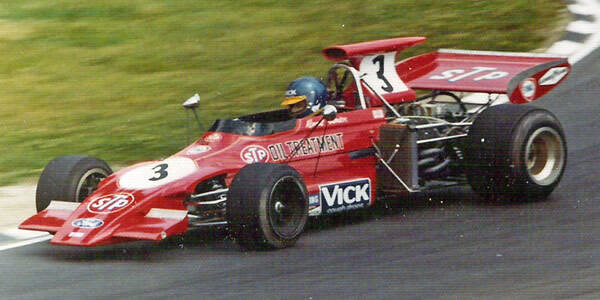
721x

721g
The March 721 is a Formula One car, designed, developed, and made by March Engineering for the 1972 Formula One season. It was powered by the 3.0 L Ford-Cosworth DFV engine.
The basic version of the 721, which did not have an additional designation in the form of a letter, was a slightly improved version of the old 711 and was built for customers such as Frank Williams Racing Cars and Günther Hennerici's Eifelland. It also served as an interim car for the factory team until the new 721X was ready. Eifelland's car was fitted with a new bodywork designed by Luigi Colani and was renamed as Eifelland E21.
The March 721X was a completely new design but the drivers couldn't handle the car and the 721X is generally viewed as a bad design.
Seeing that the car was a failure, March built an alternative model, the 721G, in just nine days to avert a complete failure in the 1972 season. For the 721G, a conventional Formula 2 chassis from the March 722 was adapted for Formula 1. March had built three Formula 1 model within a year.

Ronnie Peterson
Niki Lauda
Henri Pescarolo
Rolf Stommelen
Mike Beuttler
731


1973-1974
The March 731 was a Formula One racing car designed by Robin Herd of March Engineering for the 1973 season which saw continued use through 1974. While unsuccessful in the hands of the works team, private entrant Hesketh Racing had some success with James Hunt driving.
Hunt finished third in the Dutch Grand Prix and second in the United States Grand Prix, and with two other finishes in the points ended up in eighth place in the World Championship. Hunt's success contributed entirely to March's fifth place in the 1973 Constructors' Championship
March had expended much time and effort in developing the previous season's 721 model, and so for 1973 they modified the existing 721G models, moving the radiator to the front and revising the bodywork.

Roger Williamson
Henri Pescarolo
Jean-Pierre Jarier
741


1974
The March 741 is a Formula One car, designed, developed and built by March Engineering for the 1974 season, powered by a 3.0 L (180 cu in) Cosworth DFV engine. Although more successful than its predecessor, the March 731, it failed to finish any higher than fourth place.
Following the dismal performance of the previous season's 731, designer Robin Herd based the 741 on the monocoque and suspension of the 732, March's successful Formula Two car. He moved the radiators to the side and the oil cooler to the rear.
Eighteen of the twenty constructors whose cars contested the 1974 Formula One Championship built up their cars around Cosworth's mighty DFV V8 engine. (The only exceptions were Ferrari and BRM.) March mated the 741's Cosworth engine to a Hewland FG400 transaxle.
One of the most distinctive features of the 741 was its rear wing, which featured uncommonly large side plates. The wing itself wasn't particularly large.
March only built two cars for the 1974 season, but due to shunts both cars had to be rebuilt on multiple occasions. By the end of the season, Stuck's March 741 had been rebuilt on new tubs twice and Brambilla's car had been rebuilt on new tubs three times. At the time, March didn't retire serial numbers nor issue new numbers for extensively rebuilt cars.

Hans-Joachim Stuck
Reine Wisell
Howden Ganley
Vittorio Brambilla
751


1975
The March 751 is a legendary Formula 1 car built by March Engineering for the 1975 season. Powered by the iconic 3.0-liter Ford-Cosworth DFV V8 engine, the car is highly recognized for its distinctive wide nose and massive rear wing.
Its most famous moment came at the 1975 Austrian Grand Prix, where Italian driver Vittorio Brambilla secured a historic victory in torrential rain, famously crashing his car out of excitement right after crossing the finish line.
Lella Lombardi made history by finishing 6th at the Spanish GP, becoming the first and only female driver to score championship points in Formula 1. Hans-Joachim Stuck joined for the last five races of the season.

Vittorio Brambilla
Lella Lombardi
Hans-Joachim Stuck
Mark Donohue
761


1976-1977
The March 761 was a Formula One racing car designed by Robin Herd of March Engineering for the 1976 season which saw continued use in 1977. The 761 was not a new design, in fact the initial three cars were built up from the 751s which survived the 1975 season. Ronnie Peterson qualified on pole at the Dutch Grand Prix, and set fastest lap at, and won, the Italian Grand Prix.
The 761 was fast but fragile and by this point the F1 effort was being run on a shoestring with a two-car 'works' effort featuring Peterson and Hans-Joachim Stuck, the cars tending to turn up in different liveries as race-by-race sponsorship deals were signed.
For 1977, the works cars were upgraded and referred to as 761B. A token F1 effort with Rothmans sponsorship was run in 1977 for Alex Ribeiro and Ian Scheckter, but nothing worthwhile was achieved.
At the end of the 1977 season, the F1 team's assets and FOCA membership were sold to ATS (who had bought the Penske cars); Herd was retained by them as a consultant and was hence in the curious position of developing a development of his own 1975 car - and the 1978 ATS had some features reminiscent of contemporary March thinking. Mosley left the company to concentrate on FOCA matters.

Ronnie Peterson
Vittorio Brambilla
Lella Lombardi
Arturo Merzario
Hans-Joachim Stuck
Alex Ribeiro
Ian Scheckter
771
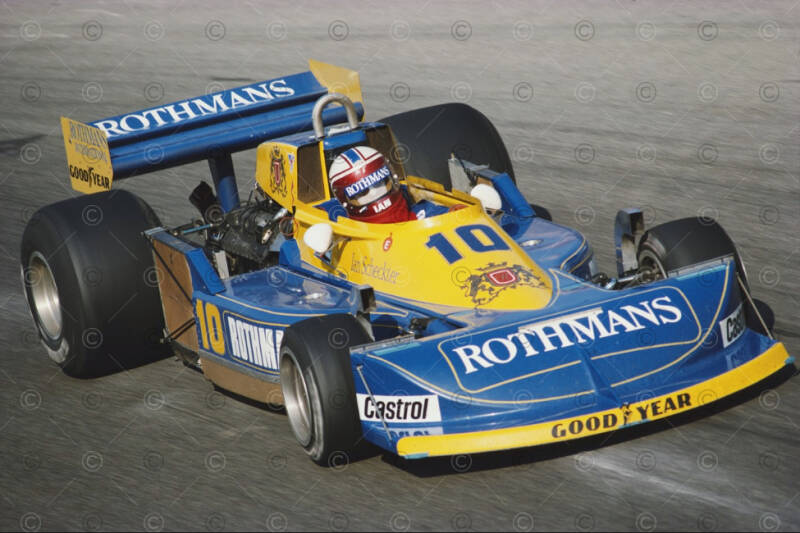


1977
The March 771 was a Formula 1 racing car built by March Engineering for the 1977 season. Designed by Martin Walters, it served as a heavily updated successor to the March 761. The car featured a completely revised, wider aluminum monocoque, a front-mounted radiator setup, and was dressed in a striking blue and yellow Rothmans livery.
Like its predecessors, it relied on the classic Ford-Cosworth DFV V8 engine paired with a Hewland gearbox.
The car was primarily built for South African driver Ian Scheckter (older brother of 1979 F1 World Champion Jody Scheckter). Due to ongoing developmental struggles, Scheckter primarily raced the older 761B. He practiced with the 771 at multiple events but only officially started a handful of races with it, securing a 10th-place finish at the Dutch Grand Prix.

Ian Scheckter
The First Exit (1977)
By the late 1970s, founders Max Mosley and Robin Herd realized running a competitive Formula 1 works team while simultaneously building customer cars was financially unsustainable. At the end of the 1977 season, they chose to exit F1, selling their team assets and official FOCA membership to ATS. March focused heavily on building highly successful customer cars for Formula 2, Formula 3, and IndyCar instead.

781
The March 781 was a unique Formula 1 car built by March Engineering for the 1978 season. Unlike its predecessors, the 781 never competed in an official Formula 1 World Championship Grand Prix.
Instead, it was purpose-built as a low-cost customer F1 car to compete exclusively in the Aurora AFX British Formula One Championship (a secondary domestic F1 series).March officially left World Championship F1 after 1977 to focus on Formula 2. They built the 781 by taking their dominant 1978 March 782 F2 body/monocoque and grafting a rear end derived from older F1 parts onto it.

Following their 1980 British title, RAM decided to return full-time to the official F1 World Championship. However, F1 rules changed for 1981, banning customer cars; teams were now forced to build their own chassis.
Because RAM lacked the infrastructure to build a car from scratch, John Macdonald formed an alliance with March co-founder Robin Herd. They created a separate entity called March Grand Prix. They used the "March" name solely because it had a more prominent reputation than RAM.
After the 1983 season, the partnership with March was officially dissolved. RAM Racing finally became a true F1 constructor under their own name.
811


1981
The March 811 is a Formula One car built by March Engineering and used by RAM Racing in the 1981 Formula One World Championship. Designed by Robin Herd, Gordon Coppuck, and Adrian Reynard, it was powered by the traditional 3.0 L (180 cu in) Ford-Cosworth DFV V8 engine. It initially used Michelin tyres, but eventually switched to Avon tyres at the 1981 French Grand Prix. It was March's first Formula One car since 1977.
RAM initially only competed sporadically. In 1976, 1977, and 1980 it used race cars from other manufacturers such as Brabham, March and Williams, which were purchased or rented, as a pure customer team at selected Grand Prix events.
Conceptually, the March 811 was a copy of the Williams FW07, which in turn was heavily based on the Lotus 79. Observers emphasized this in the formulation: "March is building a Williams."
The 811 was considered a very simply built car, had an aluminium monocoque and sheet piling made of magnesium. Robin Herd used internal torsion bar springs front and rear. The powerplant was a naturally aspirated Cosworth (DFV) engine, which was connected to a five-speed gearbox from Hewland (type FGA).

Derek Daly
Eliseo Salazar
821


1982
The March 821 was a British Formula One racing car used by the John MacDonald-owned RAM Racing in the 1982 Formula One World Championship. Regardless of its model designation, the car had no connection with long-established race car manufacturer March Engineering. The car did not score any world championship points. Designed by Adrian Reynard, a total of five cars were built. It was also the last Formula One car to bear the "March" name until 1987, with March focusing most of their attention and resources into CART IndyCar racing.
The March 821 was an evolution of the previous year's 811. Observers said the 821 was "the car the 811 should have been back in the spring of 1981." Conceptually, the 821 still followed the lines of the Williams FW07, which had been very successful in 1979 and 1980. The 821 was lighter than its predecessor. At 585 kg, its weight was within the range of the minimum permissible weight.
Contrary to the general trend towards turbo engines, RAM continued to stick to naturally aspirated engines. As with the previous model, RAM used a 3.0-litre eight-cylinder Cosworth DFV engine in the 821. As a result, the team increasingly fell behind in terms of performance: while the DFV engines, depending on the tuner, delivered between 490 and 530 hp, the turbo engines already achieved 560 hp (Hart) or 600 hp (Ferrari, Renault) during the 1982 season.

Jochen Mass
Rupert Keegan
Raul Boesel
Emilio de Villota
ram march 01


1983
The RAM March 01 (often officially referred to as the RAM 01) was a Formula 1 car campaigned by RAM Racing during the 1983 season. The car marked a transition period where RAM still utilized the 'March' name for recognition, but built the cars entirely in their own separate facility.
Despite its clean look, the car suffered from a severe lack of budget and performed very poorly. Following the ban on ground-effect aerodynamics at the end of 1982, designer Dave Kelly had to engineer a completely new 'flat-bottom' chassis for 1983. While top-tier teams like McLaren and Ferrari switched to expensive and lightweight carbon fiber, RAM had to stick to a heavier aluminum chassis due to budget constraints.
The car was powered by the reliable 3.0-liter Ford-Cosworth DFY V8 (a short-stroke, higher-revving development of the legendary DFV) mated to a manual Hewland gearbox.
A total of three chassis were built. The cars were so slow that qualifying proved to be the team's biggest hurdle all year long.

Eliseo Salazar
Jacques Villeneuve Sr.
Kenny Acheson
Jean-Louis Schlesser
The Leyton House Era & Fraud Scandal (1987–1991)
March returned to Formula 1 in 1987 with backing from Japanese real estate company Leyton House. Utilizing brilliant early aerodynamic designs by a young Adrian Newey, the team showed immense promise. By 1989, Leyton House owner Akira Akagi fully bought out the F1 team, officially renaming it Leyton House Racing.
The turning point came in August 1991, when Akagi was arrested for his involvement in the massive Fuji Bank fraud scandal. The team's primary source of funding instantly vanished.
871


1987
The March 871 was a Formula One racing car designed by the March Racing Team and driven in the 1987 Formula One season. The car was powered by a Cosworth DFZ V8 engine, and was driven by the 1986 International Formula 3000 champion, Italian Ivan Capelli.
The team was sponsored by Japanese real estate company Leyton House.
The 871 chassis was not ready for the first race in Brazil, so the team used an F3000/F1 hybrid called the March 87P. The 871 was ready for the second race in San Marino.
The best result and the only points were achieved with a 6th place at the 1987 Monaco Grand Prix. However Capelli and the March 871 did finish 4th in the Colin Chapman Trophy for constructors of cars equipped with naturally aspirated engines.
The 871 had a Cosworth DFZ, 3494 cc 90° V8, mated to a 6-speed manual.

Ivan Capelli
881


1988-1989
The March 881 was a Formula One racing car designed by Adrian Newey, his first ever Formula One car, and raced by March Racing Team in the 1988 season by Italian Ivan Capelli and the debuting Maurício Gugelmin from Brazil. The car's best result was a second place driven by Capelli at the 1988 Portuguese Grand Prix.
The March 881 used the then new to Formula One Judd V8 engine, and was consistently the fastest speed trapped atmo car of the 1988 season, with Capelli clocked at a class fastest 312 km/h (194 mph) on the first straight at Hockenheim for the German Grand Prix. Capelli and his March 881 was the only non-turbo car/driver combination in 1988 to actually lead a Grand Prix when he briefly took the lead from Alain Prost in his McLaren-Honda. This was also the first time since the 1983 season that a naturally aspirated car had led a Formula One Grand Prix.
March finished the year 6th in the Constructors' Championship with 22 points.

Maurício Gugelmin
Ivan Capelli
cg891


1989
The March CG891 was a Formula One racing car designed by Adrian Newey and raced by March Racing Team in the 1989 season, driven by Ivan Capelli and Maurício Gugelmin. The car's best result was seventh place, achieved three times by Gugelmin. It also took the fastest lap at the 1989 French Grand Prix.
Designed by Adrian Newey, the March CG891 used the aerodynamic concept he had originally conceived for the previous year's car, the March 881, but was much more refined. The monocoque, of carbon fibre composite, was particularly slimline.
The car was powered by a Judd EV 3.5 litre V8 engine in an exclusive arrangement with John Judd's Engine Developments company. The engine was rated as having 625 bhp with a maximum rpm of 11.500.
Although neither Gugelmin or Capelli scored a points finish with the CG891, the team finished the 1989 Constructors' Championship in 12th, having achieved four points. This was due to Gugelmin's third place with the 881 at the opening race of the year, the Brazilian Grand Prix.

Maurício Gugelmin
Ivan Capelli
1990-1992

The F1 team raced as Leyton House Racing in 1990 and 1991, acquiring Ilmor V10 power.
The team nearly caused a massive upset at the 1990 French Grand Prix with Capelli and Gugelmin capitalising on their superior aerodynamics and smooth race track to attempt the race on a single set of tyres while everyone else stopped for tyres mid-race.
Engine problems claimed Gugelmin and slowed Capelli allowing Prost to slip by with three laps left.
By the end of 1991, Akagi was immersed in the Fuji Bank scandal and Leyton House withdrew from racing. The team was bought by Ken Marrable, an associate of Akagi, and resumed the name March for the 1992 season but with little funding and results fell far short of expectations.
The Leyton House Racing operation closed down as the team (now unconnected to the March group) attempted to assemble a project for the beginning of the 1993 season.
cg911b


1992-1993
The Leyton House CG911 was a Formula One racing car designed by Chris Murphy and Gustav Brunner for the 1991 Formula One season. Unlike its CG901 predecessor, which used a Judd EV V8 engine, the CG911 used an Ilmor 2175A V10 engine. Leyton House Racing initially started the 1991 season with Maurício Gugelmin and Ivan Capelli as their drivers, as they had in 1990, but Karl Wendlinger replaced Capelli for the final two races of the season.
For 1992, when Leyton House renamed themselves as March F1, the CG911 was updated to the March CG911B specification, with Wendlinger, Jan Lammers, Paul Belmondo and Emanuele Naspetti all sharing driving duties and a CG911C specification car was entered in 1993, but never raced.
Although March initially intended to run the CG911C in 1993 with Lammers and Jean-Marc Gounon, the team folded and they did not compete that year. They entered the 1993 South African Grand Prix with Lammers and Jean-Marc Gounon, but did not compete; although their cars arrived at the Kyalami circuit, the engines did not.

Karl Wendlinger
Jan Lammers
Paul Belmondo
Emanuele Naspetti
The Final Collapse (1992–1993)
For the 1992 season, a consortium bought the struggling team back and revived the historic March name. They managed to finish the season using pay-drivers (including Dutch driver Jan Lammers) to keep afloat, but the operation ran completely out of money by winter.
Although March officially entered two cars for the opening race of the 1993 South African Grand Prix, the money never arrived, the cars never left the factory, and the team officially entered receivership and shut down before the weekend began
A complex series of buyouts and sales saw the March group (now essentially a financial services outfit) divest itself of its racing interests; after a management buyout, March and Ralt were subsequently sold to Andrew Fitton and Steve Ward in the early 1990s. Fitton later wound March up and Ward continued Ralt at a lower level.
In the late 1990s the engineering assets of March were sold to Andy Gilberg. This consisted of over 30,000 engineering drawings and design rights for the customer cars, works F1 cars from the 1970s and other projects produced at the Murdock Road facility. These records are currently available to car owners, racing services providers and historians through www.marchives.com.


Create Your Own Website With JouwWeb