


Lincoln Motor Company, or simply Lincoln, is the luxury vehicle division of American automobile manufacturer Ford Motor Company. Marketed among the top luxury vehicle brands in the United States, Lincoln is positioned closely against its General Motors counterpart Cadillac. Starting with the 2021 model year, the brand solely offers SUV and crossover vehicles.
The division helped to establish the personal luxury car segment with the 1940 Lincoln Continental.


1917
The Lincoln Motor Company was founded in August 1917 by Henry Leland and his son Wilfred. Among the founders of Cadillac, Leland had sold Cadillac to General Motors in 1909; staying on as an executive, he left in 1917 over a dispute with GM President William Durant regarding war production.
Leland named Lincoln Motor Company after Abraham Lincoln, stating that Lincoln was the first President for whom he ever voted.
The company was financed by securing a contract to produce Liberty V12 aircraft engines for use during World War I. In total, Lincoln Motor Company would assemble 6500 Liberty V12 engines by the end of World War I concluding production; by the end of the war, Lincoln would employ 6000 workers.
On January 26, 1920, Lincoln Motor Company was reorganized as an automobile manufacturer, retooling its Detroit factory to produce automobiles. On September 16, 1920, Lincoln Motor Company produced its first automobile, the Lincoln Model L.
model L

1920–1930 convertible coupe

dietrich coupe roadster

convertible victoria
The Lincoln L series (also called the Lincoln Model L) is a luxury car introduced by the Lincoln Motor Company in 1921 as its first automobile. It was manufactured in Detroit, Michigan, and would continue on after the bankruptcy of Lincoln in 1922 and its purchase by Ford Motor Company.
The debut Lincoln was positioned at the top end of the motorcar marketplace, competing against the Mercedes-Benz 630, Rolls-Royce Phantom I, Renault Type MC, Packard Twin Six, and Cadillac Type 61. It was replaced during 1930 by the Model K.
The L series was designed by Angus Woodbridge, the son-in-law of Henry Leland; trained as a ladies hatmaker, the design of the L series was considered old-fashioned for the time.
The L-series was available with different V8 engines and in different body styles: 2-door convertible, 4-door convertible, 2-door coupe, 4-door sedan, 4-door town car, 4-door limousine and the 4-door phaeton.
model K


1931-1940
The Lincoln K series (also called the Lincoln Model K, in line with Ford nomenclature) is a luxury vehicle that was produced by the Lincoln Motor Company between 1931 and 1940. The second motor line produced by the company, the Model K was developed from the Model L, including a modernized chassis on a longer wheelbase. In 1931, Lincoln also introduced a V-12, becoming a feature of the company for nearly 20 years.
One of the most exclusive vehicles produced in the United States during the 1930s, the Model K competed domestically against the Cadillac V-12 and V-16, Packard Twin Six, Chrysler Imperial, Pierce-Arrow Model 53 and the Duesenberg Model J, as well as bespoke bodied ultra-luxury models from Hispano-Suiza, Rolls-Royce, Bentley, Bugatti, and Mercedes-Benz.[1] Alongside multiple body configurations produced by Lincoln, bare chassis were provided for coachbuilders.
After the 1939 model year, Lincoln ended production of the Model K, selling leftover vehicles as 1940 models. For 1941 and 1942, the Lincoln Custom was sold as an indirect successor to the Model K, offered as an 8-passenger limousine or touring sedan produced as a long-wheelbase version of the Lincoln-Zephyr. Since World War II, various Lincoln sedans (the Continental or its Town Car successor) have been produced as long-wheelbase sedans or factory limousines, but no direct model line has been developed as a successor to the Model K (as of 2020 production).

Lincoln Motor Company had struggled with the transition from military to automobile production, with some customers having to wait nearly a year for their vehicles to be completed from the time of purchase. By 1922, the company was on the verge of bankruptcy and was placed in receivership.
Under the influence of Edsel Ford, Lincoln Motor Company was purchased by Henry Ford on February 4, 1922. While Lincoln was valued at $16 million, a $5 million bid by Ford was the sole bid received for the company (forced to be increased by the court).
The Lincoln factory was redesigned and expanded (to nearly 100.000 m2), with the components of the engine upgraded for increased reliability and performance.
zephyr

1936-1942


The Lincoln-Zephyr is a line of luxury cars that was produced by the Lincoln division of Ford from 1936 until 1942. Bridging the gap between the Ford V8 DeLuxe and the Lincoln Model K (in both size and price), it expanded Lincoln to a second model line, competing against the Chrysler Airflow, LaSalle, and the Packard One-Twenty.
Following the discontinuation of the Model K after 1940, Lincoln shifted its production exclusively to the Lincoln-Zephyr design. After World War II, the Zephyr name was dropped.
The Zephyr had been the basis of the first Lincoln Continental, which debuted in 1940 and became Lincoln's longest-running nameplate. The model line was powered by a V12 engine, in contrast to its competitors' V8 and inline-8 engines.
The Lincoln-Zephyr was conceived by Edsel Ford and designed by Eugene Turenne "Bob" Gregorie. It was assembled at the Lincoln Motor Company Plant in Detroit, Michigan.
Body stylea were the 4-door sedan, 4-door convertible sedan, 2-door sedan, 2-door coupe and the 2-door convertible coupe.
Production of all American cars was halted by the Government in 1942 as the country entered World War II, with Lincoln producing the last Lincoln Zephyr on February 10.
After the war, most makers restarted production of their prewar lines, and Lincoln was no exception. The Zephyr name, however, was no longer used after 1942, with the cars simply called Lincolns.
continental
The Lincoln Continental is a series of mid-sized and full-sized luxury cars produced between 1939 and 2020 by Lincoln, a division of the American automaker Ford. The model line was introduced following the construction of a personal vehicle for Edsel Ford, who commissioned a coachbuilt 1939 Lincoln-Zephyr convertible, developed as a vacation vehicle to attract potential Lincoln buyers. In what would give the model line its name, the exterior was designed with European "continental" styling elements, including a rear-mounted spare tire.
In production for over 55 years across nine different decades, Lincoln has produced ten generations of the Continental. Within the Lincoln model line, the Continental has served several roles ranging from its flagship to its base-trim sedan.
Along with the creation of the personal luxury car segment, the Lincoln Continental marked the zenith of several designs in American automotive history. The Continental is the final American vehicle line with a factory-produced V12 engine (1948), the final four-door convertible (1967), and the final model line to undergo downsizing (for the 1980 model year).

first generation (1940–1942, 1946–1948)

second generation (1956–1957)

third generation (1958–1960)

fourth generation (1961–1969)

fifth generation (1970–1979)

sixth generation (1980)

seventh generation (1982–1987)

eighth generation (1988–1994)

ninth generation (1995–2002)

tenth generation (2017–2020)
After a fourteen-year hiatus, the tenth generation Continental went on sale in the fall of 2016. Previewed by a namesake concept car at the 2015 New York Auto Show, the 2017 Continental succeeded the Lincoln MKS, and was manufactured at Ford's Flat Rock Assembly.
Production of the Continental ended on October 30, 2020, without a replacement for the full-size sedan segment.
EL series


1949-1951
The Lincoln EL-Series is a full-size luxury car that was marketed and sold by Lincoln from 1949 to 1951. Replacing the H-Series Lincoln, the postwar model line was the first complete redesign of the Lincoln sedan line since 1936 (its predecessor was derived from the prewar Zephyr). In line with its predecessor, the EL-Series Lincoln carried only the Lincoln nameplate, using no model name. The Lincoln was positioned below the Cosmopolitan within the Lincoln model range.
The first Lincoln developed under the combined Lincoln-Mercury Division of Ford Motor Company, the Lincoln shared much of its body with the 1949 Mercury Eight, distinguished primarily by its longer 121-inch wheelbase. For the first time since 1933, a V8 engine was offered in a Lincoln instead of a V12, now sharing its engine with the Ford F-Series "Big Job" trucks.
1956
During 1956, Lincoln-Mercury was reorganized slightly, following the creation of the free-standing Edsel and Continental divisions, Lincoln-Mercury was changed to Mercury-Edsel-Lincoln (MEL), with Edsel slotted alongside/below Mercury and Continental above Lincoln, as the flagship of all of Ford Motor Company. By the end of 1959, Continental was integrated into Lincoln, and Edsel was withdrawn.
The Lincoln Motor Company Plant, built in Detroit, Michigan, by Henry Leland in 1917, was closed after 1952; subsequent Lincolns were produced alongside Mercury Montereys and Mercury Montclairs. For the 1957 model year, Ford opened Wixom Assembly in Wixom, Michigan, as a facility to specialize in Lincoln production. From 1957 until 2007, the facility produced Lincoln vehicles nearly exclusively, along with the Ford GT and several generations of the Ford Thunderbird.
versailles

1977-1980


The Lincoln Versailles is a mid-size luxury sedan manufactured by Ford Motor Company and marketed by its Lincoln brand for model years 1977-1980 as a rebadged variant of the Ford Granada and Mercury Monarch. Replacing the Mercury Grand Monarch Ghia, the Versailles competed with the Cadillac Seville — and was noted as the first vehicle marketed in North America with clearcoat paint and halogen headlights.
Deriving its nameplate from the French palace outside Paris, the Versailles was offered as a four-door sedan — as the final vehicle developed from the chassis architecture of the American Ford Falcon.
The Versailles shared its powertrain with the Monarch upon which it was based, with a V8 engine as a sole choice. The three-speed C4 automatic transmission was the only transmission available.
In its entire production run, Lincoln would sell 50.156 examples of the Versailles. By comparison, Cadillac would outsell that total in both 1978 and 1979, the last two years of the first-generation Seville.
town car
The Lincoln Town Car is a model line of full-size luxury sedans that was marketed and produced by the Lincoln division of the American automaker Ford Motor Company. Deriving its name from a limousine body style, Lincoln marketed the Town Car from 1981 to 2011, with the nameplate previously serving as the flagship trim of the Lincoln Continental. Produced across three generations for thirty model years, the Town Car was marketed directly against luxury sedans from Cadillac and Chrysler.
Marketed nearly exclusively as a four-door sedan (a two-door sedan was offered for 1981 only), many examples of the Town Car were used for fleet and livery (limousine) service. From 1983 to its 2011 discontinuation, the Town Car was the longest car produced by Ford worldwide, becoming the longest mass-production car sold in North America from 1997 to 2011. While not a direct successor of the Town Car, the Lincoln MKS would become the longest American sedan until 2016 (overtaken by the Cadillac CT6).

first generation (1981–1989)

second generation (FN36/116; 1990–1997)

third generation (FN145; 1998–2011)
During the 2000s, in spite of declining sales, the Town Car remained one of the highest-selling American-brand luxury sedans. Outside of retail markets, it was the most used limousine and chauffeured car in the United States and Canada.
On August 29, 2011, the final Town Car rolled off the assembly line, without any fanfare or announcement from Ford;[2] St. Thomas Assembly produced its final vehicle (a 2012 Crown Victoria for export) on September 15, 2011.
In China, FAW produced a licensed version of the Lincoln Town Car rebadged as the Hongqi CA7460 (红旗, Red flag CA7460) and Hongqi Qijian (红旗旗舰, Flagship) from November 10, 1998 until 2005.
navigator
The Lincoln Navigator is a full-size luxury SUV marketed and sold by the Lincoln Motor Company brand of Ford Motor Company since the 1998 model year. Sold primarily in North America, the Navigator is the Lincoln counterpart of the Ford Expedition. It is the heaviest production Lincoln ever built, and is also the Lincoln with the greatest cargo capacity and the first non-limousine Lincoln to offer seating for more than six people.
In its first calendar year of sales (i.e. 1998), Navigator contributed to an unprecedented event of recent decades – with Lincoln overtaking perennial rival Cadillac in annual sales volume.

first generation (1998)

second generation (2003)

third generation (2007)

fourth generation (2018)

fifth generation (2025)
The 2025 Lincoln Navigator delivers impressive performance and capability, powered by a robust 3.5-liter twin-turbocharged V6 engine producing 440 horsepower at 5,850 rpm and a formidable 510 lb-ft of torque at 3000 rpm. Paired with a smooth 10-speed SelectShift® automatic transmission and advanced four-wheel drive, this luxury SUV offers a seamless driving experience on any terrain.
LS


2000-2006
The Lincoln LS is a mid-size luxury car which was manufactured and marketed by the Lincoln Motor Company for the 2000-through-2006 model years, having entered production in June 1999. Primarily sold in the North American market, it is a four-door sedan with seating for five occupants.
The LS has a front-engine, rear-wheel-drive layout and an all-aluminum 3.0 L DOHC V6 which was a variant of the Jaguar AJ-V6 engine, itself closely related to Ford's Duratec 3.0. Optional was an all-aluminum 3.9 L DOHC V8, a shorter-stroke variant of the Jaguar 4.0 L AJ-26 V8. With the latter configuration initially offered with a manual transmission. Described as a sport sedan, it has a near 50/50 weight distribution, and aimed to provide a blend of luxury and sport to attract a new generation of buyers to the Lincoln brand.
Produced at a time when Lincoln formed a part of Ford's Premier Automotive Group division. the LS shared the Ford DEW98 platform with the Jaguar S-Type and the eleventh-generation Ford Thunderbird.
The LS received a refresh for 2003, coinciding with Lincoln's then-new "Travel Well" ad campaign.
The LS was touted for its value as a sport sedan since it undercut other mid-size luxury (E-segment / executive car) offerings from German and Japanese marques; the LS V8 was priced similarly to six-cylinder-equipped versions of the BMW 5 Series and Lexus GS. While larger and roomier, the LS was also less refined than its competitors in terms of interior quality and handling.
blackwood


2002-2003
The Lincoln Blackwood is a luxury full-size pickup truck that was marketed by the Lincoln division of Ford Motor Company for the 2002 model year. The first pickup truck marketed by Lincoln, the Blackwood was derived from the Ford F-150 SuperCrew and the Lincoln Navigator. Drawing its name from its simulated black woodgrain cargo box, the Blackwood was offered solely with a black-painted exterior.
Although the concept vehicle had a positive public reception, the production Blackwood fell far under sales projections in the United States and Mexico. After the 2002 model year, the Blackwood was discontinued in the United States, with a short run of 2003 models produced for Mexico. In total, only 3,383 units were produced, making it both the rarest and shortest-produced Lincoln model line.
Shared with the Navigator, the Blackwood is fitted with a 5.4 L V8, producing 300 hp. In place of the SOHC 16-valve Triton V8 used by the F-150, the Blackwood used the DOHC 32-valve InTech V8 used by Lincoln; the engine was paired to a 4-speed automatic transmission.
After the 2002 model year, Lincoln ended sales of the Blackwood in the United States, with all 2003 production of the model line sold in Mexico; the final Lincoln Blackwood rolled off the assembly line in December 2002, 15 months after its entry into production.
mark lt


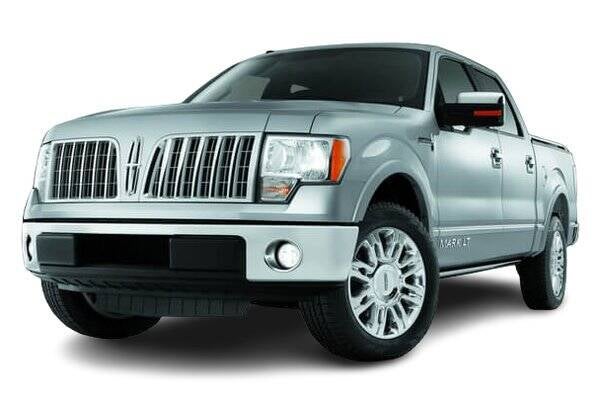

first generation (2006–2008)
second generation (2010–2014)
The Lincoln Mark LT is a luxury full-size pickup truck manufactured and marketed by Ford's Lincoln division for model years 2006–2008 (U.S. and Canada) and 2006–2014 (Mexico) as a badge engineered, luxury-trimmed variant of the Ford F-150 truck — and a successor to the 2002-only Lincoln Blackwood.
The Mark LT was manufactured at Ford's River Rouge Plant in Dearborn, Michigan, and at the Ford Cuautitlan plant in Cuautitlán, Mexico, on the same lines as the closely related Ford F-150, on which it was based. It used the same 300 hp 5.4 L Triton V8 and has four doors. The Mark LT also had optional all-wheel drive.
Lincoln projected selling 13.000 Mark LT's annually in the United States. The Mark LT was more successful than the Blackwood in its first year of sales with 10.274 sold in the first calendar year of sales (February 2005 through February 2006). The 2006 Mark LT outsold the Cadillac Escalade EXT, but the 2007 EXT gained on the Mark LT's sales consistently. After disappointing sales, the Mark LT was cancelled in the United States and Canada after the first generation. A second generation was marketed in Mexico where it was often the Lincoln Division's best selling model.
mks


2009-2016
The Lincoln MKS is a full-size luxury car which was manufactured by Ford and marketed by its Lincoln division for the 2009-through-2016 model years. Primarily sold in the North American market, it is a notchback four-door sedan with seating for five occupants and received a facelift for MY 2013.
The MKS shares its platform with the other so-called Chicago D3's, the Ford Flex, Lincoln MKT, and the fifth-generation Ford Taurus, which were manufactured at Ford's Chicago Assembly plant in Chicago, Illinois.
The MKS uses V6 engines, with the launch model using a 3.7-liter Ford Cyclone engine, while a twin-turbocharged 3.5-liter EcoBoost engine (shared with the Taurus SHO) was added for MY 2010. The base Cyclone engine was revised to a Ti-VCT specification for MY 2013.
The MKS was discontinued after 2016, with domestic MKS production having reached 100.248 for MY 2009–2016. It was replaced by the tenth generation Lincoln Continental.
2012
To reflect the end of the Lincoln-Mercury division pairing (from 1945 to 2010), in December 2012, the formal name of Lincoln was changed to The Lincoln Motor Company (its name prior to 1940). To help differentiate Lincoln vehicles from Ford counterparts, Ford established separate design, product development, and sales teams for Lincoln. In a marketing shift, Lincoln began to target "progressive luxury customers", buyers who sought luxury without ostentation.
nautilus


first generation (U540; 2019)
second generation (CDX707; 2024)
The Lincoln Nautilus is a mid-sized luxury crossover SUV marketed over two generations by Ford Motor Company's Lincoln luxury brand. The Nautilus was initially renamed from the MKX as part of a midcycle update in 2018 for the 2019 model year, as Lincoln phased out its use of "MK" model names. The name Nautilus is derived from the ancient Greek word nautes, meaning "sailor", as in nautical or astronaut.
The counterpart of the updated Ford Edge, the Nautilus is slotted between the Aviator and the MKC (which was replaced by the Corsair for the 2020 model year) in Lincoln's lineup. A 245-horsepower 2.0-liter EcoBoost inline-four is the standard engine, with a 335-horsepower 2.7-liter EcoBoost V6 carried over from the MKX as an option; both engines are fitted with start-stop capability. An eight-speed automatic transmission is paired to both engines (replacing the previous six-speed).
The second-generation Nautilus was released in 2023 for the Chinese market. It is a mid-sized SUV with five seats, available with either a gasoline or a hybrid gasoline-electric powertrain. The North American market Nautilus was presented on April 17, 2023, and went on sale in early 2024, imported from China.
z


2022-now
The Lincoln Z, previously known as the Lincoln Zephyr, is a mid-size luxury sedan produced since 2022 by Changan Ford, a joint venture between Chinese automaker Changan Automobile and American automaker Ford Motor Company, and sold by Lincoln Motor Company, a subsidiary of Ford.
The Lincoln Z is powered by Changan Ford's 2.0-liter turbocharged gasoline engine, with an output of 243 hp and 376 N⋅m of torque, giving the car a top speed of 225 km/h. The Z uses an 8-speed automatic transmission.
Unlike other large discontinued Lincolns and Ford sedan in North America that were all-wheel drive, the Chinese-made Lincoln sedan powertrain wheels only available in front-wheel drive.
futura

The idea for the Futura came from designer Bill Schmidt, who got the idea while he was diving, after an encounter with a shark.

The Lincoln Futura is a concept car promoted by Ford's Lincoln brand, designed by Ford's lead stylists Bill Schmidt and John Najjar, and hand-built by Ghia in Turin, Italy, at a cost of $250.000 (equivalent to $2.900.000 in 2024).
Displayed on the auto show circuit in 1955, the Futura was modified by George Barris into the Batmobile, for the 1966 TV series Batman.

The Futura was powered by a 368 cubic inch Lincoln engine and powertrain; the chassis was an early prototype Y-shaped backbone perimeter frame that would go into production on the 1956–1957 Continental Mark II.


The Futura was a success as a show car, garnering favorable publicity for Ford, and so was released as a model kit and a toy. In a much more subdued form, its headlight and tailfin motifs would appear on production Lincolns for 1956 and 1957, such as the Lincoln Premiere and Lincoln Capri. The concave front grille inspired the grille on the 1960 Mercury Monterey and the 1960 Ford Galaxie.

In 1966, Barris was asked to design a theme car for the Batman television series. Originally, the auto stylist Dean Jeffries was contracted to build the car for the show in late 1965, but when the studio wanted the car sooner than he could deliver, the project was given to Barris.[ With the short notice, Barris thought the Futura might work well, and using Jeffries's initial car, decided that its unusual, winged shape would be an ideal starting point for the Batmobile. Barris hired Bill Cushenbery to modify the car's metalwork.
Barris went on to build three fiberglass replicas using the frames and running gear from 1966 Ford Galaxie cars for the show circuit. Barris later acquired a fourth replica, a metal car built on a 1958 Ford Thunderbird.
Barris retained ownership of the car after its conversion to the Batmobile, leasing it to the TV studio for filming. After production of the TV series ended, it was displayed in Barris' own museum in California.


Create Your Own Website With JouwWeb